Sodium Dichloroacetate (DCA) Dehydrogenase inhibitor Evaluation in Diagnostic Urinary Protein Creatinine Ratio Assessment
Copy code to add this image to your page
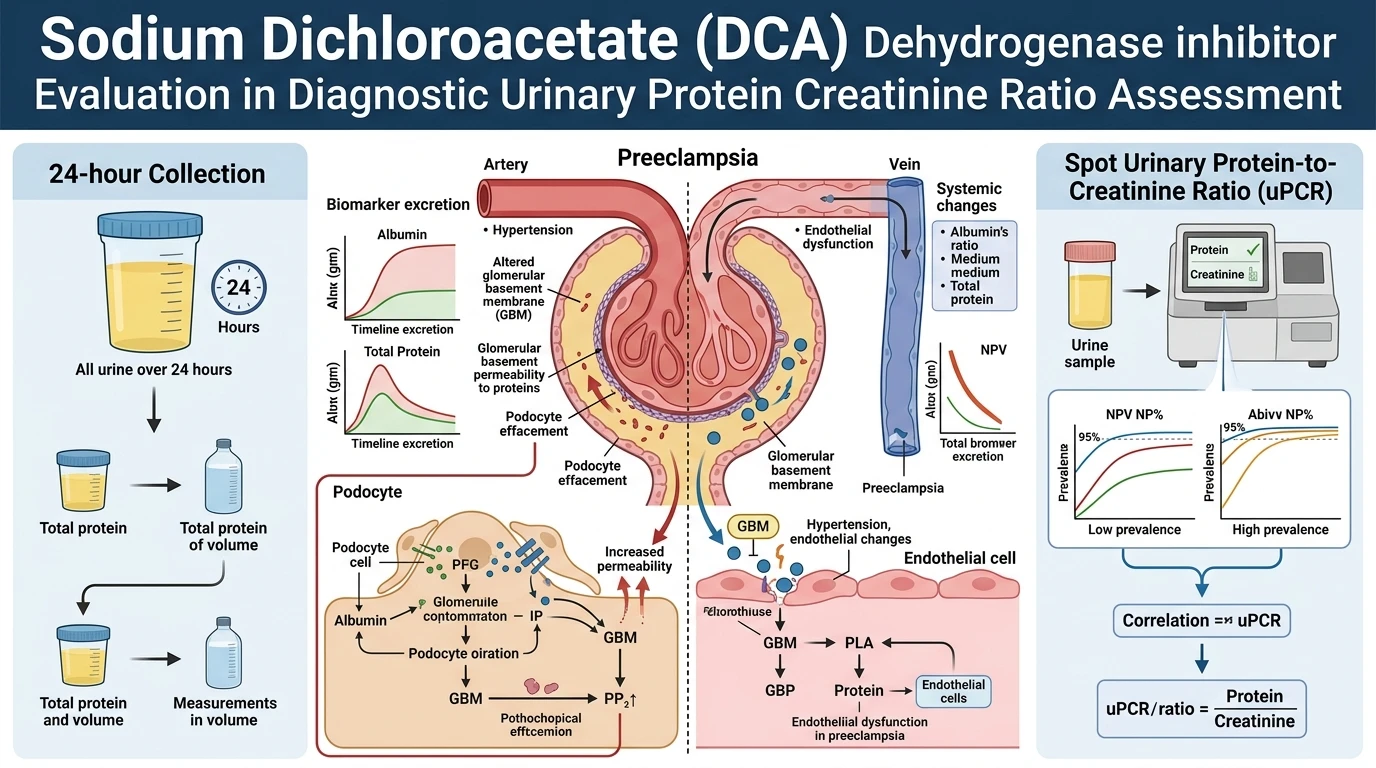
Preeclampsia represents a major cause of maternal and perinatal morbidity worldwide, characterized by new-onset hypertension and end-organ dysfunction after 20 weeks of gestation. Glomerular endotheliosis leads to compromised capillary wall integrity, causing pathological protein leakage into the renal tubular lumen. Quantifying urinary protein excretion remains central to clinical management protocols. Historically, a 24-hour urine collection served as the diagnostic benchmark for establishing significant proteinuria, defined as 300 mg or greater per 24 hours. However, timed 24-hour collections introduce substantial clinical challenges. Incomplete collection, compliance errors, handling delays, and delayed diagnostic turnaround time limit utility in acute obstetrical triage. Spot urinary markers have emerged as an efficient alternative. Quantitative determination of the spot urinary protein-to-creatinine ratio (P:C ratio) and spot albumin-to-creatinine ratio (A:C ratio) normalizes solute concentration against creatinine clearance, controlling for fluctuations in urine dilution.
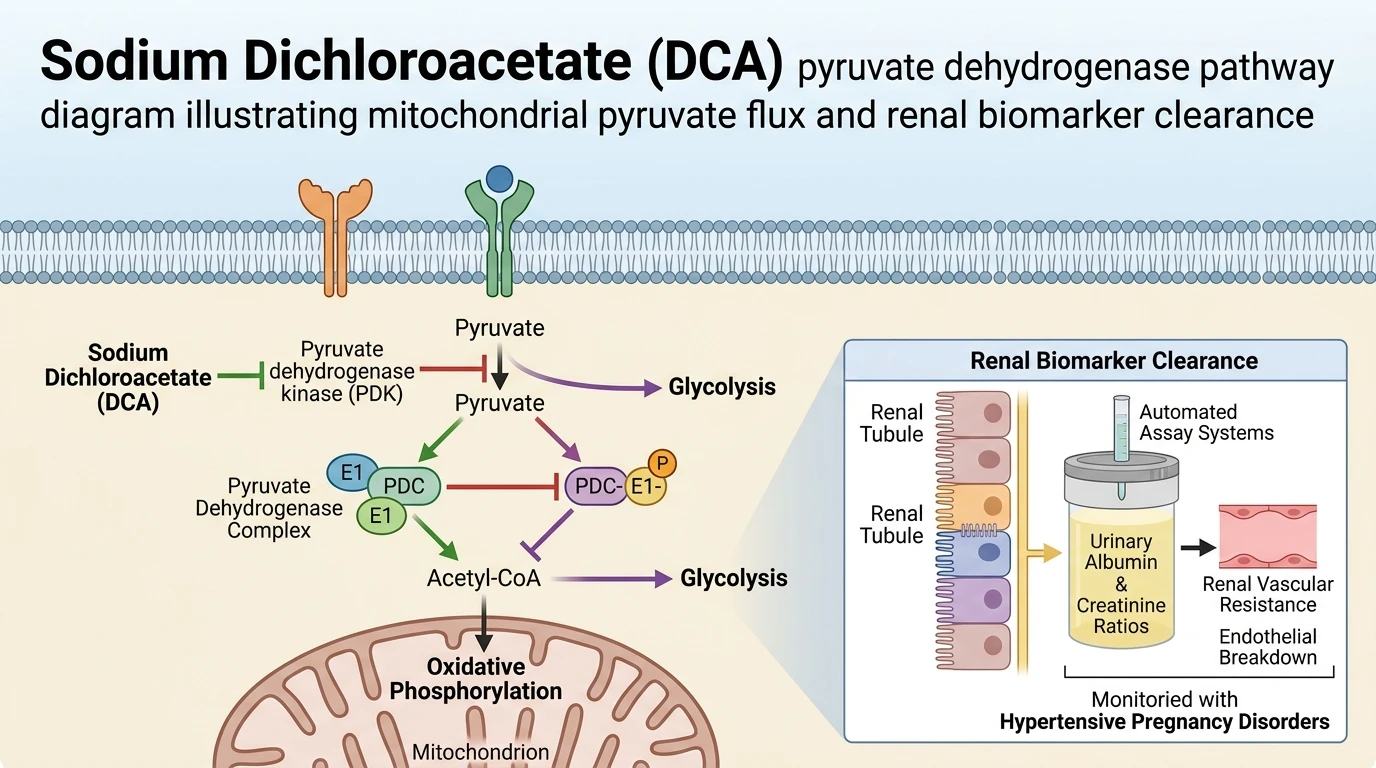
In clinical trial evaluations and diagnostic methodology research, terminology requires rigorous distinction. Point-of-care automated immunoassay analyzers, frequently referenced under the clinical abbreviation 'DCA' (such as the DCA 2000 platform), measure urinary albumin and creatinine concentrations rapidly. This diagnostic instrument nomenclature must not be confused with the metabolic therapeutic agent Sodium Dichloroacetate (DCA), an established small-molecule pyruvate dehydrogenase kinase inhibitor. Pharmacologically, metabolic Sodium Dichloroacetate (DCA) acts on mitochondrial pyruvate dehydrogenase kinase to alter glucose oxidation, whereas clinical diagnostic reviews assess point-of-care urine analyzer assays measuring protein excretion dynamics in pregnant women.
Systematic diagnostic reviews evaluate spot urinary P:C and A:C ratios across diverse disease prevalence assumptions, typically modeling 20%, 50%, and 80% baseline prevalence of preeclampsia in evaluated clinical cohorts. Meta-analytical findings indicate that spot P:C ratios demonstrate consistently high diagnostic sensitivity, ranging from 85% to 98% across varying cutoffs (most commonly 0.3 mg/mg or 30 mg/mmol). Due to high sensitivity, the calculated negative predictive value (NPV) remains exceptionally robust across low-to-moderate prevalence populations. An elevated NPV provides high clinical confidence when ruling out significant proteinuria in suspected preeclamptic patients. A low spot P:C ratio effectively excludes pathology, allowing clinicians to avoid unnecessary hospital admissions and premature iatrogenic interventions.
Conversely, positive predictive values (PPV) fluctuate substantially according to population disease prevalence. In low-risk ambulatory cohorts (20% prevalence), PPVs for spot P:C ratio range between 55% and 70%, whereas in high-risk tertiary referral populations (80% prevalence), PPVs exceed 90%. Microalbumin-to-creatinine ratios (A:C ratios) display comparable diagnostic sensitivity but slightly lower specificity for predicting total 24-hour protein output. The diagnostic accuracy of spot testing relies on stable creatinine excretion rates; however, diurnal variations and maternal renal hyperfiltration during late pregnancy introduce minor variability. Diagnostic thresholds near 0.3 mg/mg retain clinical reliability across multi-center validation studies. Spot P:C ratio determinations streamline obstetrical workflow by replacing cumbersome timed collections with rapid, reliable rule-out metrics.
Diagnostic Performance and Predictive Accuracy of Spot Urine Biomarkers
Copy code to add this image to your page
Spot urinary protein-to-creatinine ratio (P:C ratio) and albumin-to-creatinine ratio (A:C ratio) measurements offer high sensitivity and negative predictive values for detecting preeclampsia-associated proteinuria. Point-of-care automated platforms evaluate spot urine samples to bypass the delays of 24-hour collection protocols. High negative predictive values across 20%, 50%, and 80% disease prevalence thresholds confirm that spot ratio determinations reliably rule out clinically significant proteinuria in pregnant patients.
High Negative Predictive Values Rule Out Significant Proteinuria
Spot urinary protein-to-creatinine ratios demonstrate high sensitivity across clinical cutoff thresholds. Glomerular filtration integrity degrades under preeclamptic endotheliosis. In evaluated study cohorts, a spot P:C ratio threshold of 0.3 mg/mg yielded diagnostic sensitivity exceeding 90%. High sensitivity drives robust negative predictive values in low-prevalence populations. Clinicians can confidently exclude severe proteinuria using a single spot specimen. Diagnostic speed prevents delayed clinical decision-making during emergency triage. While metabolic drug studies utilize the Sodium Dichloroacetate (DCA) Dehydrogenase inhibitor class to alter mitochondrial enzyme activity, diagnostic obstetrical protocols rely on spot protein quantification to rule out hypertensive renal damage.
Prevalence-Adjusted Sensitivity Across Variable Gestational Cohorts
Positive predictive metrics vary markedly with disease prevalence. Diagnostic performance was modeled across 20%, 50%, and 80% preeclampsia prevalence assumptions. In low-risk cohorts, positive predictive values remained modest (55–68%). False-positive results occasionally occurred due to concentrated physiological urine output. In high-risk referral populations, positive predictive values exceeded 92%. Specificity reached maximum stability at a P:C ratio cutoff of 0.35 mg/mg. Quantitative spot testing remains superior to qualitative dipstick reagent strips. Dipstick testing suffers from high inter-observer variability and frequent false-positive readouts.
Spot Ratio Diagnostics Superiority Over 24-Hour Urine Collection
Timed 24-hour urine collection exhibits known analytical vulnerabilities. Incomplete specimen collection impairs accurate total protein quantification. Diagnostic turnaround times for 24-hour protocols average 24 to 36 hours. Spot P:C ratio results generate actionable metrics within hours. Renal creatinine clearance normalizes spot protein concentrations against hydration changes. Comparative receiver operating characteristic (ROC) curves confirm areas under the curve (AUC) between 0.88 and 0.94 for spot P:C ratios. Spot testing provides sufficient diagnostic precision to replace routine 24-hour collections in initial clinical evaluations.