NEDD8 Inhibitors
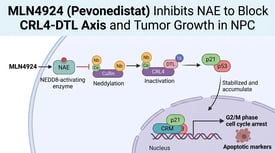
NEDD8 inhibitors target the NEDD8 (Neural precursor cell expressed developmentally down-regulated protein 8) conjugation pathway, a ubiquitin-like modification system known as neddylation. Neddylation is a post-translational modification process where NEDD8, a small protein structurally similar to ubiquitin, is covalently attached to target proteins. This process is catalyzed by a cascade of enzymes: an E1 activating enzyme (NAE1/UBA3), an E2 conjugating enzyme (UBE2M/UBC12 or UBE2F), and an E3 ligase (primarily the Cullin-RING ligases, CRLs). The main signaling pathway involves the activation of CRLs, which are the largest family of E3 ubiquitin ligases, responsible for ubiquitinating approximately 20% of all ubiquitinated proteins. Neddylation of the cullin subunit of CRLs is essential for their full activity, promoting conformational changes that enhance substrate binding and ubiquitin transfer. By inhibiting neddylation, NEDD8 inhibitors effectively inactivate CRLs, leading to the accumulation of CRL substrates, many of which are tumor suppressors or cell cycle regulators. This accumulation triggers cell cycle arrest and apoptosis, primarily by disrupting proteasomal degradation pathways. Diseases or conditions associated with NEDD8 pathway dysregulation are predominantly cancers, where CRLs are often hyperactive, contributing to uncontrolled cell proliferation and survival. Many oncogenes are stabilized by CRLs, while tumor suppressors are degraded. Therefore, inhibiting neddylation is a potent anti-cancer strategy. Specific cancers where NEDD8 inhibitors show promise include multiple myeloma, acute myeloid leukemia (AML), non-Hodgkin lymphoma, and various solid tumors (e.g., lung, breast, colorectal cancer).
Beyond cancer, neddylation has been implicated in viral replication, neurodegeneration, and immune responses, suggesting broader therapeutic potential. For instance, some viruses hijack the neddylation pathway for their own replication, making it a potential antiviral target. In neurodegenerative diseases, dysregulation of protein degradation pathways, including neddylation, can contribute to the accumulation of toxic protein aggregates. Current research progress on NEDD8 inhibitors is highly advanced, particularly with the development of pevonedistat (MLN4924). Pevonedistat is a first-in-class, potent, and selective small molecule inhibitor of the NEDD8-activating enzyme (NAE1/UBA3). By blocking the initial step of the neddylation cascade, pevonedistat effectively inhibits the neddylation of all cullins, leading to global CRL inactivation. Pevonedistat has undergone extensive preclinical testing, demonstrating significant anti-tumor activity in a wide range of cancer models. It has progressed to multiple clinical trials, including Phase III trials for high-risk myelodysplastic syndromes (MDS) and acute myeloid leukemia (AML), and Phase II trials for other hematological malignancies and solid tumors. While it has not yet received full regulatory approval, its clinical development represents a major success in targeting the neddylation pathway. Other NEDD8 inhibitors are also in earlier stages of preclinical development, exploring different points in the neddylation cascade or alternative chemical scaffolds. The success of pevonedistat has validated neddylation as a druggable target in oncology.
Common classifications of NEDD8 inhibitors are primarily based on their molecular target within the neddylation cascade. The most prominent class targets the NEDD8-activating enzyme (NAE1/UBA3), exemplified by pevonedistat, which is an ATP-competitive inhibitor that forms a covalent adduct with NEDD8. Other potential classifications could include inhibitors of NEDD8-conjugating enzymes (E2s) or NEDD8-E3 ligases, though these are less developed. Inhibitors can also be classified by their chemical structure (e.g., small molecules) and their selectivity for the neddylation pathway over the ubiquitin-proteasome system, to minimize off-target effects. The high specificity of pevonedistat for NAE is a key feature, distinguishing it from general proteasome inhibitors. Other relevant general knowledge includes the critical role of the neddylation pathway in maintaining cellular proteostasis and cell cycle progression. Inhibiting this pathway leads to a rapid accumulation of CRL substrates, such as p21, p27, and CDT1, which are key cell cycle inhibitors, thereby inducing cell cycle arrest and apoptosis. A key challenge is managing potential toxicities, as the neddylation pathway is essential for normal cellular function. However, cancer cells often exhibit a heightened dependency on CRL activity, providing a therapeutic window. Resistance mechanisms can involve compensatory pathways or mutations in the neddylation machinery, though these are still under investigation. Research tools include specific antibodies for neddylated proteins, cell lines with altered neddylation pathway components, and activity assays for NAE and other enzymes.
Combination therapy is a major strategy, with pevonedistat being explored in combination with hypomethylating agents (e.g., azacitidine) or chemotherapy in hematological malignancies, aiming for synergistic anti-tumor effects and overcoming resistance. The continued clinical development of pevonedistat and the exploration of new NEDD8 inhibitors underscore the significant therapeutic potential of targeting this pathway.