AZD9291 (Osimertinib) Irreversible EGFR Kinase Inhibition and Acquired Resistance Pathways
Copy code to add this image to your page
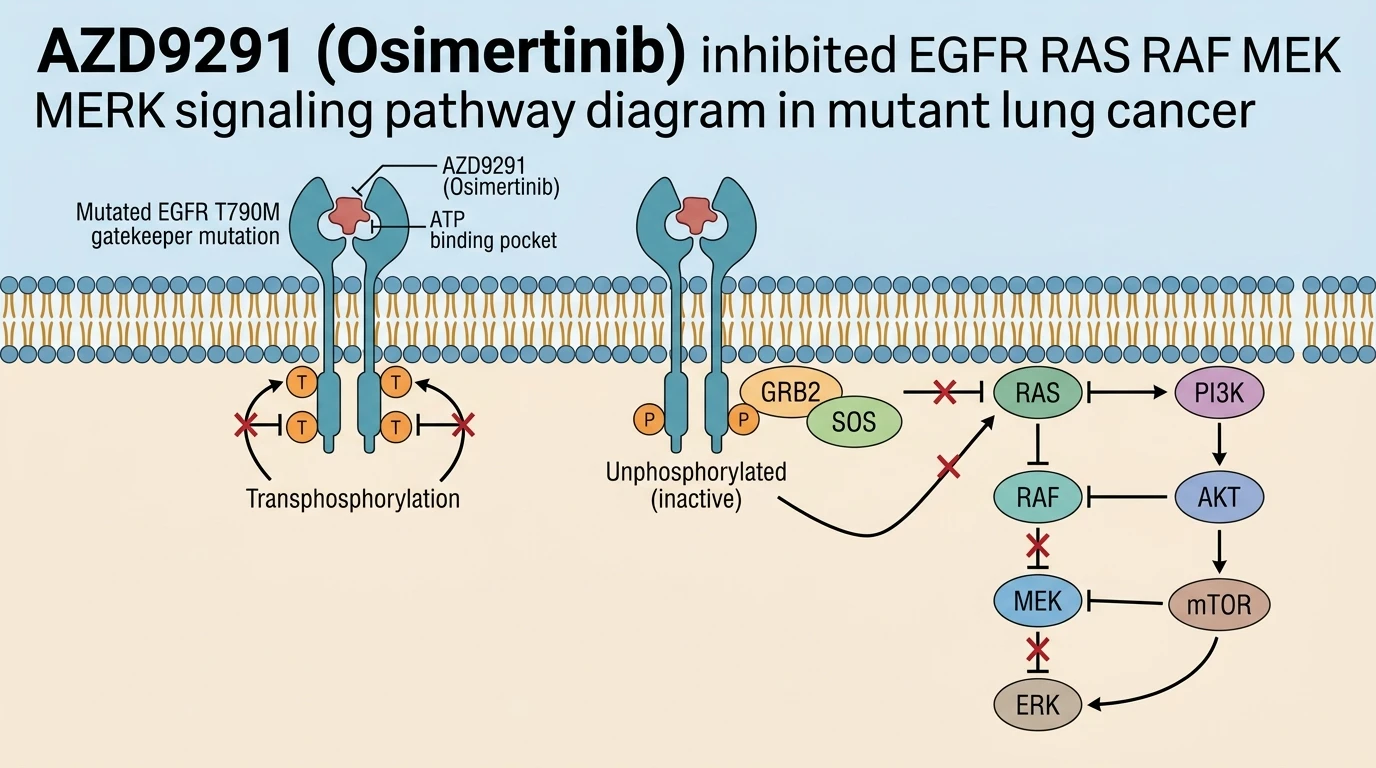
Epidermal Growth Factor Receptor (EGFR) mutations act as primary driver alterations in non-small cell lung cancer (NSCLC), particularly in adenocarcinoma subtypes. Classical activating mutations—most prominently frame deletions in exon 19 and the point mutation L858R in exon 21—reconfigure the ATP-binding cleft of the intracellular kinase domain. This structural shift maintains the catalytic domain in an active conformation, driving continuous activation of downstream RAS-RAF-MEK-ERK and PI3K-AKT signaling cascades. While first-generation tyrosine kinase inhibitors (TKIs) like erlotinib and gefitinib initially suppress mutant receptor signaling, therapeutic durability is limited by secondary resistance mechanisms. The gatekeeper mutation T790M restores receptor affinity for ATP to wild-type levels, sterically hindering reversible TKI binding and rendering early-generation compounds ineffective.
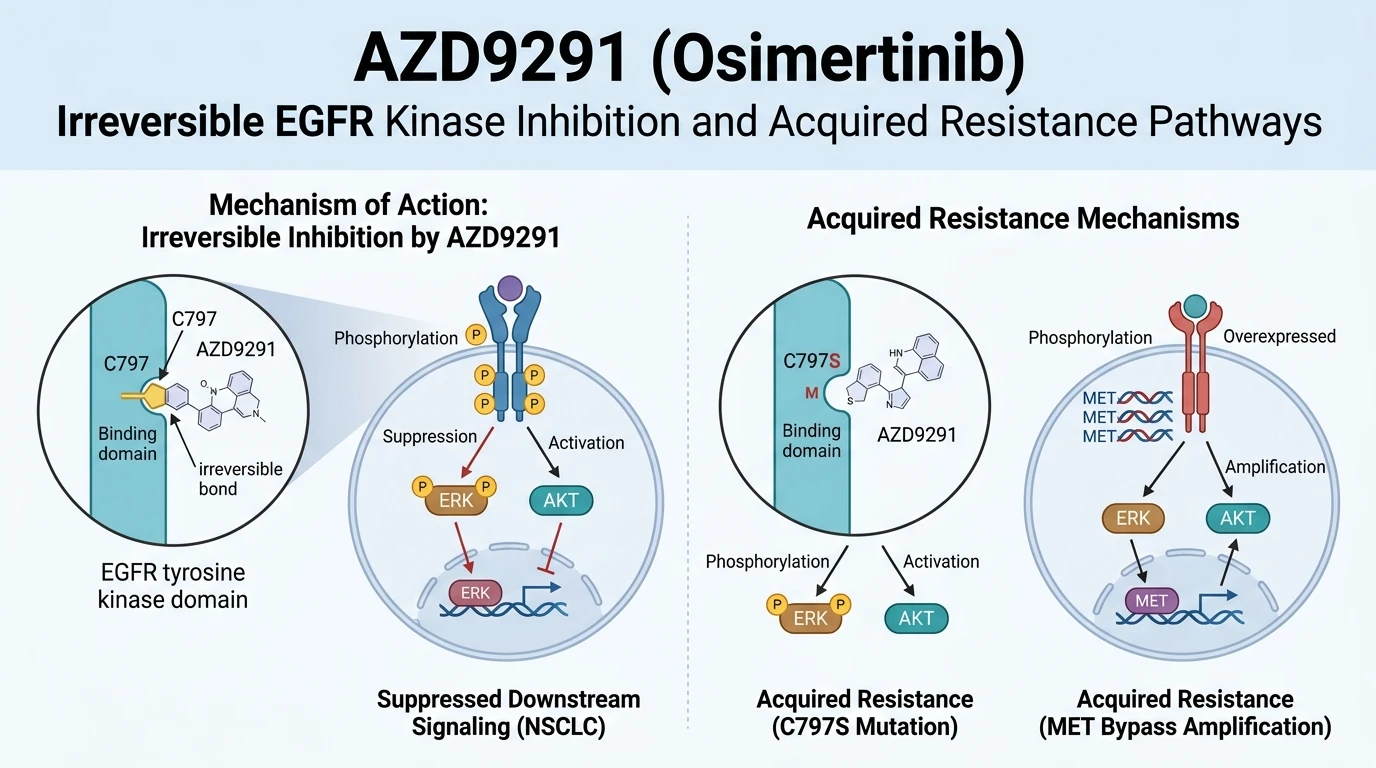
AZD9291 (Osimertinib) was synthesized as an oral, third-generation, irreversible EGFR tyrosine kinase inhibitor engineered to target both sensitizing mutations and the T790M resistance allele while sparing wild-type receptor function. Structurally characterized by a mono-anilino-pyrimidine core, the compound forms a targeted covalent bond with the conserved cysteine-797 (C797) residue within the ATP-binding pocket of the EGFR kinase domain. Covalent adduction occurs via a nucleophilic Michael addition reaction involving the acrylamide motif of AZD9291. Crucially, this irreversible mechanism yields potent biochemical suppression against classical sensitizing mutations (exon 19 del, L858R) and the T790M resistance mutation, exhibiting nanomolar half-maximal inhibitory concentration ($IC_{50}$) values in cell-free kinase assays. Unlike second-generation irreversible inhibitors, the molecule displays significantly lower potency against wild-type EGFR, minimizing dose-limiting toxicities such as severe cutaneous rash and diarrhea. Furthermore, the agent demonstrates superior blood-brain barrier penetration compared to earlier TKIs, achieving meaningful central nervous system drug exposure and controlling intracranial metastases in advanced NSCLC patient cohorts.
Despite high initial clinical response rates and prolonged progression-free survival in both treatment-naïve and T790M-positive secondary settings, drug resistance inevitably emerges under selective pressure. Molecular profiling of resistant tumor samples reveals diverse resistance pathways. On-target secondary EGFR mutations frequently compromise covalent compound engagement. Mutation of the nucleophilic cysteine residue to serine (C797S) eliminates the covalent anchor required for irreversible inhibition, abolishing drug potency while retaining kinase functionality. Alternative tertiary mutations, including G724S within the glycine-rich loop and L718Q or L718V within the ATP-binding pocket, similarly disrupt inhibitor binding through steric clash or alteration of domain flexibility.
In addition to tertiary point mutations within the target kinase, off-target bypass pathway activation frequently drives acquired resistance. Receptor tyrosine kinase gene amplifications—most notably MET and HER2—reactivate downstream ERK and AKT phosphorylation independently of EGFR activation. Genomic alterations in downstream signaling nodes, including KRAS or BRAF mutations and oncogenic rearrangements such as RET or FGFR3 fusions, similarly circumvent upstream EGFR suppression. Additionally, a subset of resistant tumors undergoes histological transformation, morphing from non-small cell adenocarcinoma into small cell lung cancer (SCLC), accompanied by RB1 and TP53 loss. Detailed clinical analyses of resistance mechanisms emphasize the necessity of serial liquid biopsy and tissue profiling to track these dynamic clonal trajectories and guide subsequent combination treatment strategies.
Pharmacological Characterization and Structural Drivers of Resistance
Copy code to add this image to your page
AZD9291 (Osimertinib) is an irreversible third-generation EGFR tyrosine kinase inhibitor designed to select against both sensitizing mutations (exon 19 del, L858R) and the gatekeeper T790M resistance allele. The molecule forms a covalent alkyl bond with residue C797 within the catalytic kinase domain, suppressing downstream RAS-RAF-MEK-ERK and PI3K-AKT signaling while sparing wild-type EGFR. Acquired resistance develops through tertiary EGFR mutations such as C797S, bypass pathway amplifications including MET or HER2, and histological transformation.
Covalent Target Engagement and Wild-Type Sparing Selectivity
AZD9291 achieves high potent target engagement by covalently modifying the C797 residue in the ATP-binding cassette. Alkylation stabilizes the drug-receptor complex. This prevents ATP binding across extended time scales. Consequently, auto-phosphorylation of mutant EGFR rapidly decreases in cell line models. Downstream ERK and AKT phosphorylation ceased within minutes following compound exposure. Cellular viability dropped sharply in EGFR-mutant lines. In contrast, wild-type EGFR expressing cell models required substantially higher inhibitor concentrations for kinase suppression. Biochemical assays confirm a selectivity margin exceeding 10-fold relative to wild-type receptors. This wild-type sparing profile reduces off-target toxicities in clinical settings. Structural analysis demonstrates that the acrylamide tail aligns precisely with C797 without perturbing adjacent native kinase domains.
Heterogeneous Bypass Activation Drives Secondary Therapeutic Escape
Acquired resistance mechanisms disrupt covalent target binding or bypass EGFR dependency altogether. The tertiary C797S mutation replaces the targeted nucleophilic thiol with a hydroxyl group. Covalent bond formation fails completely. Under these conditions, AZD9291 functions purely as a reversible inhibitor with markedly reduced binding affinity. In parallel, genomic MET amplification drives persistent ERBB3 phosphorylation, reactivating the PI3K-AKT survival axis despite full EGFR suppression. Animal xenograft studies confirm that combination therapy with MET inhibitors restores apoptotic signaling in MET-amplified tumor models. Histological transformation to small cell phenotypes represents another major resistance pathway. Tumor cells drop epithelial markers and downregulate EGFR expression. Tracking these diverse genomic events requires comprehensive molecular monitoring.