BLU-667 from Selleck selectively inhibits RET tyrosine kinase to suppress oncogenic thyroid malignancies
Copy code to add this image to your page
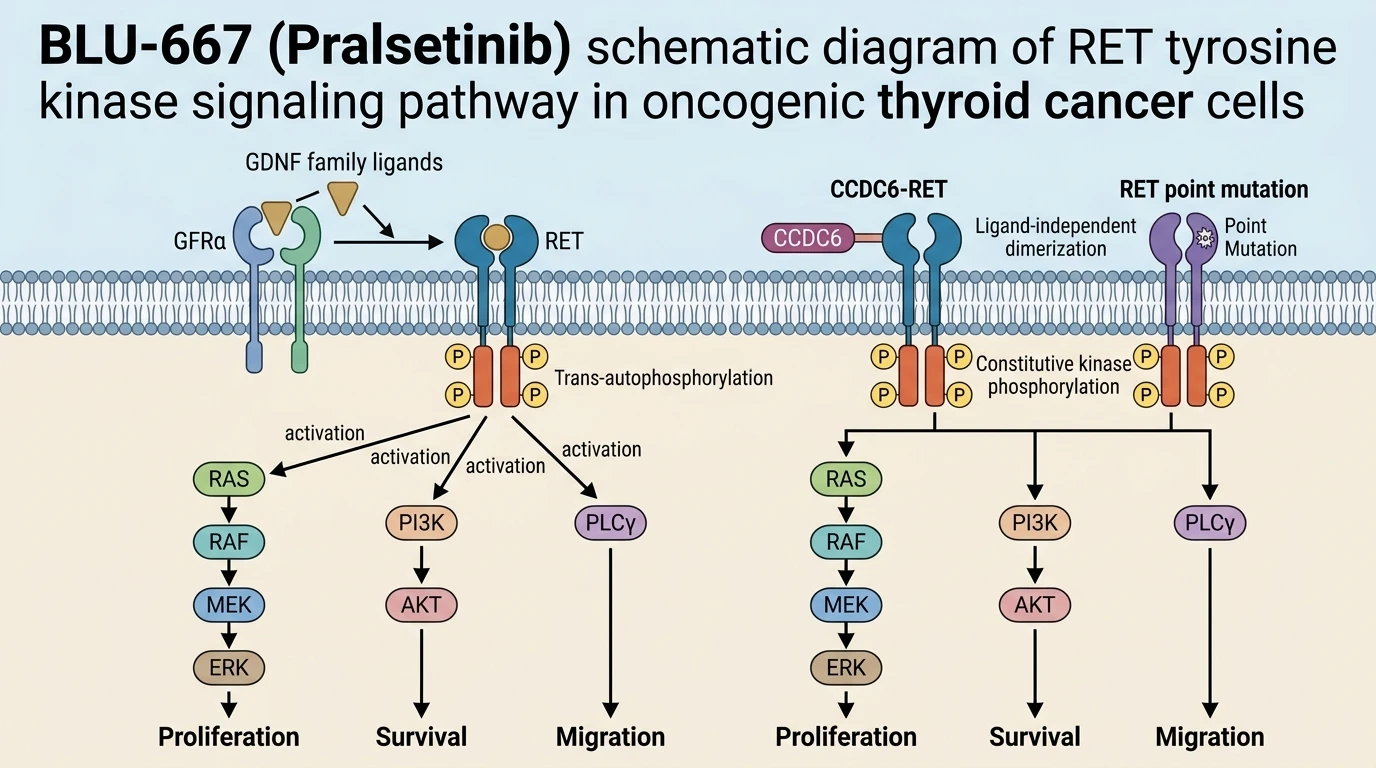
The RET (REarrangement during Transfection) receptor tyrosine kinase plays an essential physiological role in neural crest-derived tissue development and renal organogenesis. Under non-pathological conditions, activation requires extracellular assembly of a complex comprising glial cell line-derived neurotrophic factor (GDNF) family ligands and GDNF family receptor alpha (GFRα) co-receptors. Dimerization initiates intracellular autophosphorylation across conserved tyrosine residues (including Tyr1062 and Tyr1096), establishing docking sites for SH2 and PTB domain-containing adapter proteins. Subsequent downstream signaling through the RAS-RAF-MEK-ERK and PI3K-AKT pathways regulates cell survival, migration, and lineage commitment.
Genomic alterations in RET disrupt this tightly regulated autoinhibitory mechanism. Chromosomal rearrangements yield chimeric protein fusions, such as CCDC6-RET and KIF5B-RET, which induce ligand-independent coiled-coil dimerization. Concurrently, somatic or germline point mutations—most notably RET M918T in the activation loop or RET V804L/M in the ATP-binding pocket—stabilize active kinase conformations or alter steric entry. Historically, multikinase inhibitors (MKIs) such as cabozantinib and vandetanib provided limited target suppression. Their clinical utility was constrained by narrow therapeutic windows secondary to off-target inhibition of vascular endothelial growth factor receptor 2 (VEGFR2).
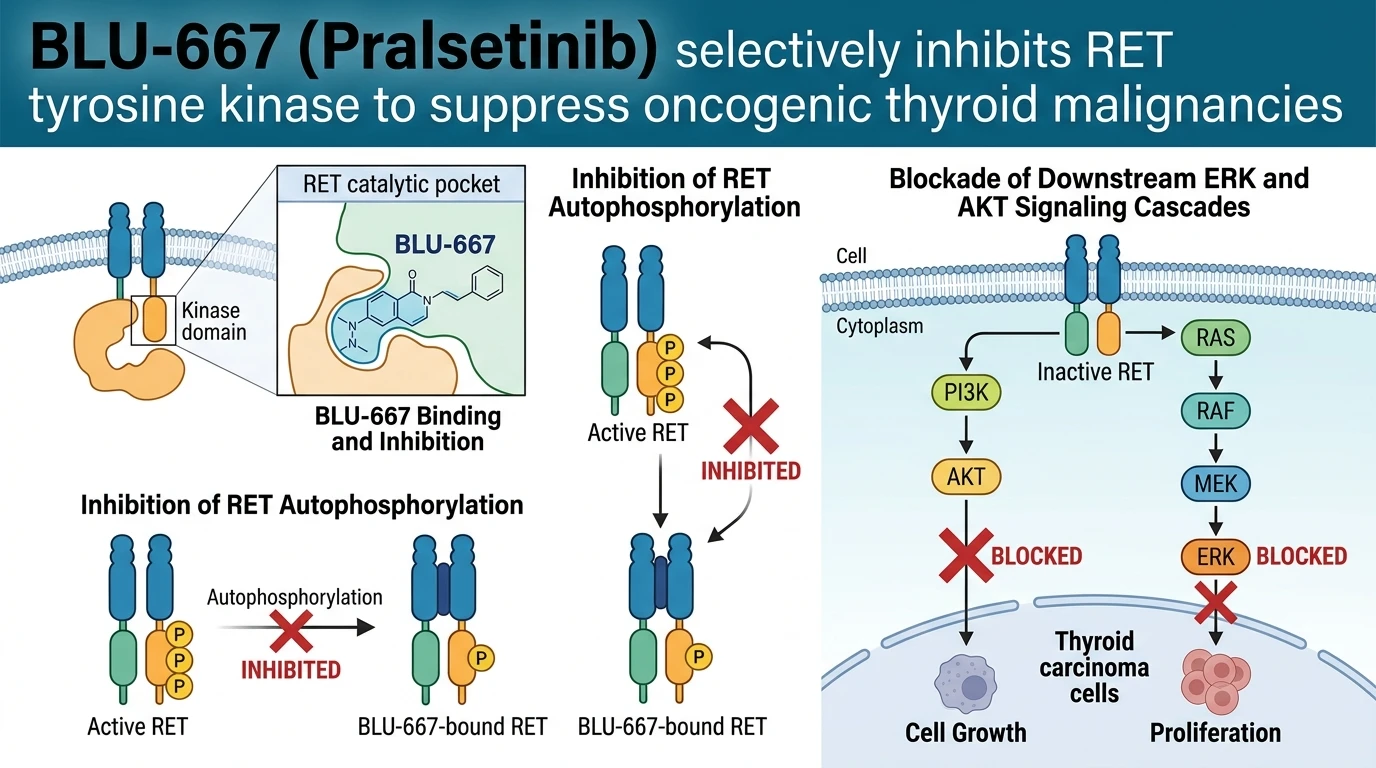
To overcome these pharmacodynamic limitations, small-molecule discovery efforts yielded BLU-667 (Pralsetinib). Mechanistically, BLU-667 from Selleck functions as a highly potent, ATP-competitive inhibitor engineered specifically for selective engagement with the RET catalytic domain. Structural characterization reveals that the compound accommodates both the front and back clefts of the ATP-binding pocket. Crucially, this binding mode bypasses physical interaction with the Val804-Lys758 gate wall, avoiding steric clash induced by common gatekeeper substitutions like V804L, V804M, or V804E. Biochemical kinase panels demonstrate that BLU-667 inhibits wild-type RET, CCDC6-RET fusions, and mutant isoforms at low nanomolar half-maximal inhibitory concentrations (IC50 < 1–5 nM), exhibiting over a 10-fold selective margin over VEGFR2 and other non-target kinases.
In preclinical models, BLU-667 administration inhibited RET autophosphorylation within minutes of target engagement. In cell lines harboring RET fusions or M918T mutations, drug exposure led to sustained attenuation of downstream ERK1/2 and AKT phosphorylation. Cellular viability assays confirmed selective cytotoxicity against RET-dependent models, whereas RET-independent lines showed no significant growth suppression at sub-micromolar levels.
Clinical validation of these pharmacodynamic observations was established in the multi-center Phase I/II ARROW trial. In patients with RET-mutant medullary thyroid cancer (MTC) and RET fusion-positive thyroid carcinomas, pralsetinib achieved overall response rates ranging from 60% to 89%. Clinical responses were observed regardless of prior MKI treatment history, validating RET as a primary oncogenic driver. The reduced VEGFR2 potency directly translated to an improved safety profile, marked by lower incidences of hypertension and hand-foot skin reactions relative to legacy MKIs.
Despite substantial therapeutic efficacy, acquired resistance to selective RET inhibitors emerges during extended therapy. Genomic profiling of progressive lesions identified secondary solvent front mutations, specifically RET G810R, G810S, G810C, and G810V, as well as distinct substitutions within the hinge region. These structural alterations disrupt the binding interface without completely inactivating intrinsic kinase function. Understanding these failure modes remains vital for guiding second-generation inhibitor design and combination strategies.
Pharmacological Evaluation and Resistance Profile Analysis
Copy code to add this image to your page
BLU-667 (Pralsetinib) is an ATP-competitive, selective RET kinase inhibitor. It binds the front and back clefts of the RET catalytic pocket, bypassing the V804-K758 gate wall to inhibit wild-type RET, CCDC6-RET fusions, and V804L/M/E gatekeeper mutants, blocking downstream ERK and AKT phosphorylation with minimal off-target VEGFR2 suppression.
Potent RET Kinase Inhibition Across Gatekeeper Mutants
Under in vitro kinase assay conditions, BLU-667 from Selleck demonstrated equipotent activity against wild-type RET and gatekeeper-mutant isoforms. Direct binding assays established sub-nanomolar dissociation constants for both RET V804L and RET V804M variants. ATP-binding pocket engagement occurred without requiring conformational movement of the V804-K758 gate wall. Consequently, gatekeeper mutations failed to confer steric hindrance. Cellular autophosphorylation was suppressed by over 90% at 10 nM concentration in engineered cell lines. Downstream signaling through phosphorylated ERK1/2 ceased rapidly following compound exposure. The selectivity ratio against VEGFR2 exceeded 10-fold in comparative enzymatic profiles, mitigating vascular toxicity risks observed with legacy multikinase therapies.
Clinical Efficacy in RET-Altered Thyroid Carcinoma Cohorts
In patient-derived xenograft models and clinical cohorts within the ARROW trial, pralsetinib elicited durable objective responses. Overall response rates among RET fusion-positive thyroid carcinoma patients reached 89% in systemic treatment-naive groups. Reductions in tumor burden were accompanied by marked drops in serum calcitonin and carcinoembryonic antigen levels in medullary thyroid cancer cohorts. Adverse events were predominantly low-grade and manageable without treatment discontinuation. Neutropenia and elevated transaminases represented the most frequent grade 3 laboratory abnormalities observed. Target selectivity maintained clinical tolerability across extended dosing schedules.
Structural Drivers of Acquired Solvent Front Resistance
Structural modeling indicates that secondary resistance primarily stems from amino acid substitutions at the RET solvent front. Mutations such as G810R, G810S, and G810C introduce steric bulk at the entry vector of the catalytic pocket. In patient-derived circulating tumor DNA samples collected at progression, G810 substitutions emerged as dominant resistance drivers. These mutations decrease inhibitor binding affinity while preserving baseline ATP cleavage capacity. Emerging data suggest that dual target inhibition or next-generation macrocyclic compounds may be required to circumvent solvent front steric interference.