AZD0156 inhibits ATM kinase to promote selective radiosensitization in human melanoma cells
Copy code to add this image to your page
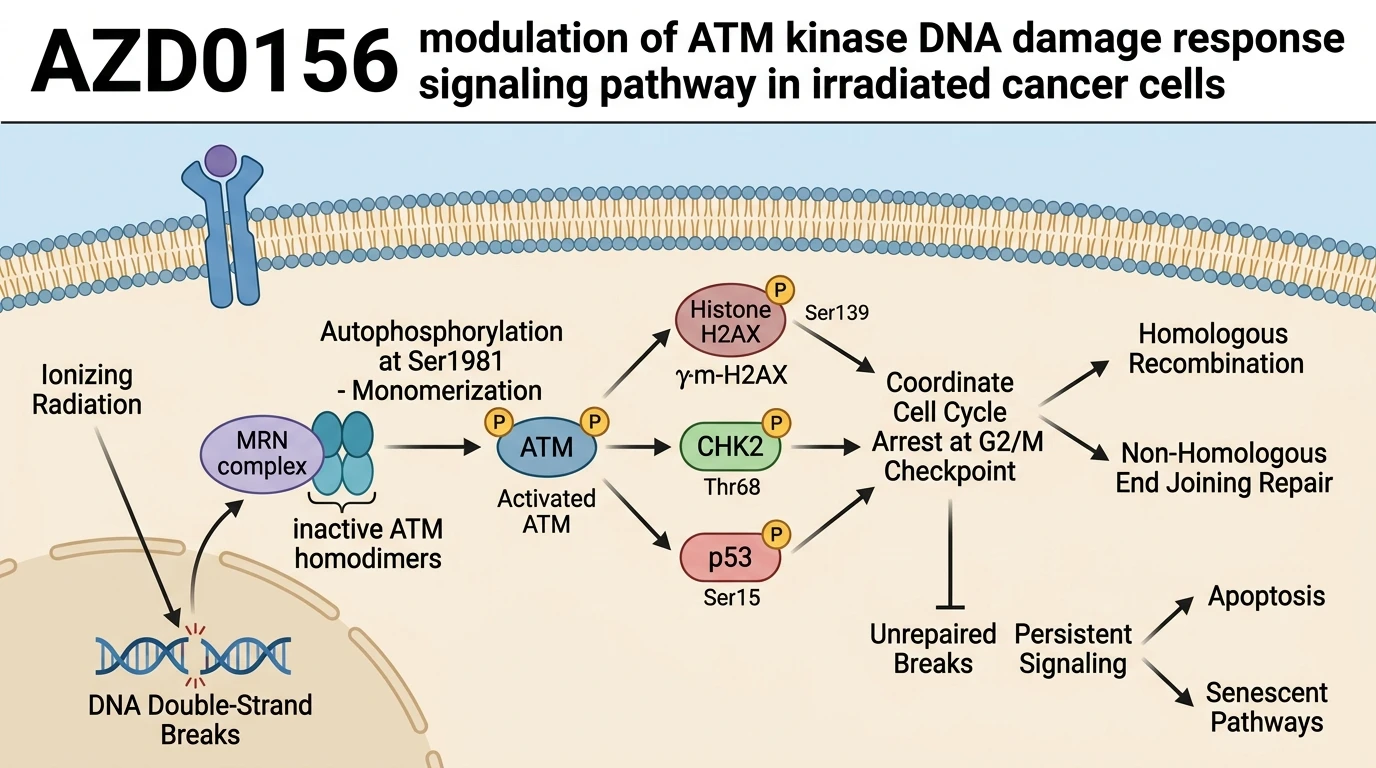
Ionizing radiation exerts cytotoxic effects primarily through double-strand DNA breaks (DSBs). Cells respond to this genomic injury through a network of transducers known as the DNA damage response (DDR). Central to this machinery is the Ataxia telangiectasia mutated (ATM) kinase, a high-molecular-weight serine/threonine protein kinase belonging to the phosphoinositide 3-kinase-related kinase (PIKK) family. Upon induction of chromosomal DSBs, the MRE11-RAD50-NBS1 (MRN) sensor complex binds damaged DNA termini and recruits inactive, dimeric ATM complexes. Target engagement at DSB sites triggers autophosphorylation at Ser1981, prompting dimer dissociation into active monomers. Activated ATM monomer subunits phosphorylate downstream transducers, including CHK2 at Thr68, p53 at Ser15, KAP1 at Ser824, and H2AX at Ser139. Small-molecule intervention at this enzymatic node impairs homologous recombination repair, offering a precise strategy to sensitize malignant cells to ionizing radiation.
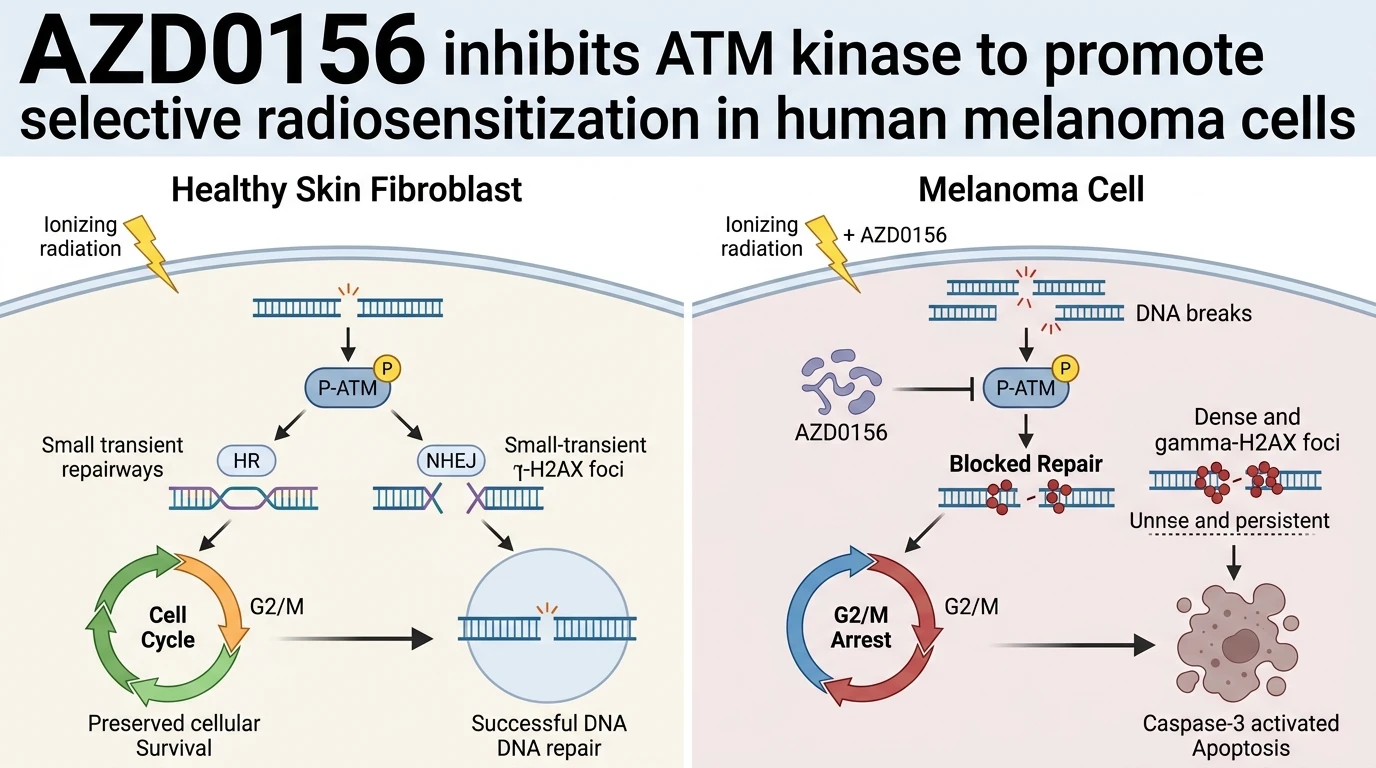
The small molecule AZD0156 functions as an ATP-competitive inhibitor targeting the catalytic domain of ATM kinase. Structural modeling indicates that the molecule occupies the ATP-binding cleft of ATM, establishing key hydrogen-bonding interactions within the hinge region and occupying adjacent hydrophobic pockets. In biochemical assays, the inhibitor displays sub-nanomolar affinity for ATM while maintaining high selectivity against related PIKK members, including ATR, DNA-PKcs, and mTOR. Pharmacological characterization in human melanoma cell models demonstrates that catalytic suppression of ATM by AZD0156 rapidly abrogates radiation-induced auto-phosphorylation at Ser1981. Consequently, phosphorylation of downstream effectors such as CHK2 and KAP1 is markedly blunted. Inhibiting this signaling axis prevents the assembly of homologous recombination repair factors, including RAD51 foci. As a result, melanoma cells subjected to ionizing radiation alongside target inhibition exhibit persistent double-strand breaks, evidenced by sustained gamma-H2AX foci across extended post-irradiation time points.
Experimental evaluations across multiple melanoma cell lines demonstrate profound radiosensitization. In clonogenic survival assays, treatment with low nanomolar concentrations of the compound prior to single-dose radiation significantly reduces survival fractions across various radiation doses. Calculation of dose-modifying factors (DMF) indicates strong synergistic interaction between catalytic target inhibition and radiation exposure. Notably, this radiosensitizing effect demonstrates cellular selectivity. In cultured human primary dermal fibroblasts, identical combination regimens induce minimal reductions in clonogenic survival. Healthy skin fibroblasts preserve double-strand break repair capability through alternative mechanisms, maintaining baseline viability under tested assay conditions.
Analysis of cell cycle kinetics provides further mechanistic insight into the observed cell death. Exposure to radiation alone triggers a transient G2/M phase delay, allowing DNA repair before mitotic entry. Co-treatment with AZD0156 forces melanoma cells into an extended G2/M phase arrest. Flow cytometric profiles show an accumulation of cells with 4N DNA content. Unresolved structural DNA damage during this arrested state prevents entry into mitosis, ultimately directing cells toward programmed cell death pathways. Western blot analyses confirm marked elevations in cleaved caspase-3 and PARP fragmentation following combination treatment, confirming transition from cell cycle arrest to active apoptosis.
Comparative studies evaluating AZD0156 against the ATR inhibitor VE-822 highlight important differences in therapeutic index. Although ATR inhibition by VE-822 enhances radiation sensitivity in tumor cells, it simultaneously increases radiosensitivity in non-malignant skin fibroblasts, limiting its therapeutic window during cutaneous radiation exposure. In contrast, AZD0156 achieves tumor-specific radiosensitization without inducing off-target cytotoxicity in normal dermal fibroblasts. This difference reflects distinct biological dependencies on ATM versus ATR signaling in transformed melanoma versus normal stromal cells. These findings support the potential of selective ATM inhibition in combination regimens for melanoma treatment.
Pharmacological Profile and Selectivity of ATM Inhibition
Copy code to add this image to your page
AZD0156 selectively inhibits ATM kinase, preventing double-strand break repair following radiation exposure. In melanoma cells, combined AZD0156 and ionizing radiation blocks homologous recombination, induces pronounced G2/M cell cycle arrest, and drives apoptotic cell death. Normal skin fibroblasts retain viability under identical exposure conditions, demonstrating target-mediated tumor selectivity.
Selective Radiosensitization in Melanoma Versus Healthy Dermal Fibroblasts
Cellular viability dropped sharply in irradiated melanoma populations. When combined with single-fraction ionizing radiation, low nanomolar doses of AZD0156 shifted clonogenic survival curves downward across all tested melanoma cell lines, yielding dose-modifying factors indicative of robust pharmacological synergy. Healthy human dermal fibroblasts exhibited minimal toxicity. In contrast to transformed cells, non-malignant fibroblasts maintained DNA repair fidelity and baseline proliferation, demonstrating a favorable in vitro safety margin between tumor and normal tissue contexts.
G2/M Phase Accumulation and Enhanced Apoptotic Execution Cascade
Radiation alone induced transient G2/M delay. Concomitant ATM catalytic inhibition altered cell cycle progression, locking melanoma cells into persistent G2/M arrest through the continuous accumulation of unrepaired double-strand DNA breaks. Phosphorylation of H2AX remained elevated at twenty-four hours. Flow cytometric analysis confirmed that prolonged checkpoint arrest led to mitochondrial membrane depolarization and subsequent cleavage of caspase-3 and PARP.
Therapeutic Index Advantages Relative to ATR Inhibitor VE-822
ATR blockade induced systemic radiosensitization across tissue types. Head-to-head comparison demonstrated that VE-822 reduced clonogenic survival in both normal skin fibroblasts and melanoma cells following radiation exposure. Selective ATM inhibition preserved healthy tissue integrity. The compound AZD0156 achieved superior tumor selectivity, sparing normal dermal fibroblasts while maintaining strong radiosensitization in melanoma cells under identical experimental conditions.