Dynasore Inhibition of Dynamin-2 GTPase Prevents Caveolae-Mediated Porcine Deltacoronavirus Entry
Copy code to add this image to your page
The entry of enveloped viruses into host target cells represents an obligatory step in establishing productive infection. Porcine Deltacoronavirus (PDCoV), an enteropathogenic coronavirus infecting swine, targets intestinal epithelial cells and causes acute enteritis. Defining the entry pathway utilized by PDCoV provides clear target opportunities for blocking host-pathway dependencies. Like many enveloped coronaviruses, PDCoV initiates infection via host receptor binding on the cell surface, followed by particle internalization through host endocytic machinery or direct fusion at the plasma membrane.
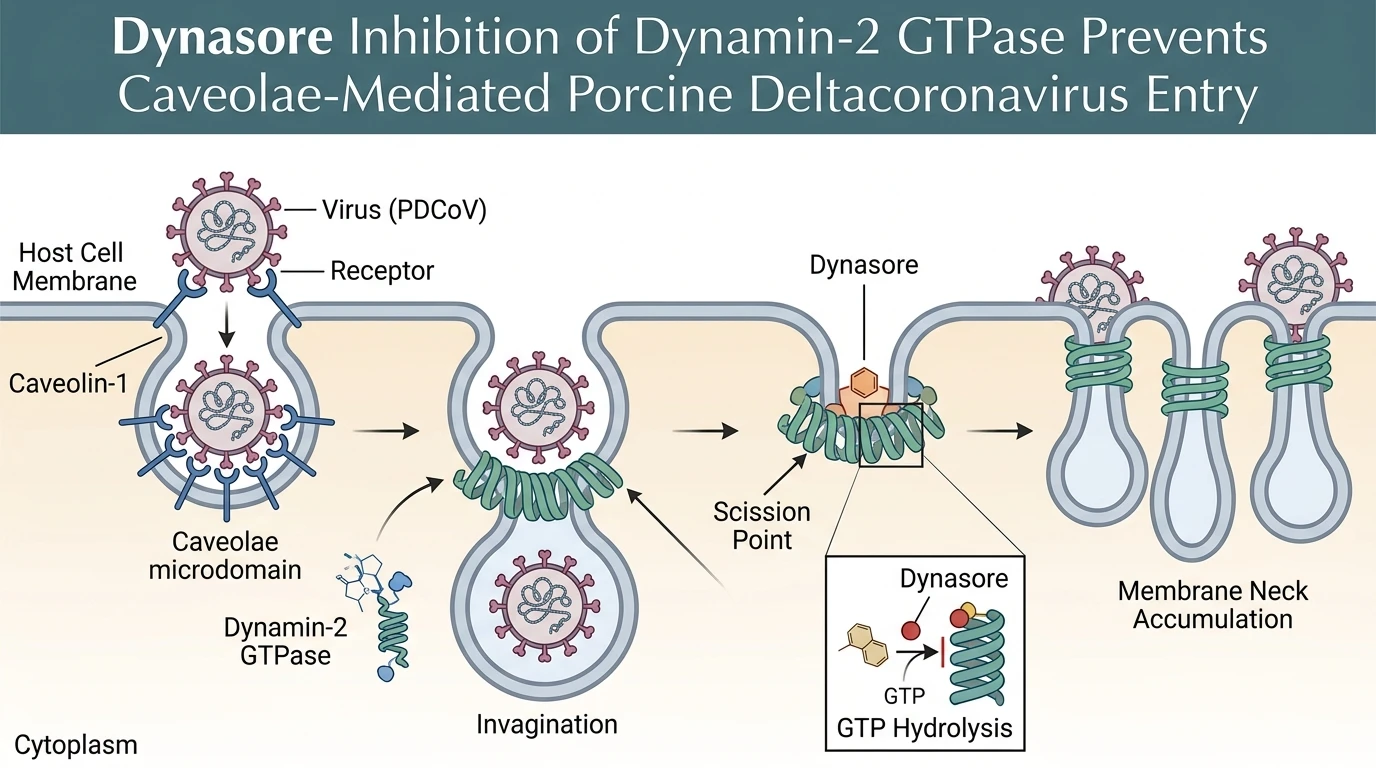
To identify the mechanisms governing PDCoV uptake, the small-molecule inhibitor Dynasore was evaluated in porcine kidney epithelial (PK-15) cell cultures. Dynasore operates as a cell-permeable, non-competitive inhibitor targeting the catalytic GTPase activity of both dynamin-1 and dynamin-2. Dynamin-2 is a ubiquitous large GTPase that oligomerizes into helical rings around the constricted necks of invaginated cell surface pits. Upon GTP hydrolysis, dynamin undergoes a conformational mechanical twist that severs the lipid neck, liberating nascent endocytic vesicles into the cytosol. By blocking GTP hydrolysis within the enzymatic pocket, Dynasore arrests vesicle scission and traps membrane-bound cargo at the cell surface.
In viral entry assays using PK-15 monolayers, pretreatment with Dynasore yielded a dose-dependent reduction in PDCoV internalization. Confocal fluorescence microscopy and quantitative viral particle tracking established that initial virion attachment to host surface receptors remained uninhibited in the presence of the drug. However, subsequent cellular internalization fell dramatically. To verify that this effect reflected targeted endocytic arrest rather than general cytotoxic injury, fluorescently labeled transferrin uptake—a canonical reference marker for dynamin-dependent endocytosis—was measured simultaneously. Dynasore suppressed transferrin endocytosis across identical concentration ranges, establishing a direct quantitative correlation between host endocytic blockade and restricted viral invasion.
The downstream consequences of endocytic scission blockade were quantified at 24 hours post-infection. Quantitative reverse transcription PCR (RT-qPCR) measuring intracellular PDCoV genomic RNA copies demonstrated marked concentration-dependent inhibition. In cells treated with 100 µM Dynasore, viral RNA replication dropped to approximately 40% of baseline levels observed in vehicle-treated controls. Western blot analyses evaluating the viral nucleocapsid (N) protein—the primary structural protein translated during viral gene expression—showed concordant downregulation, reflecting sustained suppression of intracellular replication cascades.
To confirm target specificity and exclude off-target pharmacological effects, genetic loss-of-function experiments were conducted in parallel. Transfection of PK-15 cells with a dominant-negative dynamin-2 mutant (K44A), which lacks critical GTP-binding capacity, selectively blocked PDCoV internalization and suppressed viral protein expression. Similarly, targeted shRNA knockdown of endogenous dynamin-2 transcripts diminished PDCoV infectious titers to levels matching chemical GTPase inhibition. Additional depletion of plasma membrane cholesterol using methyl-beta-cyclodextrin impaired viral entry, confirming that entry proceeds specifically via caveolae-mediated membrane microdomains rather than clathrin-independent or fluid-phase macropinocytosis.
These chemical biology and molecular genetic data establish that PDCoV internalization into PK-15 host cells depends strictly upon dynamin-2 GTPase catalytic activity and caveolae-mediated endocytosis. Inhibiting dynamin-mediated neck scission with Dynasore retains virions at the external plasma membrane, preventing endosomal maturation, cytosolic viral genome release, and subsequent viral translation.
Pharmacological Characterization of Caveolar Entry Blockade
Copy code to add this image to your page
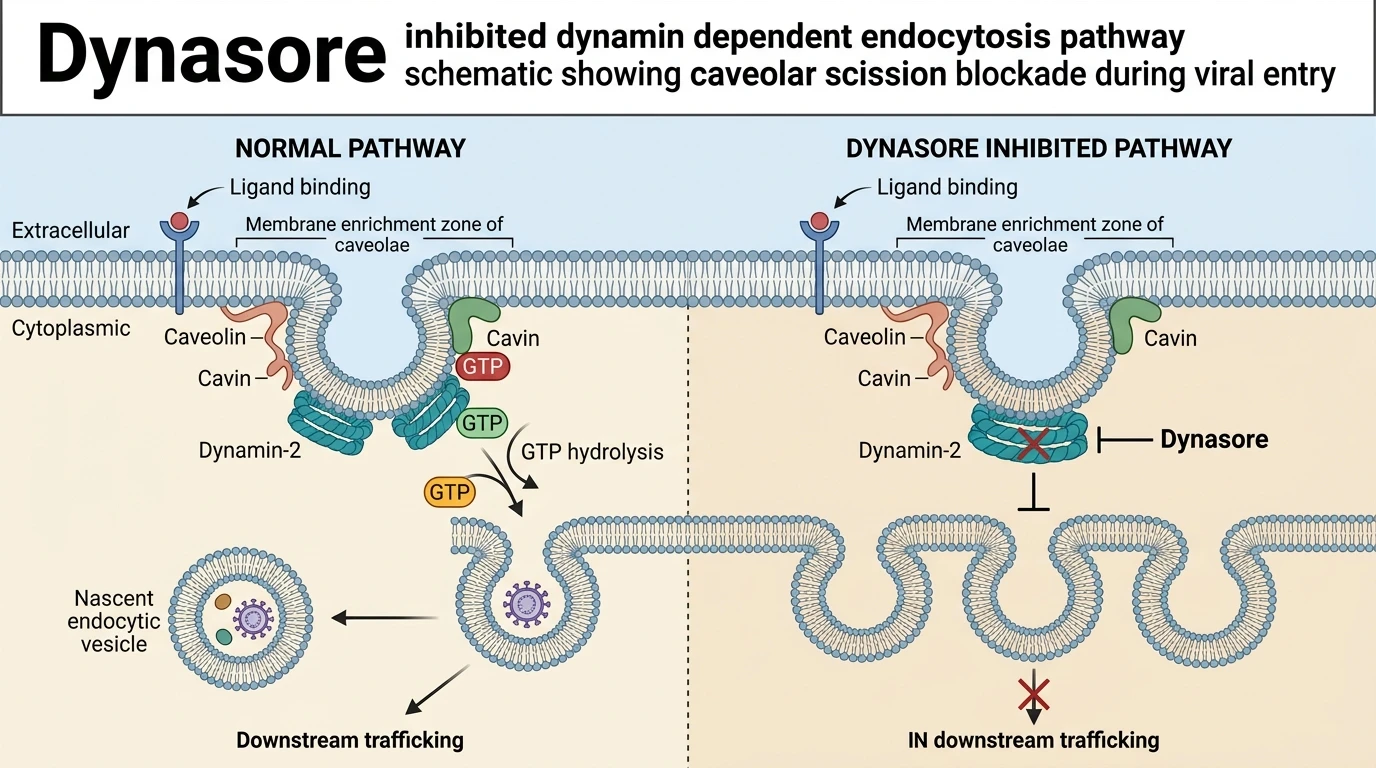
Dynasore acts as a cell-permeable small-molecule inhibitor of dynamin GTPase activity, specifically blocking dynamin-1 and dynamin-2 isoforms. By inhibiting GTP hydrolysis at the neck of invaginated membrane pits, it prevents the final scission step of endocytic vesicles. In Porcine Deltacoronavirus (PDCoV) infection of PK-15 cells, this inhibition impedes caveolae-mediated endocytosis, leaving initial viral attachment intact while preventing internalization of viral particles. Consequently, viral genomic RNA synthesis and nucleocapsid protein translation are significantly attenuated.
Dose-Dependent Suppression of Viral RNA and Nucleocapsid Synthesis
Pharmacological challenge with Dynasore yielded a dose-dependent reduction in intracellular viral burden within infected PK-15 epithelial monolayers. Quantification of genomic RNA via reverse transcription quantitative PCR demonstrated marked attenuation of viral transcripts at 24 hours post-infection. Viral replication dropped to approximately 40% of baseline levels at a concentration of 100 µM. Western blot analysis confirmed parallel downregulation of the viral nucleocapsid (N) protein. Importantly, host cell viability remained uncompromised across the tested concentration range in vitro. Membrane binding assays verified that initial viral attachment to cell surface receptors occurred normally despite dynamin blockade. Scission failure directly caused the loss of infectivity. These empirical observations establish that viral particle internalization, rather than primary receptor adhesion, represents the sensitive obligate step targeted by small-molecule GTPase inhibition.
Genetic Validation Using Dominant-Negative Dynamin-2 Mutants and Knockdown
To confirm that the phenotypic response induced by Dynasore stemmed specifically from dynamin-2 neutralization rather than off-target activity, genetic loss-of-function studies were performed. Expression of a dominant-negative dynamin-2 mutant featuring a K44A point mutation in the GTP-binding domain abolished endocytic vesicle neck cleavage. Parallel shRNA knockdown of endogenous dynamin-2 transcripts in PK-15 cells reproduced this blockade. Both genetic perturbations significantly restricted viral internalization and transferrin endocytosis, phenocopying the pharmacological effect of Dynasore treatment. Subsequent caveolae disruption assays further corroborated that host cell entry relies strictly on caveolin-1 rich membrane microdomains. Together, these complementary genetic and chemical biology tools definitively demonstrate that PDCoV entry relies on a dynamin-dependent, caveolae-mediated endocytic pathway.