Ivacaftor (VX-770) VX-770 CFTR activator Enhances Channel Gating Probability in Pediatric Cystic Fibrosis
Copy code to add this image to your page
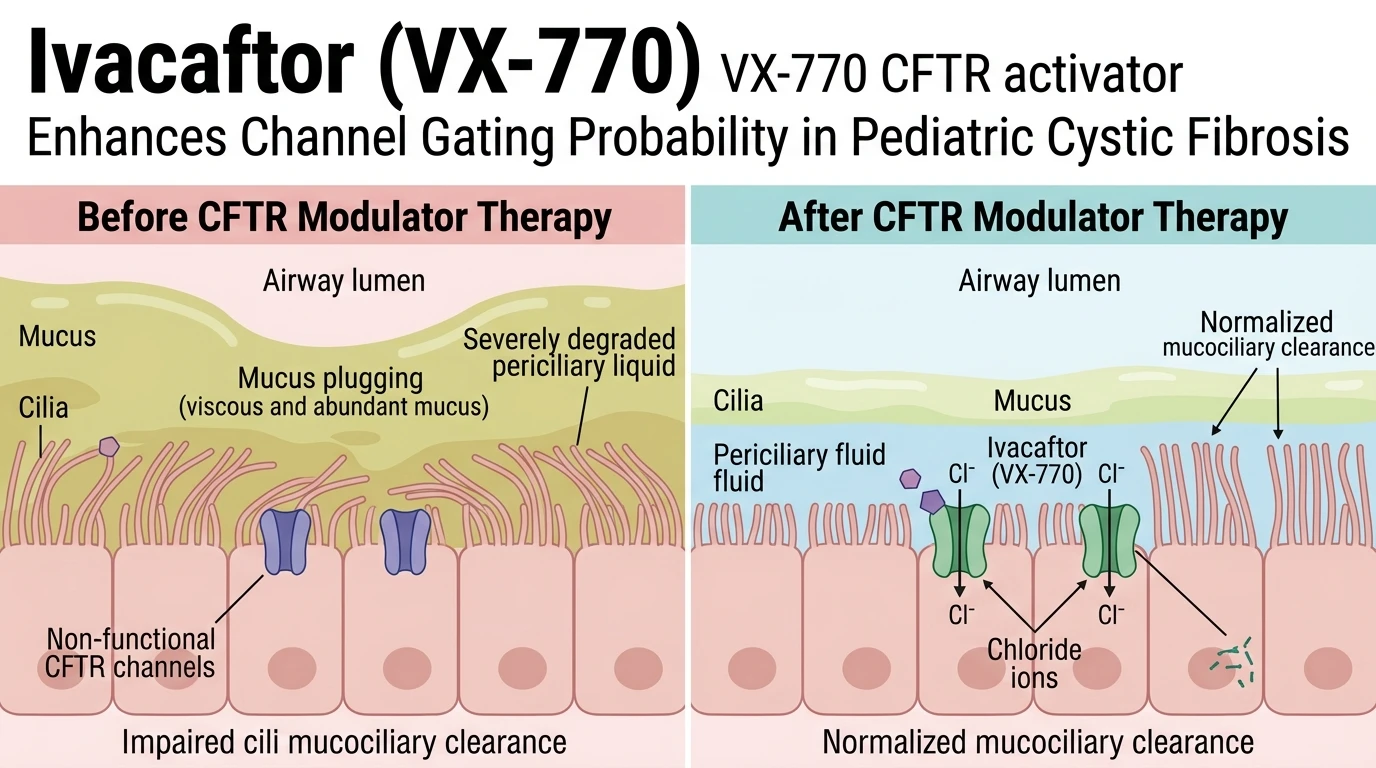
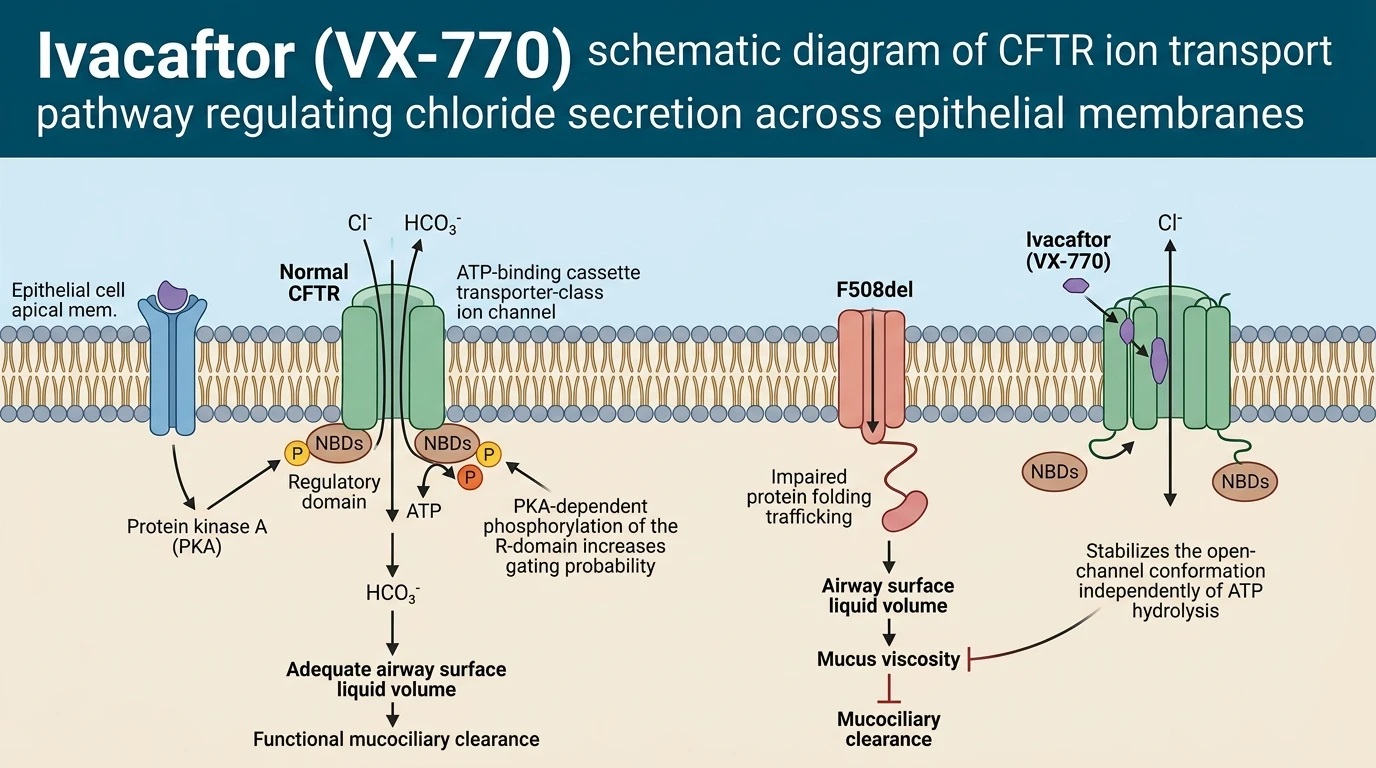
Cystic fibrosis (CF) stems from loss-of-function mutations in the gene encoding the cystic fibrosis transmembrane conductance regulator (CFTR), an apical membrane anion channel crucial for transepithelial salt and fluid balance. The most prevalent alteration, a deletion of phenylalanine at position 508 (F508del), induces misfolding, premature endoplasmic reticulum-associated degradation, and defective gating of the residual channels reaching the plasma membrane. In human sinonasal and bronchial epithelial cells, deficient CFTR-mediated chloride and bicarbonate transport depletes the airway surface liquid (ASL) layer. This depletion leads to mucus hyperviscosity, localized hypoxia, ongoing bacterial colonization, and relentless structural lung damage.
Pharmacological strategies targeting CFTR defects rely on small-molecule modulators classified into correctors and potentiators. Tezacaftor and elexacaftor act as correctors by assisting CFTR processing and trafficking to the cell surface. Conversely, Ivacaftor (VX-770) acts as a potentiator, increasing the open probability of CFTR channels already localized at the cell membrane. Acting as a VX-770 CFTR activator, the molecule stabilizes the open-state conformation of the channel complex, restoring transepithelial anion secretion without relying entirely on ATP hydrolysis mechanisms. While monotherapy with Ivacaftor (VX-770) produces profound clinical responses in gating mutations like G551D, combining it with next-generation correctors in the elexacaftor/tezacaftor/ivacaftor (ETI) triple combination targets both the trafficking and gating defects of the F508del mutation.
In a clinical trial evaluating pediatric patients aged 6 to 11 years harboring at least one F508del allele, ETI therapy exhibited significant disease-modifying capabilities. A primary functional endpoint, the lung clearance index (LCI), measures ventilation inhomogeneity and serves as an sensitive indicator of early small airway dysfunction. Prior to modulator initiation, pediatric patients demonstrated elevated baseline LCI scores, reflecting widespread peripheral airway obstruction and gas trapping. Following ETI administration, LCI values declined rapidly, demonstrating sustained physiological improvements throughout a 12-month observation period. The majority of treated children achieved LCI values within normal physiological limits, indicating a restoration of functional ventilation dynamics.
Complementing functional metrics, chest magnetic resonance imaging (MRI) provided morphological and perfusion insight without exposing pediatric subjects to ionizing radiation. Within 3 months of initiating ETI triple therapy, functional MRI revealed marked reductions in global, morphology, and perfusion scores. The primary morphological drivers behind these score decreases were the clearing of mucus plugs and a reduction in airway wall thickening. Improved luminal clearance restored localized pulmonary blood flow, directly diminishing regional hypoperfusion defects caused by hypoxic pulmonary vasoconstriction.
Despite complete or near-complete normalization of functional parameters like LCI, chest MRI revealed that structural lung abnormalities—such as established bronchiectasis and subtle parenchymal changes—persisted in several patients. This divergence between functional recovery and structural repair highlights important biological boundary conditions. While functional airway obstruction caused by mucus impaction and active mucosal inflammation responds rapidly to CFTR potentiation, chronic structural damage represents permanent architectural remodeling. These empirical observations emphasize that initiating CFTR modulator therapy early in childhood, before irreversible structural damage takes hold, is crucial for preserving long-term pulmonary function in CF patients.
Pediatric ETI Therapy and Airway Remodeling Kinetics
Copy code to add this image to your page
Ivacaftor (VX-770) functions as a CFTR potentiator that directly binds to the transmembrane domain of the CFTR anion channel. By stabilizing the open-channel state, it increases channel gating probability ($P_o$), facilitating chloride and bicarbonate secretion across epithelial membranes. When combined with correctors elexacaftor and tezacaftor in pediatric patients with F508del CFTR, Ivacaftor rehydrates the mucosal layer, clears airway mucus plugs, reduces airway wall thickening, and restores ventilation homogeneity.
Rapid Normalization of Ventilation Homogeneity via LCI Metrics
Functional lung clearance index values dropped rapidly following ETI administration. Baseline LCI scores reflected severe peripheral gas trapping. The inclusion of the VX-770 CFTR activator stabilized surface CFTR open-channel probability. This restoration of anion transport rapidly rehydrated the periciliary liquid layer. Consequently, mucociliary transport resumed across distal airway networks. Within 12 months, functional ventilation homogeneity normalized in most pediatric subjects. However, functional recovery remained bounded by baseline disease severity.
Resolution of Mucus Plugging and Airway Wall Thickening
Chest MRI scores decreased substantially after 3 months of therapy. Global morphology and perfusion metrics reflected rapid structural clearing. Mucus clearance eliminated downstream airway impaction. Decreased mucosal edema directly reduced measured airway wall thickness. Furthermore, regional pulmonary perfusion restored rapidly as local ventilation returned. The VX-770 CFTR activator mediated sustained rehydration of luminal secretions. These imaging metrics confirm profound physiological improvements in small airway conductance.
Persistence of Structural Damage Demands Early Modulator Administration
Irreversible structural changes persisted despite complete functional normalization. Bronchiectasis scores failed to regress fully over the study period. Functional compensation obscured underlying architectural damage in selected patients. These clinical observations highlight clear developmental boundaries. Structural remodeling outpaces functional physiological recovery once wall ectasia establishes. Therefore, early intervention remains vital to prevent permanent tissue degradation.