NEthylmaleimide N-Ethylmaleimide (NEM) Thiol Alkylation and NSF Inhibition
Copy code to add this image to your page
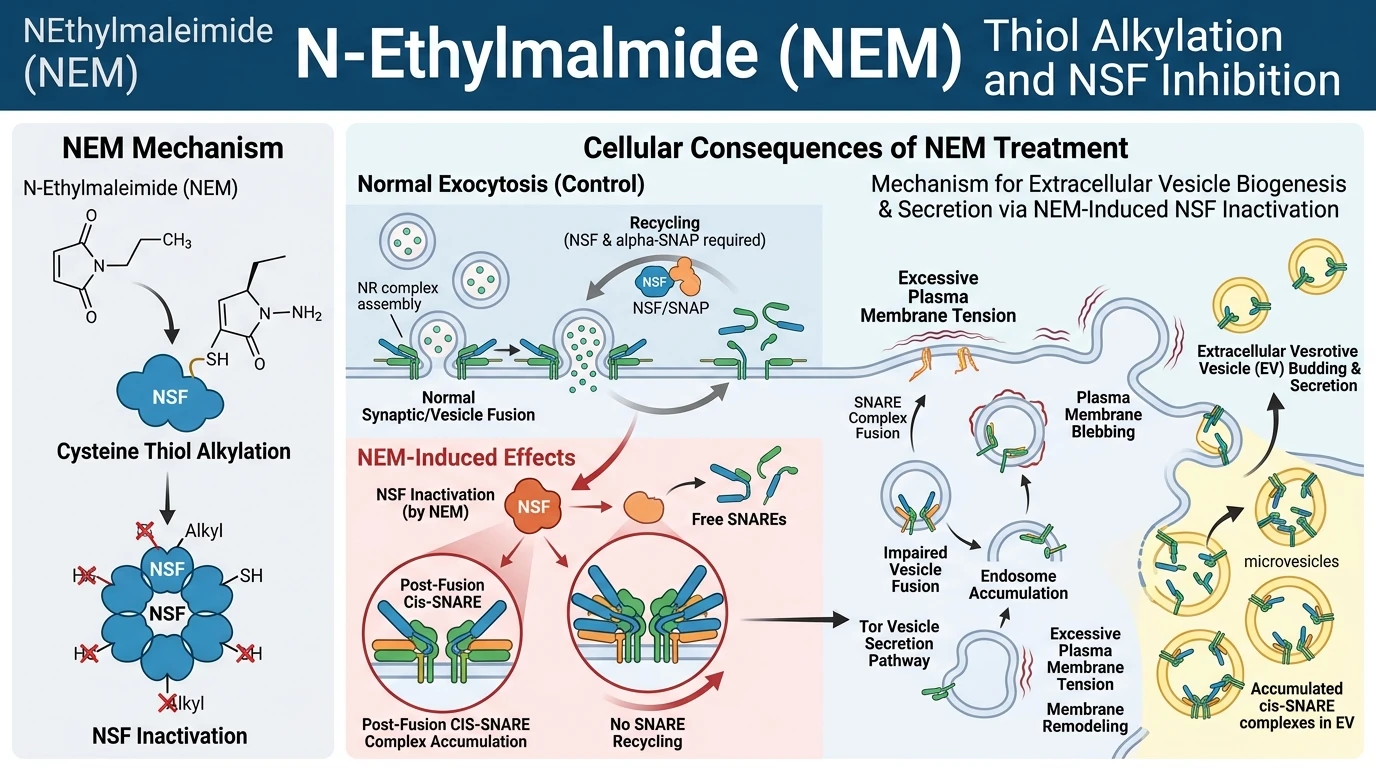
N-Ethylmaleimide (NEM) functions as a low-molecular-weight, membrane-permeable sulfhydryl reagent. Its pharmacological activity depends on electrophilic reactivity toward nucleophilic reduced cysteine thiols (-SH) in cellular environments. At neutral pH, NEM undergoes a rapid, irreversible Michael addition reaction with free sulfhydryl groups. This covalent alkylation yields a stable thioether linkage, effectively consuming free thiol pools and altering protein tertiary structure and catalytic activity. Pharmacologists routinely employ N-Ethylmaleimide (NEM) to trap redox-sensitive cysteines, freeze dynamic conformational transitions, and dissect intracellular transport cascades across various cell types.
A primary molecular target of NEM is the N-ethylmaleimide-sensitive factor (NSF), an AAA+ homohexameric ATPase. NSF governs the essential recycling of soluble N-ethylmaleimide-sensitive factor attachment protein receptor (SNARE) proteins following membrane fusion events. Under baseline physiological conditions, intracellular membrane trafficking relies on the assembly of trans-SNARE complexes between vesicle membranes and target organelle membranes. Following lipid bilayer fusion, these assemblies convert into highly stable cis-SNARE bundles. To maintain continuous membrane traffic, NSF, aided by its co-factor alpha-SNAP, binds to the cis-SNARE bundle to form a transient 20S supercomplex. NSF utilizes ATP hydrolysis to generate mechanical force, unspooling the tight four-helix bundle into monomeric SNARE components.
When NEM alkylates key cysteine residues—specifically Cys264 within the D1 ATPase domain of NSF—catalytic turnover halts entirely. Covalent modification blocks ATP hydrolysis without abolishing initial substrate binding. As a result, 20S complexes accumulate irreversibly on intracellular membranes. The loss of functional NSF stops SNARE bundle recycling, resulting in rapid depletion of free SNARE monomers at target membranes. In mammalian cell models, this selective blockade inhibits exocytosis, endosomal trafficking, and Golgi cisternae reassembly during cell division. Early functional characterization of this mechanism established fundamental rules of biochemical membrane fusion mechanisms across eukaryotic systems.
Beyond NSF, NEM-mediated thiol alkylation extends to broader cellular targets. The compound readily penetrates the hydrophobic core of the plasma membrane, reacting with intramembranous and cytoplasmic cysteine thiols. Key targets include plasma membrane flippases (aminophospholipid translocases), cytoskeletal anchoring elements, and intracellular cysteine proteases such as calpains. Under uninhibited conditions, flippases continuously hydrolyze ATP to translocate phosphatidylserine from the outer leaflet to the inner leaflet of the plasma membrane. Alkylation of flippase active-site cysteines disrupts this asymmetric lipid distribution, resulting in passive exposure of phosphatidylserine on the extracellular surface.
Concurrently, NEM modifies the actin-cytoskeleton linkage. Cytoskeletal proteins such as spectrin, vinculin, and non-muscle myosin II contain exposed cysteine thiols susceptible to NEM attack. Modification of these sites induces local detachment of the actomyosin cortex from the inner plasma membrane leaflet. Hydrostatic pressure within the cytoplasm then forces the unanchored lipid bilayer outward, manifesting as prominent plasma membrane blebs. This morphological reorganization promotes the shedding of microvesicles and extracellular vesicles (EVs) into the extracellular space.
In experimental settings, NEM-induced vesicle generation serves as a valuable model for analyzing non-classical secretion pathways. Unlike exosome biogenesis, which requires multivesicular body endosomal sorting, NEM-driven EV release proceeds directly from outward budding of the cell surface. However, because NEM indiscriminately modifies exposed reactive thiols, researchers must interpret functional responses with careful concentration-dependent controls. At low micromolar concentrations, NEM specifically probes hyper-reactive cysteines, whereas millimolar concentrations provoke widespread proteomic alkylation, triggering metabolic disruption. Understanding the dose-dependent kinetics of NEM engagement remains essential for differentiating target-specific signaling events from global cellular structural collapse.
Pharmacological Profiling and Cellular Membrane Remodeling
Copy code to add this image to your page
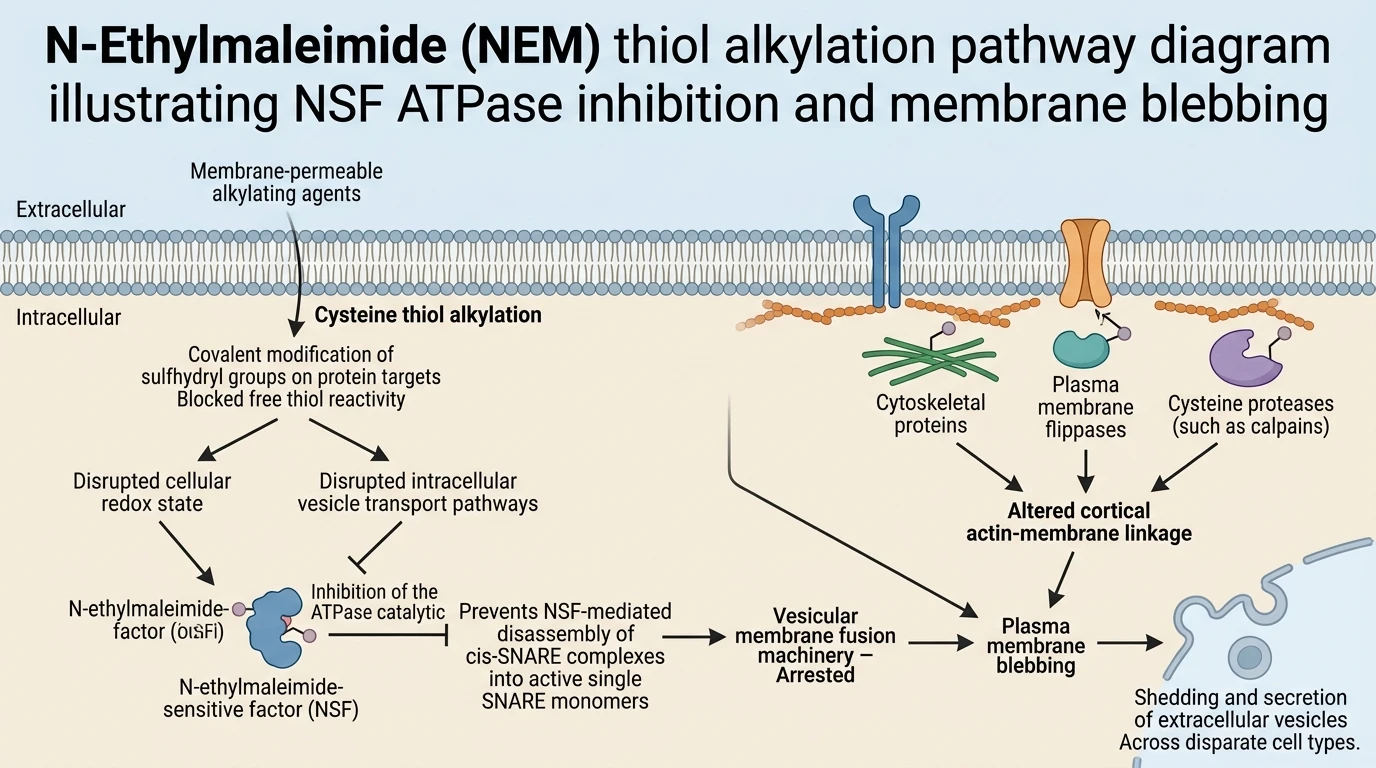
N-Ethylmaleimide (NEM) acts as a cell-permeable electrophilic alkylating agent that covalently targets reduced cysteine sulfhydryl (-SH) groups through Michael addition. Reaction with catalytic cysteines irreversibly inactivates N-ethylmaleimide-sensitive factor (NSF), an essential ATPase required for SNARE complex disassembly and membrane fusion machinery. Simultaneously, NEM-mediated alkylation of cytoskeletal proteins, plasma membrane flippases, and calpain proteases destabilizes the submembrane actin network. This disruption promotes localized detachment of the lipid bilayer, driving plasma membrane blebbing and triggering the rapid release of extracellular vesicles.
Covalent NSF Inactivation Prevents SNARE Complex Recycling
Application of NEthylmaleimide at low micromolar concentrations targets reactive cysteines within the D1 domain of NSF. This alkylation event completely abolishes ATPase catalytic activity. Consequently, assembled cis-SNARE complexes remain locked on target membranes. Vesicle fusion machinery stalls within minutes of treatment. In cultured neuronal preparations, this arrest halts synaptic vesicle recycling and neurotransmitter release. Analysis under tested in vitro assay conditions demonstrates that NSF binding to alpha-SNAP remains intact, yet mechanical unwinding fails. The accumulation of stable 20S intermediates provides direct empirical proof of NSF catalytic dependency during vesicle priming.
Cytoskeletal Retraction Drives Plasma Membrane EV Shedding
Membrane-permeable alkylation by NEthylmaleimide rapidly alters cortical actin dynamics and plasma membrane asymmetry. Modification of active-site thiols on aminophospholipid translocases leads to rapid phosphatidylserine externalization. Simultaneously, NEM inhibits endogenous calpains while cross-linking sub-membranous cytoskeletal linkers. Disruption of cortical actin attachment allows internal hydrostatic pressure to push the lipid bilayer outward. Membrane blebs form within 5 to 15 minutes across various cell types. These blebs subsequently pinch off, releasing large populations of extracellular vesicles into the supernatant. Within this specific cellular context, NEM serves as a potent chemical driver for studying direct plasma membrane microvesiculation.