CC-5013 (Lenalidomide) Mobilization of CD34+ Hematopoietic Stem Cells Post-RVD Induction
Copy code to add this image to your page
Autologous stem cell transplantation remains a cornerstone in the consolidation therapy of eligible multiple myeloma patients. Modern induction regimens incorporating the immunomodulatory agent CC-5013 (Lenalidomide) combined with bortezomib and dexamethasone (RVD) yield high response rates prior to consolidation. However, prolonged exposure to immunomodulatory drugs frequently impairs the mobilization efficiency of CD34+ hematopoietic stem/progenitor cells. Chemokine axis alterations and bone marrow microenvironment changes induced by long-term treatment elevate the risk of apheresis failure. Identifying optimal mobilization strategies following short-course induction therapy represents an essential clinical requirement.
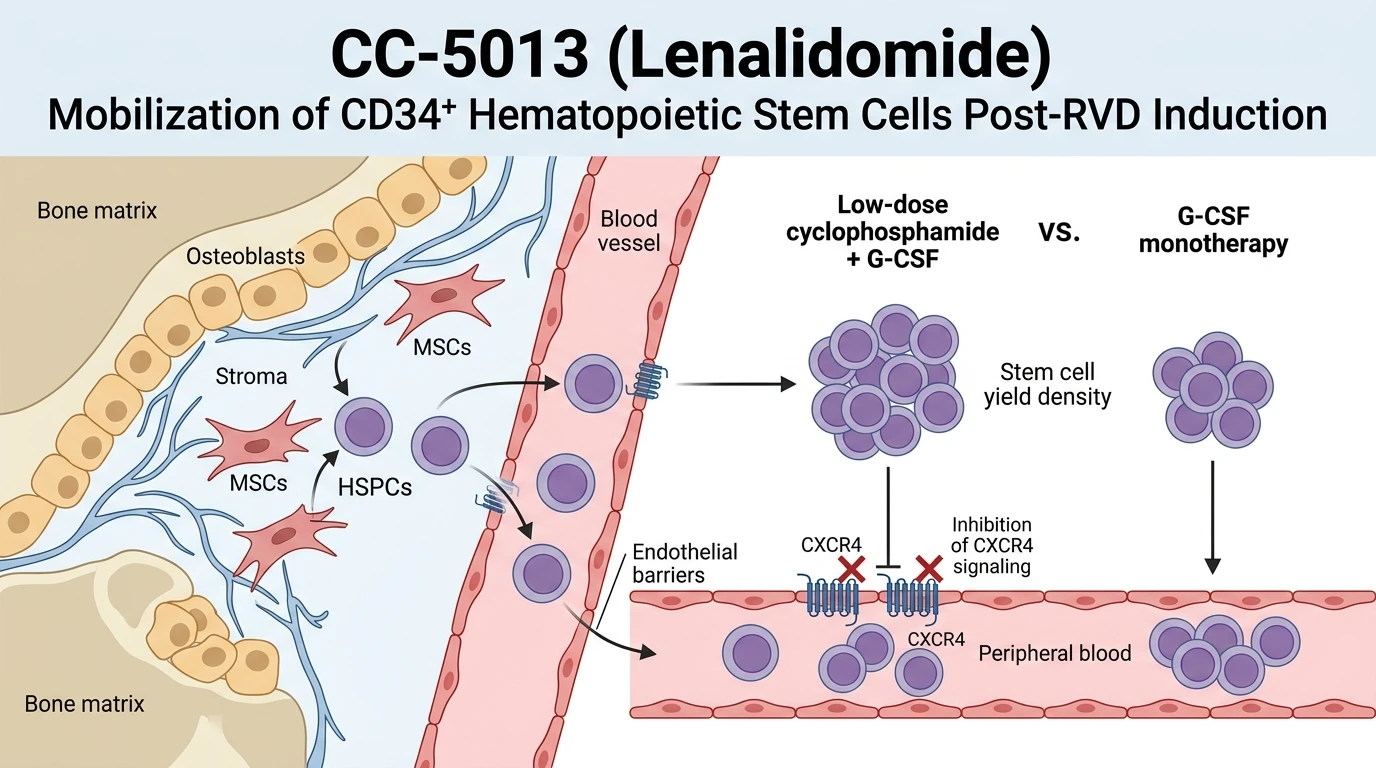
A randomized phase II trial systematically evaluated mobilization protocols in patients with multiple myeloma following RVD induction. The trial targeted the collection of CD34+ hematopoietic stem/progenitor cells necessary for single or tandem autologous transplantation. Investigators randomized patients into two cohorts post-RVD induction: Arm A received low-dose cyclophosphamide at 2 g/m² combined with granulocyte colony-stimulating factor (G-CSF), while Arm B received G-CSF monotherapy. The primary study endpoint examined the proportion of patients achieving an optimal yield defined as ≥ 3 × 10⁶ CD34+ cells/kg collected within one or two apheresis procedures. Under these protocol conditions, 94% of patients in Arm A achieved the primary endpoint compared to 77% of patients in Arm B. Although this difference did not cross standard statistical significance thresholds (P = 0.084), secondary pharmacodynamic metrics demonstrated pronounced benefits with the chemo-mobilization approach.
Secondary endpoints revealed substantial operational and quantitative advantages for the cyclophosphamide-containing regimen. Arm A required significantly fewer median apheresis sessions to meet collection targets (1 session vs. 2 sessions, P = 0.035). The first-apheresis yield was markedly superior in Arm A, generating a mean of 4.0 × 10⁶ CD34+ cells/kg versus 2.7 × 10⁶ CD34+ cells/kg in Arm B (P = 0.023). Total harvested stem cell density reflected a similar trajectory, reaching 6.7 × 10⁶ CD34+ cells/kg in the chemo-mobilization group compared with 5.3 × 10⁶ CD34+ cells/kg in the monotherapy group (P = 0.012). These empirical metrics confirm that low-dose cyclophosphamide accelerates progenitor release into peripheral circulation.
Despite the quantitative superiority of chemo-mobilization, safety parameters and minimal thresholds warrant careful interpretation. All patients across both treatment arms attained the mandatory minimal safety collection target of ≥ 2 × 10⁶ CD34+ cells/kg. Need for CXCR4 antagonist rescue using plerixafor remained low overall, registered at 6% in Arm A and 14% in Arm B. While low-dose cyclophosphamide enhances stem cell release efficiency, G-CSF monotherapy provides sufficient progenitor yield for most patients undergoing limited induction with CC-5013. Tailoring mobilization strategies based on patient-specific targets and logistical requirements remains a key clinical consideration.
Progenitor Harvesting Kinetics and Protocol Efficacy Synthesis
Copy code to add this image to your page
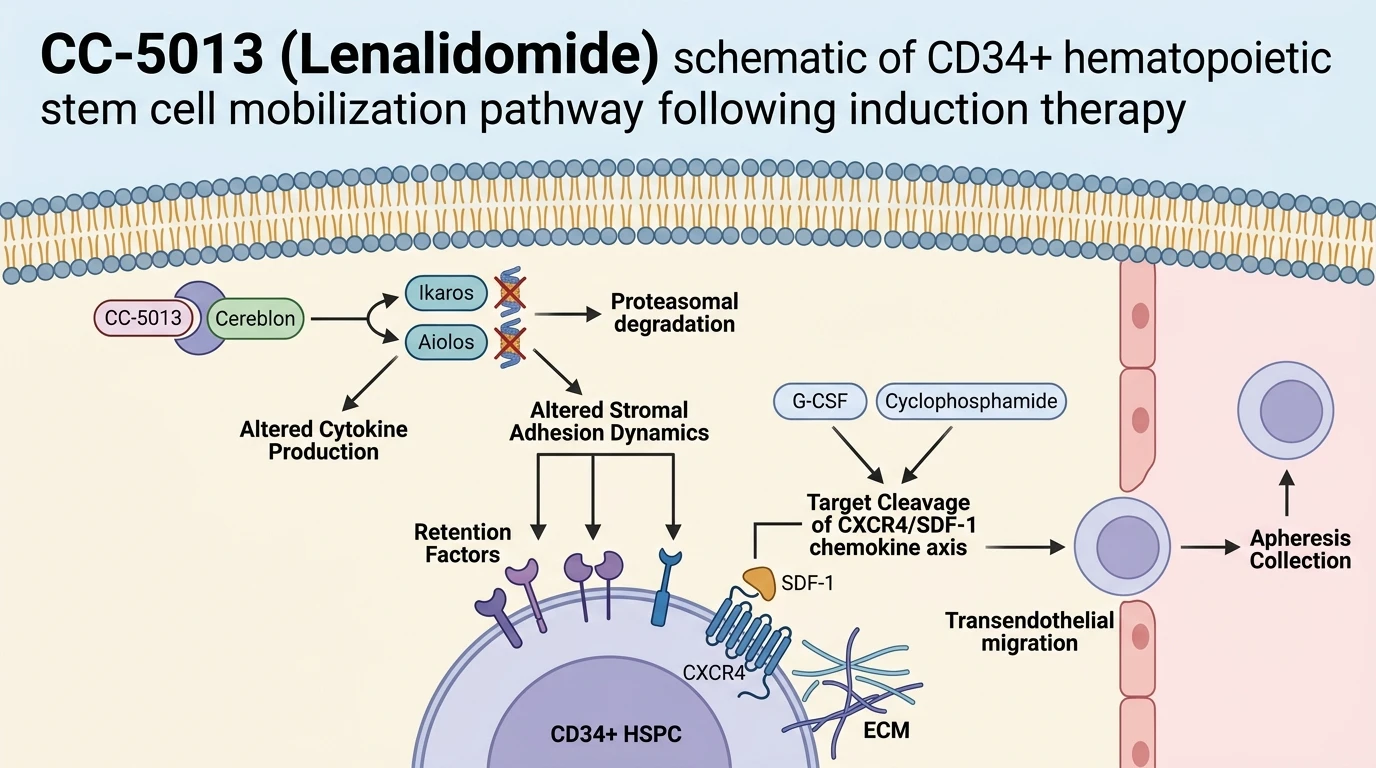
Lenalidomide modulates bone marrow microenvironment signals by inducing cereblon-dependent degradation of Ikaros and Aiolos transcription factors. This alters cytokine release and adhesion molecule expression on CD34+ hematopoietic stem/progenitor cells. When combined with mobilization protocols, cyclophosphamide and G-CSF disrupt the CXCR4/SDF-1 retention axis, forcing stem cells from endosteal niches into peripheral circulation for collection.
Cyclophosphamide Addition Accelerates Single-Session Harvesting Yields
Inclusion of low-dose cyclophosphamide at 2 g/m² significantly alters CD34+ hematopoietic stem/progenitor cell egress kinetics into peripheral blood. The first-apheresis harvest yielded a mean of 4.0 × 10⁶ cells/kg in the combination cohort compared to 2.7 × 10⁶ cells/kg with G-CSF alone. Single-day procedural success reduces operational healthcare burden. Median apheresis requirements dropped from two sessions down to one session in Arm A (P = 0.035). Total stem cell yields reached 6.7 × 10⁶ cells/kg versus 5.3 × 10⁶ cells/kg (P = 0.012). Mobilization failure rates remained negligible under tested clinical conditions. These quantitative findings demonstrate that chemo-mobilization overcomes transient marrow suppression linked to CC-5013 exposure during prior induction therapy.
G-CSF Monotherapy Preserves Efficacy Following Short Induction
G-CSF monotherapy demonstrated reliable collection rates without requiring alkylating agent administration. All evaluated trial subjects met the established minimum safety threshold of ≥ 2 × 10⁶ CD34+ cells/kg. Need for CXCR4 inhibitor rescue with plerixafor remained limited to 14% in the monotherapy arm versus 6% in the chemo-mobilization arm. Avoiding cyclophosphamide prevents added hematologic toxicity, febrile neutropenia risk, and unnecessary inpatient monitoring. For multiple myeloma patients receiving four to six cycles of CC-5013 induction, G-CSF monotherapy remains a viable standard. Patient selection should balance harvested cell density targets against potential chemotherapeutic adverse events.