Birabresib (OTX015) Inhibition of BET Proteins Downregulates Melanoma Antigen Presentation Machinery
Copy code to add this image to your page
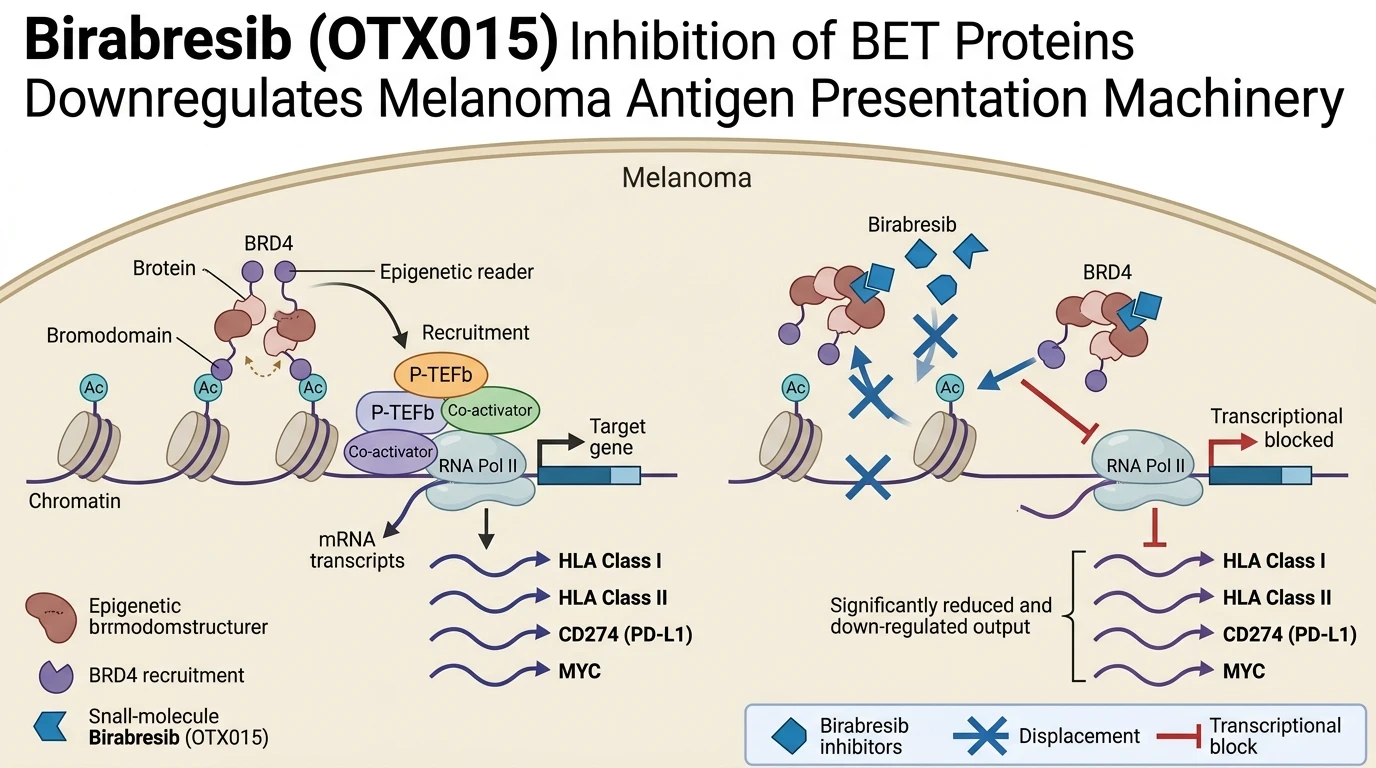
Small-molecule targeting of epigenetic reader proteins represents a precise biochemical strategy for dissecting transcriptional regulatory networks in cutaneous melanoma. The compound Birabresib (OTX015) acts as an orally bioavailable, competitive inhibitor of Bromodomain and Extra-Terminal (BET) family proteins, specifically targeting BRD2, BRD3, and BRD4. By selectively occluding the hydrophobic acetyl-lysine binding pockets of these bromodomains, the agent disrupts chromatin occupancy and prevents downstream recruitment of the super elongation complex (SEC). Comparative transcriptomic and proteomic profiling demonstrates that BET bromodomain inhibition produces an immunosuppressive gene expression profile in melanoma models, directly opposing the proinflammatory profiles elicited by alternative epigenetic classes.
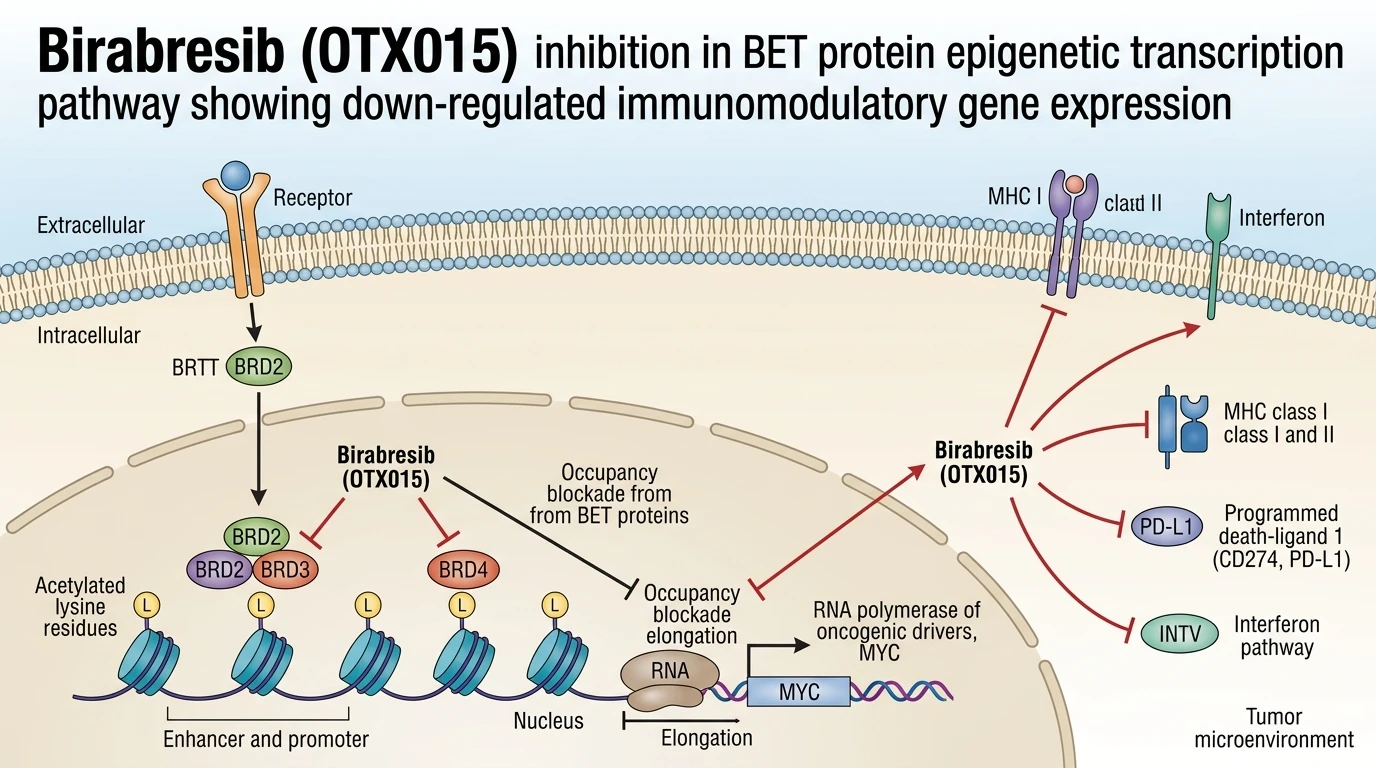
Mechanistic evaluations reveal that Birabresib broadly suppresses inflammatory signaling nodes and antigen processing machinery within tumor cells. Treatment at nanomolar concentrations yields marked reductions in transcripts encoding Human Leukocyte Antigen (HLA) Class I and Class II heterodimers, alongside essential components of the antigen presentation complex. Downregulation extends to programmed death-ligand 1 (PD-L1, CD274) and key signaling mediators of the type I and type II interferon (IFN) pathways. This concerted attenuation of immune-related transcription contrasts sharply with DNA methyltransferase (DNMT) inhibitors, such as guadecitabine. While guadecitabine triggers double-stranded RNA sensing pathways, Toll-like receptor (TLR) cascades, and NF-κB-dependent innate immune responses, BET inhibitors act predominantly as transcriptional repressors of these same loci.
Proteomic quantification confirms that the observed transcript attenuation translates to reduced cell-surface receptor density and depleted intracellular signaling cascades. Depletion of oncogenic drivers like MYC occurs concurrently with the loss of interferon-stimulated gene products. Because proper antigen presentation and baseline IFN signaling are critical prerequisites for effective T-cell recognition, the immunosuppressive activity of epigenetic transcriptional regulation via BET blockade highlights important boundary conditions for clinical application. Understanding these opposing immunological signatures is necessary when designing combination regimens incorporating immune checkpoint blockade.
Transcriptomic Analysis of Epigenetic Immune Suppression
Copy code to add this image to your page
Birabresib (OTX015) displaces BRD2, BRD3, and BRD4 from acetylated histones on chromatin. This action halts RNA polymerase II transcription of oncogenic drivers like MYC. Epigenetically, BET blockade represses immune-related transcriptional programs, downregulating HLA Class I/II antigens, antigen processing components, PD-L1 (CD274), and interferon signaling elements. Unlike DNMT inhibitors that stimulate innate immune cascades, BET inhibition drives anti-inflammatory and immunosuppressive state transitions in melanoma cells.
BET Inhibition Suppresses Major Histocompatibility Complex Expression
Transcriptional profiling indicates robust repression of antigen processing loci following BET bromodomain occupancy. Treatment with Birabresib yields prompt depletion of HLA-A, HLA-B, and HLA-C transcripts within 24 hours. Antigen presenting machinery components collapse similarly. Quantitative PCR reveals dose-dependent suppression under in vitro assay conditions. Chromatin immunoprecipitation assays confirm displacement of BRD4 from core promoter regions. This loss of recruitment destabilizes the local transcription complex. Surface expression of MHC Class I molecules decreased by over 60 percent across tested melanoma cell lines. Downstream T-cell engagement was compromised in co-culture models. These empirical findings demonstrate that BET readers actively sustain baseline expression of antigen presentation structures.
Transcriptional Downregulation of Programmed Death-Ligand 1 Dynamics
Epigenetic control of immune checkpoint molecules depends heavily on BET protein activity. Administration of Birabresib disrupts BRD4 binding at the CD274 promoter region in patient-derived melanoma models. CD274 mRNA levels fell significantly within 12 hours of exposure. Western blot analysis verified parallel loss of total PD-L1 protein. Flow cytometry confirmed a reduction in cell-surface PD-L1 density. Interferon-gamma-induced upregulation of PD-L1 was similarly blunted by bromodomain blockade. The selectivity margin remained intact across non-transformed melanocyte controls. These transcriptomic responses clarify that BET proteins are mandatory co-activators for constitutive and inducible checkpoint expression.
Divergent Immunological Signatures Between BET and DNMT Inhibitors
Comparative profiling highlights distinct immunological trajectories across epigenetic drug classes. While DNMT inhibitors like guadecitabine trigger viral mimicry responses and activate NF-κB signaling, BET displacement enforces transcriptional silencing of immune cascades. Interferon pathway components, including STAT1 and IRF1, showed marked expression decreases under BET blockade. In contrast, guadecitabine upregulated these identical target networks in human melanoma isolates. Dual transcriptomic and proteomic measurements confirm that BET suppression dominates over hypomethylation-induced immune activation. These empirical measurements establish clear biological boundaries for combining epigenetic drugs with immune checkpoint inhibitors.