Bcl-2 Inhibitors
The B-cell lymphoma 2 (Bcl-2) family of proteins are master regulators of the intrinsic (mitochondrial) apoptotic pathway, dictating cell fate by controlling mitochondrial outer membrane permeabilization (MOMP). This family comprises both anti-apoptotic proteins (e.g., Bcl-2, Bcl-xL, Mcl-1, Bcl-w, A1) and pro-apoptotic proteins. The pro-apoptotic proteins are further divided into multi-domain effectors (e.g., Bax, Bak) and BH3-only proteins (e.g., Bad, Bid, Bim, Noxa, Puma). In healthy cells, anti-apoptotic Bcl-2 family members sequester pro-apoptotic BH3-only proteins, preventing them from activating Bax and Bak. Upon apoptotic stimuli, BH3-only proteins are activated, displacing and neutralizing the anti-apoptotic proteins, thereby allowing Bax and Bak to oligomerize and form pores in the mitochondrial outer membrane. This leads to the release of cytochrome c and other pro-apoptotic factors into the cytoplasm, which then activate caspases and initiate the apoptotic cascade. Bcl-2 inhibitors, often termed BH3 mimetics, are small molecules designed to mimic the BH3 domain of pro-apoptotic proteins.
They bind to the hydrophobic groove of anti-apoptotic Bcl-2 family members, displacing endogenous BH3-only proteins and thereby unleashing Bax and Bak to trigger apoptosis. Dysregulation of the Bcl-2 family, particularly overexpression of anti-apoptotic members, is a hallmark of many cancers, contributing to tumor cell survival, proliferation, and resistance to conventional therapies. Consequently, Bcl-2 inhibitors are primarily developed for the treatment of various hematological malignancies and certain solid tumors. They have shown particular promise in chronic lymphocytic leukemia (CLL), acute myeloid leukemia (AML), and various lymphomas, where Bcl-2 or Mcl-1 are frequently overexpressed. Research into Bcl-2 inhibitors has led to significant clinical breakthroughs. Venetoclax (ABT-199) is a highly selective, first-in-class Bcl-2 inhibitor that has revolutionized the treatment of CLL and AML. It received accelerated FDA approval for relapsed/refractory CLL with 17p deletion and later for newly diagnosed CLL, as well as for newly diagnosed AML in combination with hypomethylating agents or low-dose cytarabine.
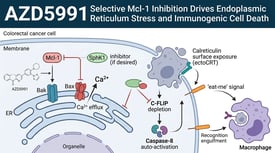
Navitoclax (ABT-263) was an earlier dual Bcl-2/Bcl-xL inhibitor, but its clinical utility was limited by dose-limiting thrombocytopenia due to Bcl-xL's role in platelet survival. This led to the development of more selective inhibitors. Given that Mcl-1 overexpression can confer resistance to Bcl-2 inhibitors, selective Mcl-1 inhibitors (e.g., S63845, AZD5991, AMG 176) are now in clinical development for various cancers, often in combination with Bcl-2 inhibitors. Bcl-2 inhibitors are classified primarily by their selectivity for different anti-apoptotic Bcl-2 family members: (1) selective Bcl-2 inhibitors (e.g., venetoclax); (2) dual Bcl-2/Bcl-xL inhibitors (e.g., navitoclax); and (3) selective Mcl-1 inhibitors. Pan-Bcl-2 family inhibitors are generally avoided due to broad toxicity. Key research tool compounds include ABT-737 and its orally bioavailable derivative ABT-263. Challenges include on-target toxicities (e.g., thrombocytopenia with Bcl-xL inhibition), tumor lysis syndrome (TLS) with venetoclax (managed by careful dose escalation), and the emergence of resistance mechanisms, such as upregulation of other anti-apoptotic proteins (e.g., Mcl-1, Bcl-xL) or mutations in Bcl-2.
Combination therapies, such as venetoclax with BTK inhibitors, CD20 antibodies, or chemotherapy, are crucial strategies to enhance efficacy, overcome resistance, and achieve deeper, more durable responses.