AG-120 (Ivosidenib) AG-120 Dehydrogenase inhibitor targeted suppression of mIDH1 acute myeloid leukemia
Copy code to add this image to your page
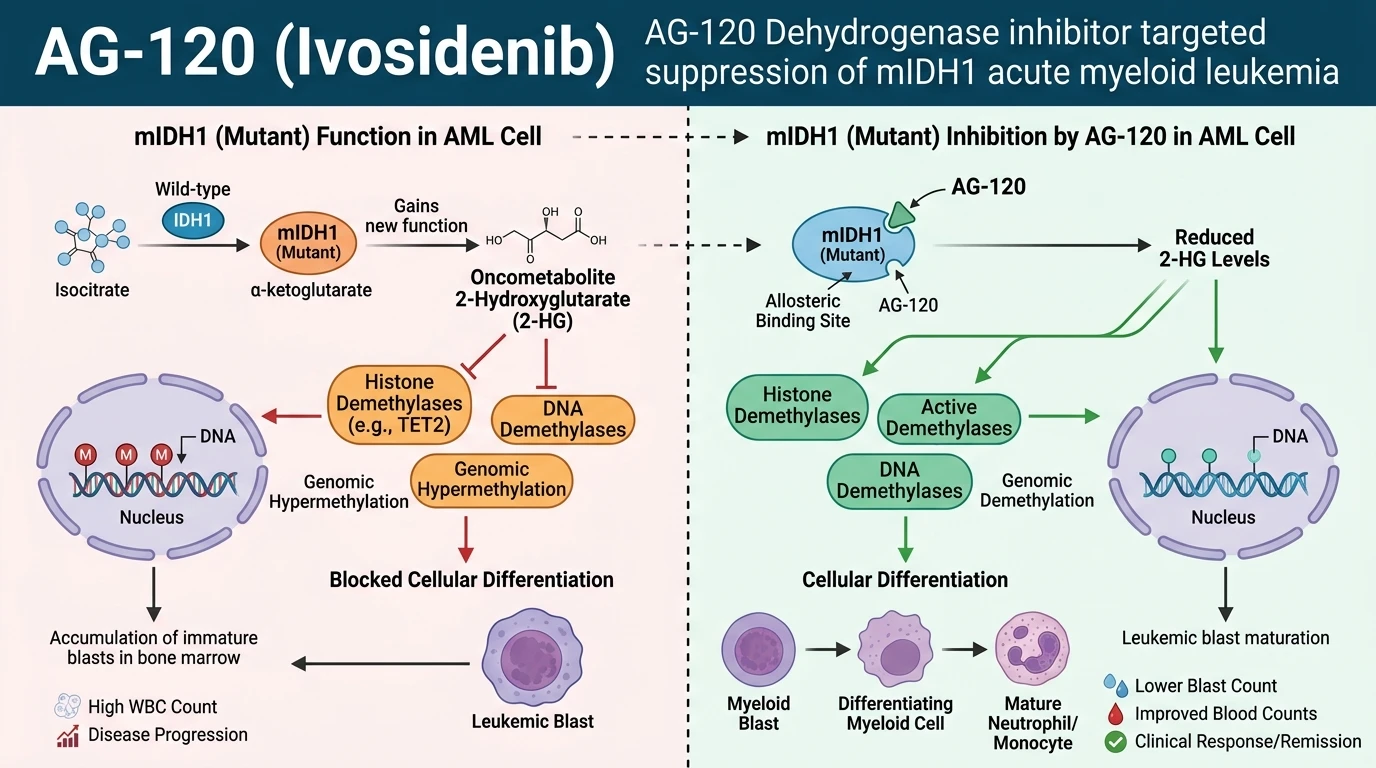
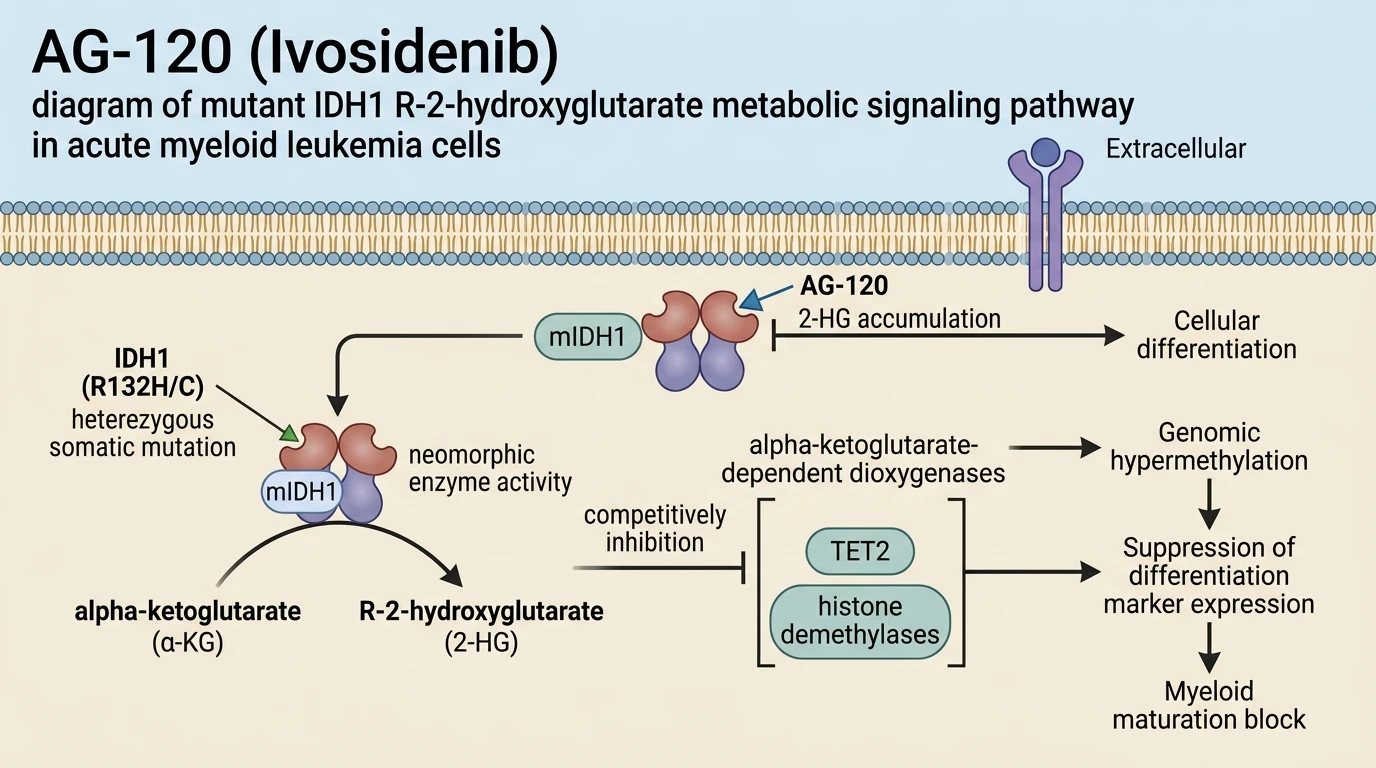
Isocitrate dehydrogenase 1 (IDH1) is a critical metabolic enzyme that catalyzes the NADP+-dependent oxidative decarboxylation of isocitrate to alpha-ketoglutarate (alpha-KG) within the cytoplasm and peroxisomes. In acute myeloid leukemia (AML), somatic missense mutations occurring at the active site residue Arg132—most frequently substitution to histidine (R132H) or cysteine (R132C)—alter enzymatic active site geometry. This modification leads to a dominant gain-of-function neomorphic activity. Rather than producing alpha-KG, the mutant enzyme utilizes NADPH to reduce alpha-KG into the oncometabolite (2R)-2-hydroxyglutarate (2-HG). Under physiological conditions, 2-HG is maintained at nanomolar concentrations; however, mIDH1 activity drives millimolar accumulation within leukemic progenitor cells.
Accumulated intracellular 2-HG acts as a competitive inhibitor of alpha-KG-dependent dioxygenases due to structural mimicry. Key enzyme families impacted include the ten-eleven translocation (TET) family of DNA hydroxylases and Jumonji C (JmjC) domain-containing histone lysine demethylases. Inhibition of TET2 activity prevents the conversion of 5-methylcytosine to 5-hydroxymethylcytosine, prompting widespread genomic hypermethylation. This epigenetic silencing suppresses lineage-specific transcription factors, enforcing a robust maturation arrest in hematopoietic progenitor cells. Biochemical data confirm that cellular differentiation remains blocked as long as 2-HG levels remain elevated.
AG-120 (Ivosidenib) was engineered as a potent, oral, highly selective, allosteric inhibitor of mutant IDH1. Structural characterization reveals that the molecule binds to a hydrophobic pocket at the homodimer interface of mIDH1, stabilizing the uncompetitive enzyme conformation and preventing the catalytic conversion of alpha-KG to 2-HG. Detailed chemical and biological properties are documented in the small-molecule IDH1 inhibitor database entry. Pharmacological administration of the AG-120 Dehydrogenase inhibitor results in rapid clearance of intracellular 2-HG in patient-derived blast cells. Subsequent relief of TET2 inhibition leads to progressive loss of DNA hypermethylation, re-expression of myeloid differentiation markers (such as CD11b and CD14), and restoration of normal granulocytic maturation.
While single-agent clinical activity established proof-of-concept in relapsed or refractory setting, optimized therapeutic regimens incorporate combination approaches. The Phase 3b ALIDHE trial (NCT05907057) investigates ivosidenib combined with the hypomethylating agent azacitidine in newly diagnosed mIDH1-mutated AML patients who are ineligible for intensive chemotherapy. Azacitidine incorporates into DNA to inhibit DNA methyltransferase 1 (DNMT1), inducing passive hypomethylation during cellular replication. When combined with AG-120, dual epigenetic targeted inhibition addresses both the production of 2-HG and the propagation of DNA methylation patterns, demonstrating additive baseline activity in pre-clinical xenograft assays.
A central feature of the ALIDHE protocol design is its active integration of patient perspectives directly into clinical study architecture. Developed in partnership with the Acute Leukemia Advocates Network (ALAN), the trial incorporates patient feedback to mitigate procedural burdens. Conventional phase 3 trial structures frequently enforce demanding visit schedules that strain patient compliance and elevate trial discontinuation rates. The ALIDHE framework optimizes visit frequency, streamlines blood sampling protocols, and reduces site visit durations while preserving core pharmacodynamic and safety monitoring endpoints.
Furthermore, the ALIDHE trial integrates structured patient-reported outcome (PRO) measures to capture functional status, health utility, and quality of life metrics. Key tools deployed include the Hematological Malignancy Patient-Reported Outcomes (HM-PRO), EuroQol 5-Dimension 5-Level (EQ-5D-5L), and Family-Reported Outcome Measure (FROM-16). Evaluating caregiver burden alongside individual psychological and physical parameters provides a comprehensive dataset on therapeutic benefit. This user-aligned framework illustrates how incorporating end-user feedback into early trial design improves feasibility, participant retention, and data quality in oncology trials.
Therapeutic Evaluation and Pharmacological Characterization
Copy code to add this image to your page
AG-120 (Ivosidenib) is an oral, selective allosteric inhibitor of mutant IDH1 (mIDH1) enzymes. By binding to the dimer interface of mIDH1, it blocks the NADPH-dependent reduction of alpha-ketoglutarate to the oncometabolite (2R)-2-hydroxyglutarate (2-HG). Depletion of intracellular 2-HG reverses the competitive inhibition of alpha-KG-dependent dioxygenases, such as TET2. This enables DNA and histone demethylation, restoring normal hematopoietic gene expression and inducing myeloid blast differentiation in mIDH1-mutated acute myeloid leukemia.
Allosteric Engagement Traps Inactive Enzyme Dimer Conformation
AG-120 engages mutant IDH1 through high-affinity binding at the homodimer interface. Structural crystallography demonstrates that binding occurs allosterically, preventing the conformational transitions necessary for NADPH-dependent catalysis. Intracellular 2-HG levels drop by over 90% within 48 hours of treatment in primary cell cultures. Blast cells resume normal maturation pathways upon 2-HG clearance. Experimental models confirm that catalytic suppression depends on continuous target occupancy by the AG-120 Dehydrogenase inhibitor. Reversible binding kinetics necessitate maintained steady-state plasma concentrations to prevent rebound accumulation of the oncometabolite.
Epigenetic Remodeling Restores Myeloid Lineage Differentiation
Sustained suppression of 2-HG relieves competitive inhibition on TET2 and JmjC demethylases. In patient-derived mIDH1 blast samples, demethylation of hypermethylated gene promoters occurs gradually over multiple cellular divisions. Expression of primary lineage markers increases significantly within two weeks of exposure under tested in vitro assay conditions. Cell division rates slow as progenitor blasts enter terminal granulocytic differentiation. Apoptotic markers remain minimal during early differentiation stages, confirming that blast clearance occurs primarily through maturation rather than direct cytotoxic lysis.
Patient-Centric Protocol Architecture Optimizes Retention and Reporting
The ALIDHE study architecture demonstrates how clinical feasibility improves through patient advocacy collaboration. Incorporating input from the Acute Leukemia Advocates Network established optimized visit intervals and localized lab testing options. Physical fatigue metrics evaluated via HM-PRO showed stabilized baseline scores throughout the initial treatment cycles. Family burden metrics assessed through FROM-16 correlated with reduced travel demands and streamlined clinical monitoring. Alignment of protocol mechanics with patient functional capacities directly reduces early trial withdrawal while yielding robust quality-of-life datasets.