Dyngo-4a (Hydroxy-Dynasore) from Selleck Drives Translocation of Lysosomal TMEM175 Channels
Copy code to add this image to your page
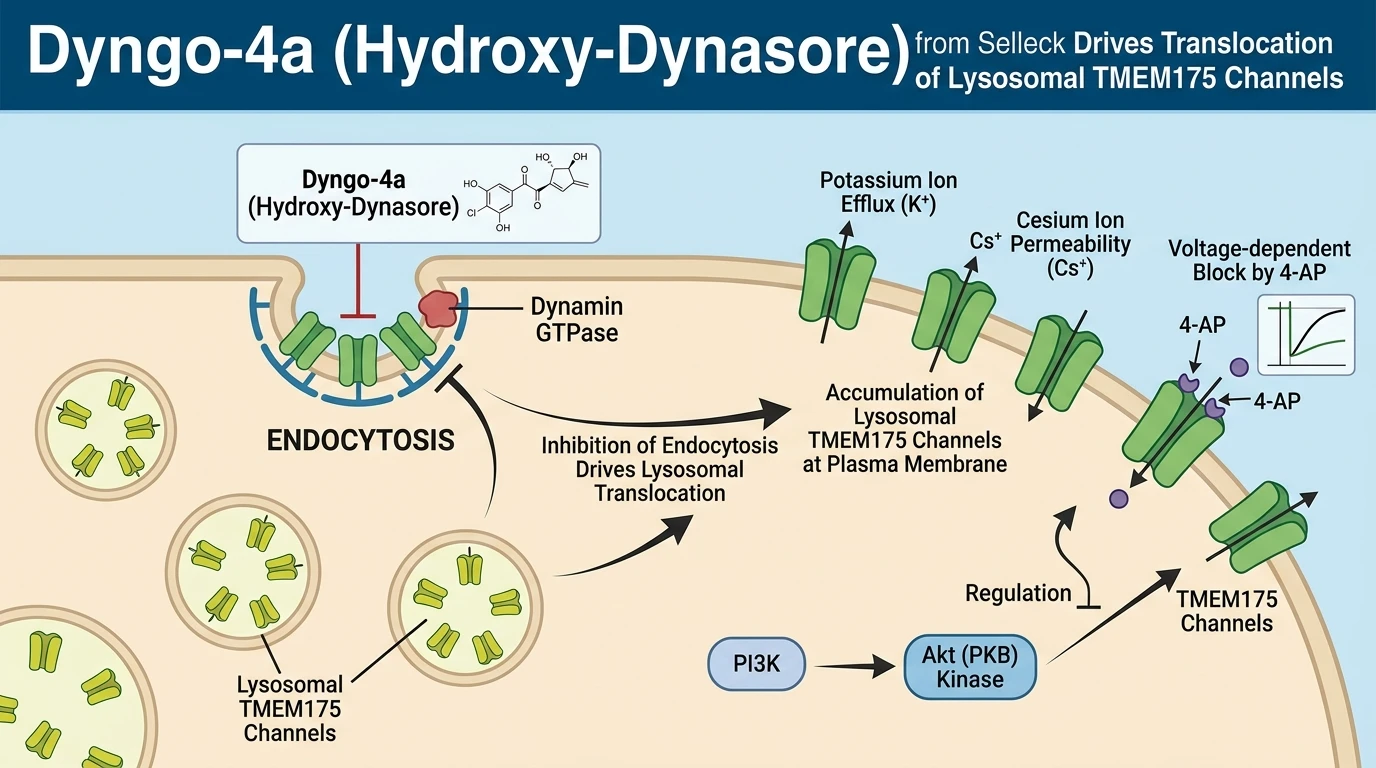
Lysosomal transmembrane protein 175 (TMEM175) functions as a proton- and potassium-selective ion channel integral to endolysosomal ion homeostasis, organelle acidification, and autophagy. Electrophysiological characterization of TMEM175 has historically faced technical challenges due to its primary localization within intracellular endosomal and lysosomal membranes. Small-molecule tools that induce plasma membrane translocation of intracellular ion channels provide crucial access for patch-clamp characterization. Among these agents, Dyngo-4a (Hydroxy-Dynasore) stands out as a potent hydroxylated derivative of the classical dynamin inhibitor dynasore. Utilizing Dyngo-4a (Hydroxy-Dynasore) from Selleck enables precise pharmacological intervention in dynamin-dependent endocytic retrieval networks, driving the accumulation of intracellular TMEM175 channels at the cell surface.
In heterologous expression models utilizing Xenopus laevis oocytes, application of Dyngo-4a (Hydroxy-Dynasore) induces rapid cell surface enrichment of functional TMEM175 channels. Dynamin inhibition blocks endosomal internalization pathways. This disruption shifts the steady-state organelle recycling equilibrium toward plasma membrane accumulation. Surface expression increases drastically following compound exposure. As a result, whole-cell recording configurations yield robust, high-amplitude potassium currents that were previously unattainable without organelle isolation protocols. Research findings confirm that surface-translocated TMEM175 retains its authentic biophysical properties. The channel exhibits higher permeability to Cs+ than to K+, displaying a classical conduction hierarchy characteristic of its pore architecture. Furthermore, the translocated channels maintain voltage-dependent blockade by extracellular 4-aminopyridine (4-AP) and exhibit modest sensitivity to extracellular acidification.
Upstream intracellular signaling cascades also modulate TMEM175 activity, particularly via serine/threonine protein kinase B (PKB/Akt). Comparative electrophysiological measurements reveal that dyngo-4a administration yields significantly larger macroscopic TMEM175 currents than upstream PKB/Akt pathway activation alone. This differential magnitude indicates that direct dynamin-targeted membrane trapping recruits a substantially larger functional pool of channel proteins to the cell surface than endogenous kinase-mediated translocation mechanisms. Molecular biologists leveraging comparative model organism databases to study ion channel orthologs rely on such robust tool compounds to benchmark conductance properties across diverse species. Pharmacological engagement of dynamin by Dyngo-4a (Hydroxy-Dynasore) thus establishes a reliable experimental framework for high-throughput characterization, structure-function mapping, and small-molecule modifier screening targeting the TMEM175 channel core.
Membrane Dynamics and Biophysical Characterization of TMEM175
Copy code to add this image to your page
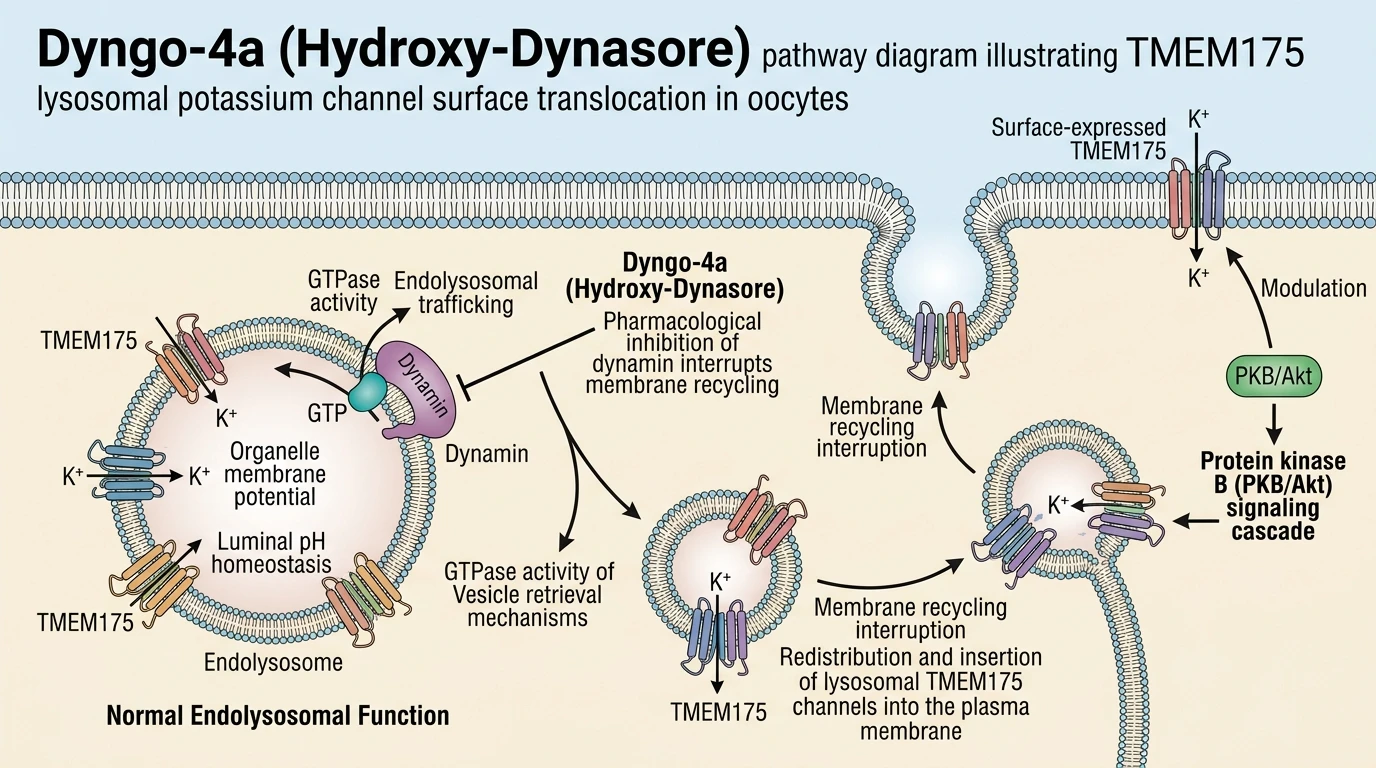
Dyngo-4a inhibits dynamin-mediated endocytosis, disrupting endolysosomal vesicle recycling. This arrest causes the accumulation and enhanced surface expression of the intracellular lysosomal potassium channel TMEM175 on the plasma membrane in Xenopus laevis oocytes. Surface-translocated TMEM175 retains its endogenous electrophysiological properties, including high Cs+ permeability, 4-AP blockade, pH sensitivity, and regulation by PKB/Akt. Dyngo-4a yields robust potassium currents exceeding those induced by kinase activation alone.
Dynamin Inhibition Enriches Plasma Membrane TMEM175 Currents
Targeting endocytic recycling with Dyngo-4a (Hydroxy-Dynasore) from Selleck alters the spatial distribution of endolysosomal TMEM175 channels. In Xenopus laevis oocytes, dynamin GTPase activity normally maintains low plasma membrane expression through continuous vesicle internalization. Dyngo-4a arrests this endocytic retrieval cascade rapidly. Channel density at the cell surface increases substantially within minutes of exposure. Microelectrode voltage-clamp recordings demonstrate a marked rise in macroscopic potassium currents. The magnitude of these recorded currents exceeds baseline control measurements by several fold. High channel density at the plasma membrane allows detailed kinetic evaluation without requiring organellar patch clamping. The observed accumulation reflects direct disruption of vesicle trafficking rather than de novo protein synthesis. Consequently, this pharmacological strategy provides an accessible, reproducible platform for examining TMEM175 channel behavior under defined extracellular ionic conditions.
Surface TMEM175 Retains Endogenous Selectivity and Gating Sensitivity
Plasma membrane-translocated TMEM175 channels preserve their hallmark biophysical attributes. Whole-cell ion substitution experiments demonstrate that surface TMEM175 maintains higher permeability for Cs+ relative to K+. The channel exhibits voltage-dependent blockade upon application of 4-aminopyridine (4-AP). Extracellular acidification produces mild current attenuation, matching responses reported in native lysosomal patches. Furthermore, signaling through PKB/Akt enhances TMEM175 activity. However, application of Dyngo-4a (Hydroxy-Dynasore) from Selleck generates current amplitudes that substantially surpass those induced by PKB activation alone. Current retention proves that membrane relocation does not compromise native channel selectivity. The structural integrity of the pore remains completely intact during translocation. These empirical metrics confirm that surface expression models faithfully mirror endogenous endolysosomal channel functionality.