Maraviroc (UK-427857) CCR5 Coreceptor Antagonism and Genotypic Tropism Cut-Offs
Copy code to add this image to your page
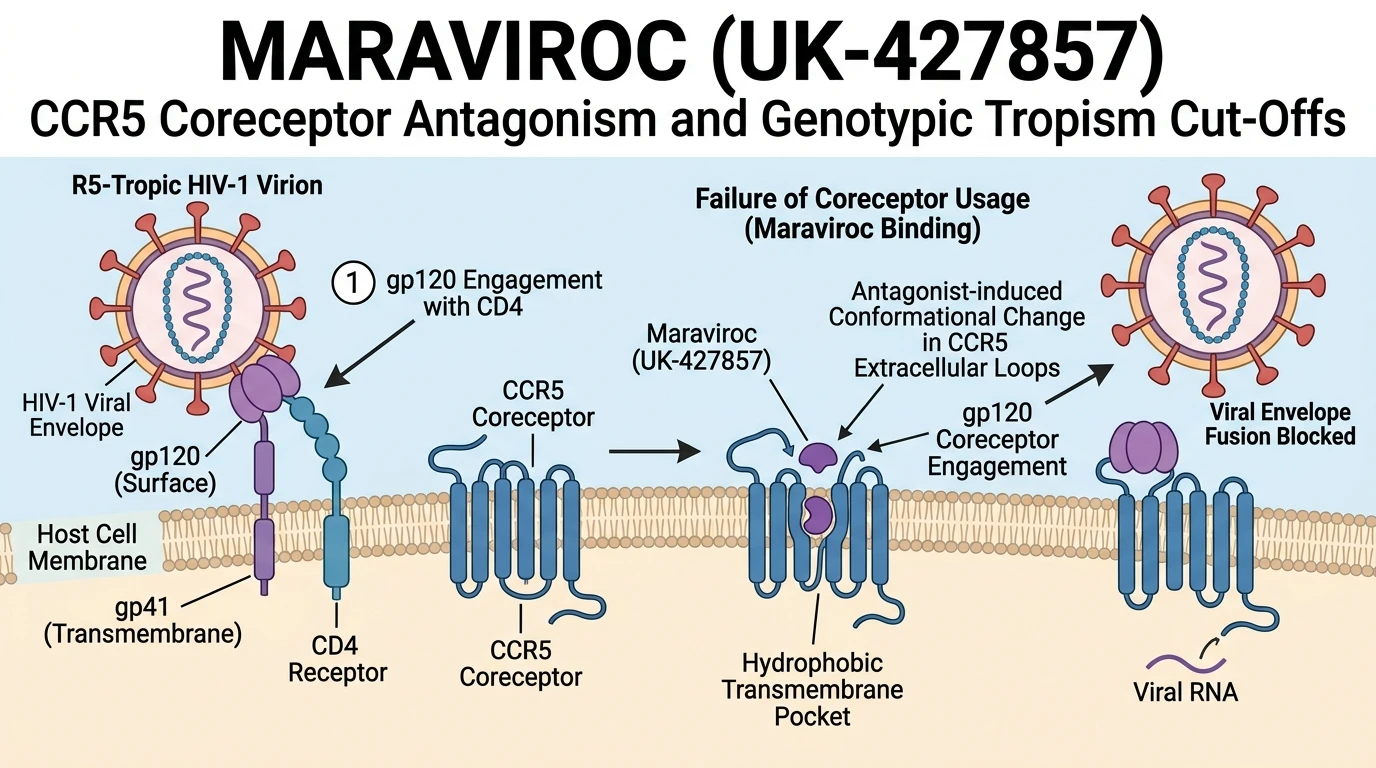
The human immunodeficiency virus type 1 (HIV-1) entry process depends on sequential interactions between the viral envelope glycoprotein complex gp120/gp41 and host cell surface receptors. Initial engagement of gp120 with CD4 induces a conformational rearrangement in the envelope complex, exposing the third variable (V3) loop. This exposed region binds to host chemokine coreceptors, primarily CCR5 or CXCR4, triggering gp41 insertion and cell fusion. Maraviroc (UK-427857) functions as a potent, non-competitive allosteric antagonist of the CCR5 coreceptor. By occupying a deep hydrophobic pocket within the transmembrane domains of CCR5, UK-427857 induces a distinct receptor conformation that renders the extracellular loops unrecognizable to the HIV-1 gp120 V3 loop. Consequently, the compound acts as an entry inhibitor, arresting viral infection prior to intracellular capsid delivery while maintaining the receptor in an inactive state that does not stimulate intracellular G-protein signaling.
Establishing co-receptor tropism is a strict prerequisite before initiating CCR5 antagonist regimens, as non-R5 variants—such as CXCR4-using (X4) or dual/mixed-tropic (D/M) viruses—are inherently insensitive to CCR5 blockade. Historical clinical protocols relied heavily on phenotypic recombinant viral assays, most notably the enhanced sensitivity trofile assay (ESTA). Although ESTA provides direct functional measurement of viral entry, its operational complexity, prolonged turnaround time, and reliance on viable plasma RNA limit its utility in routine practice or in virologically suppressed individuals. Genotypic tropism testing (GTT) addresses these limitations by sequencing the envelope V3 loop and predicting coreceptor usage using validated bioinformatic tools, including geno2pheno[coreceptor] and T-CUP. Optimizing parameter selection within these algorithms is essential for clinical decision-making.
A detailed clinical evaluation investigated the parameters dictating genotypic tropism interpretation in a cohort of 108 patients treated with maraviroc. Viral tropism was systematically profiled using both plasma viral RNA and host PBMC proviral DNA across a wide range of false positive rate (FPR) cut-offs spanning 1% to 20%. The overall clinical success rate across the patient population reached 89.8%, reflecting high therapeutic effectiveness. Statistical analysis established that baseline R5 tropism classification significantly correlated with favorable treatment outcomes specifically at FPR cut-off values between 5% and 7.5%. Importantly, this predictive association held true for both circulating plasma RNA and proviral DNA templates, confirming that genomic DNA extracted from peripheral blood cells offers a reliable substrate for tropism determination in clinical practice.
Methodological comparison among diagnostic modalities demonstrated a concordance rate of approximately 80% between bulk Sanger sequencing, ESTA, and next-generation sequencing (NGS). Although NGS exhibits superior sensitivity for detecting minority X4 variants below the detection threshold of Sanger sequencing, bulk sequencing combined with optimized FPR cut-offs provided comparable predictive performance regarding clinical response. Additionally, the study evaluated the technical impact of PCR amplification strategies. Implementing a triple amplification protocol resulted in an artificial reduction in patient eligibility for maraviroc without yielding any measurable enhancement in clinical predictive value. The repeated cycles of PCR amplification in triple protocols introduced cumulative polymerase artifacts, causing false classification of R5 viruses as dual or mixed tropic. Single PCR amplification provided robust results while preserving patient access to treatment.
Extensive multivariable analysis revealed that patient adherence to the therapeutic regimen served as the single most critical determinant of treatment success. Conversely, baseline viral resistance mutations and calculated background susceptibility scores (BSS) demonstrated no statistically significant impact on virological failure or success within this evaluated cohort. When baseline R5 tropism is accurately confirmed at an FPR of 5% to 7.5%, proper adherence allows maraviroc-containing regimens to achieve durable viral suppression. These observations demonstrate that proviral DNA sequencing coupled with single PCR amplification and an FPR cut-off of 5% to 7.5% provides a safe, accessible, and highly reliable methodology for selecting HIV-1 patients for CCR5 antagonist therapy.
Genotypic Tropism Stratification and Clinical Response Outcomes
Copy code to add this image to your page
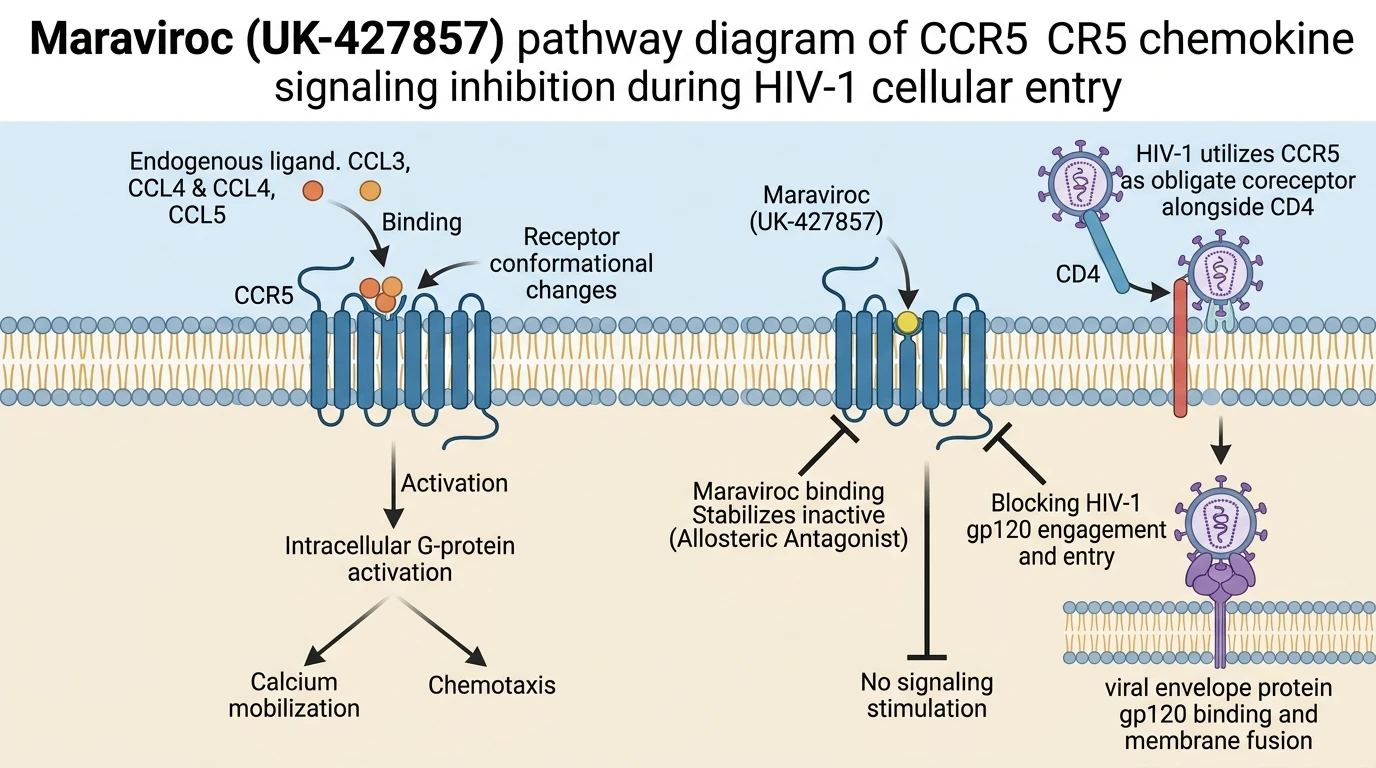
Maraviroc (UK-427857) is a selective, allosteric antagonist of the CCR5 co-receptor. By binding to a transmembrane pocket within CCR5, it stabilizes an inactive receptor conformation that prevents HIV-1 gp120 binding and membrane fusion. Clinical success relies on accurate genotypic tropism determination. Utilizing geno2pheno[coreceptor] on plasma RNA or proviral DNA at a 5%-7.5% false positive rate cut-off with single PCR amplification safely identifies eligible R5-tropic patients, with patient adherence serving as the primary driver of therapeutic efficacy.
False Positive Rate Calibration for Proviral DNA Sequencing
Bioinformatic tropism algorithms require precise calibration to balance sensitivity and specificity. Geno2pheno[coreceptor] assigns a false positive rate (FPR) representing the probability of falsely classifying an R5 virus as CXCR4-using. Analysis of patient plasma RNA and proviral DNA demonstrates optimal predictive validity at FPR thresholds between 5% and 7.5%. Lower thresholds below 3% risk misclassifying non-R5 variants as R5. This leads to early virological failure. Conversely, setting FPR thresholds above 10% excessively restricts patient eligibility. Within the evaluated patient cohort receiving UK-427857, maintaining FPR cut-offs within 5% to 7.5% yielded an 89.8% treatment success rate. Proviral DNA templates performed identically to plasma RNA. This equivalence simplifies clinical workflows for virologically suppressed patients undergoing regimen optimization.
Single PCR Amplification Prevents Artificial Tropism Misclassification
Diagnostic assay design strongly influences patient access to coreceptor antagonist therapies. Standard protocols frequently employ triple PCR amplification to maximize target recovery from low-copy samples. However, multi-pass amplification protocols introduce cumulative nucleotide misincorporation errors. These polymerase errors alter predicted V3 loop amino acid sequences within bioinformatic models. Comparative testing confirmed that triple amplification reduced patient qualification for UK-427857 therapy without enhancing clinical response prediction. Single PCR amplification provided consistent target enrichment while maintaining sequence fidelity. The overall concordance between bulk sequencing, ESTA, and next-generation sequencing remained near 80%. Single amplification protocol minimizes technical artifacts. This streamlined method ensures accurate tropism assignment while preserving therapeutic access.
Adherence Determinants Prevail Over Baseline Susceptibility Scores
Virological outcomes in maraviroc-treated individuals correlate heavily with strict regimen compliance. Multivariable analysis demonstrated that patient adherence was the dominant parameter determining virological suppression. Secondary variables—including baseline resistance mutations and background susceptibility scores (BSS)—showed no statistically significant influence on treatment failure. When baseline R5 tropism is confirmed, full adherence suppresses viral load effectively. Resistance emergence remained rare in adherent patients. These findings clarify that drug exposure overcomes moderate reductions in baseline background activity. Clinical monitoring should prioritize adherence counseling over complex genotypic susceptibility scoring.