Thymidine kinase HSVtk gene therapy targets GSDMB-expressing gastric cancer peritoneal dissemination
Copy code to add this image to your page
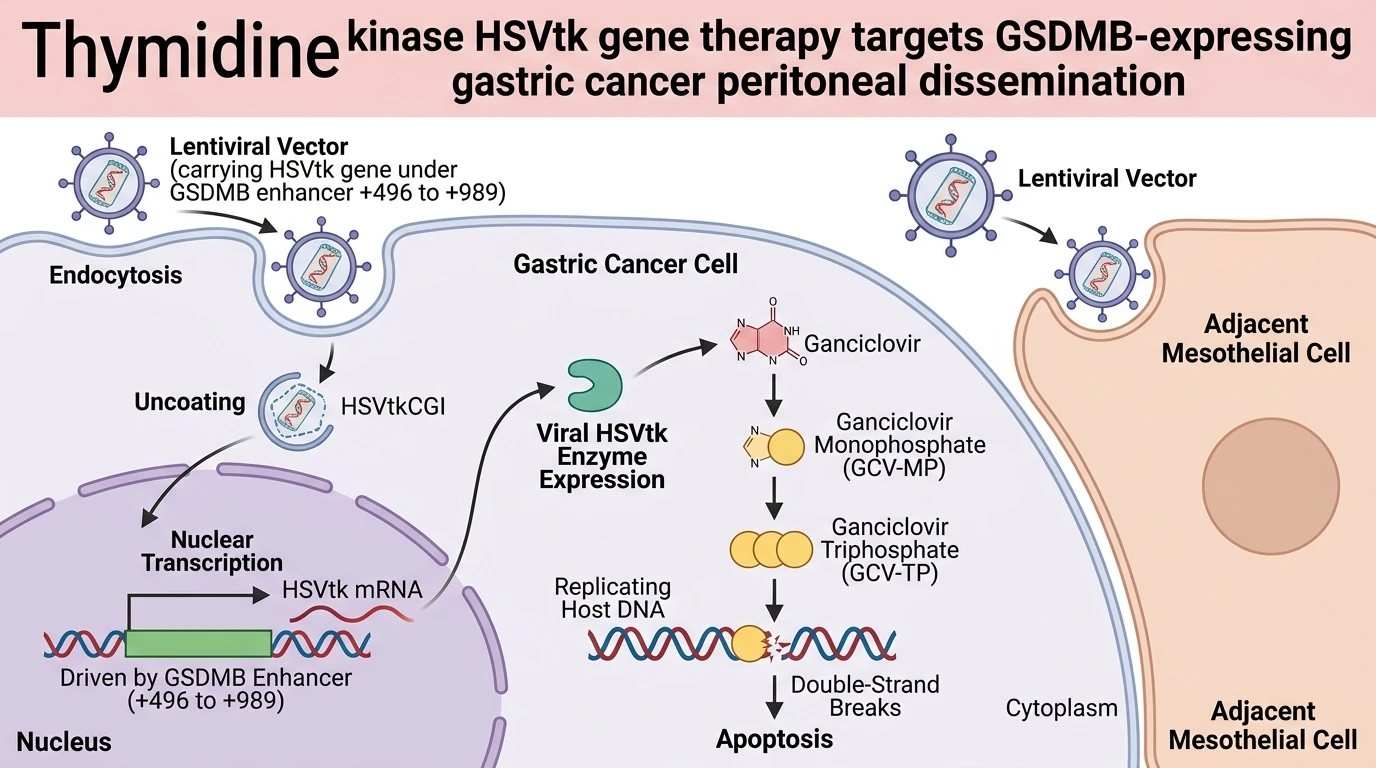
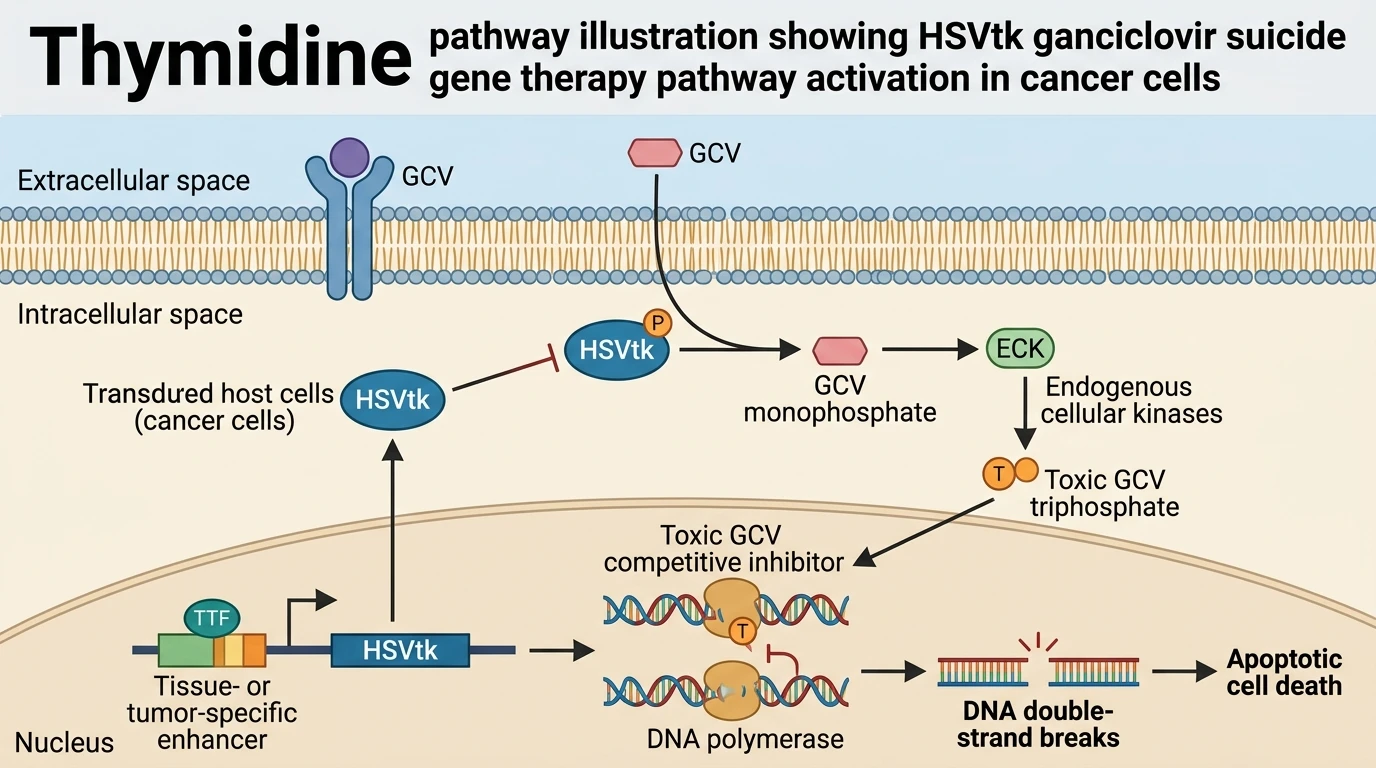
Occult peritoneal dissemination remains a primary cause of therapeutic failure and disease recurrence in gastric adenocarcinoma. Chemotherapeutic agents administered systemically often fail to reach effective therapeutic concentrations within the peritoneal cavity without inducing severe dose-limiting toxicities. Gene-directed enzyme prodrug therapy, commonly termed suicide gene therapy, offers a localized cytotoxic strategy to overcome these bio-distribution constraints. The classical paradigm relies on herpes simplex virus thymidine kinase (HSVtk), an enzyme capable of converting non-toxic nucleoside analogs into cytotoxic metabolites. While host cell enzymes utilize native Thymidine predominantly through tightly regulated salvage pathways, viral HSVtk possesses a significantly broader substrate specificity, efficient at phosphorylating guanosine analogs such as ganciclovir (GCV). Once HSVtk performs the initial rate-limiting monophosphorylation step, endogenous host cellular kinases convert GCV monophosphate into GCV triphosphate, a nucleotide analog that competes with deoxyguanosine triphosphate during DNA synthesis, causing replication fork arrest and selective cell death.
Achieving precise therapeutic selectivity requires restricting HSVtk expression exclusively to malignant cells, preventing non-specific expression in surrounding normal tissues such as the peritoneal mesothelium. Gasdermin B (GSDMB) has been identified as a gene with marked transcriptional upregulation in specific gastric cancer subtypes. Fine-mapping of the genomic loci surrounding the GSDMB promoter identified a specific enhancer region located between nucleotides +496 and +989 relative to the transcription start site. Functional reporter assays evaluated the transcriptional strength of this +496/+989 GSDMB enhancer fragment across multiple cell lines. The enhancer demonstrated robust transcriptional activity in gastric cancer cell lines, most notably in 60As6 cells. Conversely, in normal human mesothelial cells and non-malignant control lines, promoter activity remained near basal levels. This distinct disparity in expression potential provides a critical bio-engineering window for tumor-restricted transgene delivery.
To translate this transcriptional selectivity into a therapeutic vector, a lentiviral delivery system was engineered incorporating the GSDMB enhancer (+496/+989) directly upstream of the HSVtk coding sequence. Transduction of 60As6 gastric cancer cells with the GSDMB-HSVtk vector followed by exposure to ganciclovir resulted in pronounced, dose-dependent inhibition of cell proliferation in vitro. Mechanistically, intracellular accumulation of ganciclovir triphosphate halted cellular division, driving the transduced gastric cancer cells toward programmed apoptotic pathways. Importantly, parallel transduction and prodrug treatment of primary human mesothelial cells demonstrated no significant cytotoxicity, confirming that transgene expression and subsequent prodrug activation remained strictly confined to GSDMB-active cellular states.
In vivo validation was performed using a murine model of occult peritoneal dissemination, established by intraperitoneal inoculation of 60As6 gastric cancer cells. Animals received intraperitoneal administrations of either the GSDMB-HSVtk sense vector or control constructs, followed by daily ganciclovir therapy. Mice treated with the GSDMB-HSVtk/GCV regimen displayed a statistically significant prolongation of median overall survival compared to vehicle and non-sense vector controls. Post-mortem histopathology indicated a substantial reduction in peritoneal tumor nodule burden, while the surrounding mesothelial lining exhibited minimal architectural damage. These findings establish that tumor-specific enhancer regulation of HSVtk mediated prodrug conversion represents a targeted strategy for managing localized peritoneal dissemination in gastric cancer, though translation to clinical settings requires further evaluation of vector delivery efficiency and immunological host responses.
Pharmacological Evaluation of Enhancer-Driven HSVtk Suicide Therapy
Copy code to add this image to your page
The GSDMB enhancer (+496 to +989) drives specific HSVtk transgene expression in gastric cancer cells while remaining silent in normal mesothelial tissues. Transduced HSVtk monophosphorylates ganciclovir (GCV), which host kinases subsequently convert to GCV triphosphate. This metabolite incorporates into replicating DNA, blocking DNA polymerase and terminating elongation. In vitro, GSDMB-HSVtk plus GCV selectively inhibits 60As6 cell proliferation. In vivo, intraperitoneal delivery of the GSDMB-HSVtk sense vector combined with GCV significantly reduces peritoneal tumor burden and extends survival in mouse models of occult peritoneal dissemination.
GSDMB Enhancer Selectively Drives HSVtk Expression in Gastric Cancer
Transcriptional targeting restricts suicide gene therapy to malignant cell populations while sparing adjacent normal tissues. The human GSDMB gene contains a defined regulatory region spanning nucleotides +496 to +989 that exhibits pronounced transcriptional activity in gastric adenocarcinoma lines. Reporter constructs harboring this specific genomic element demonstrated high luciferase expression in human 60As6 gastric cancer cells. Conversely, minimal reporter signal occurred in normal human mesothelial cells under identical assay conditions. Endogenous nucleoside processing usually relies on physiological Thymidine kinetics, whereas HSVtk displays high affinity for synthetic purine and pyrimidine analogs. Transduction with lentiviral vectors containing the GSDMB enhancer-driven HSVtk cassette established selective enzymatic expression. Unmodified mesothelial control cells retained normal morphology and viability. These observations demonstrate effective promoter selectivity within tested cell cultures.
Peritoneal GCV Administration Prolongs Survival in Murine Xenografts
Systemic toxicity frequently limits conventional intraperitoneal chemotherapy in advanced gastric carcinoma. Combining enhancer-restricted HSVtk expression with ganciclovir prodrug administration establishes a controlled localized cytotoxic response. In vitro co-culture experiments confirmed that transduced 60As6 gastric cancer cells suffered sharp reductions in proliferation following ganciclovir treatment. The cytotoxic effects resulted from intracellular accumulation of ganciclovir triphosphate, which competes with natural Thymidine substrates during nuclear DNA synthesis. Non-transduced mesothelial cells preserved functional integrity, confirming target specificity. To validate these findings in vivo, immunocompromised mice received intraperitoneal inoculations of 60As6 cells to establish an occult peritoneal dissemination model. Intraperitoneal delivery of the sense HSVtk lentiviral vector followed by ganciclovir administration significantly extended median survival compared to vector control cohorts. Tumor burden within the peritoneal cavity decreased markedly without systemic histological organ toxicity. These preclinical results highlight the potential utility of GSDMB-targeted suicide gene strategies for controlling occult peritoneal metastases.