Gefitinib (ZD1839) targets EGFR tyrosine kinase in glioblastoma dual inhibition strategies.
Copy code to add this image to your page
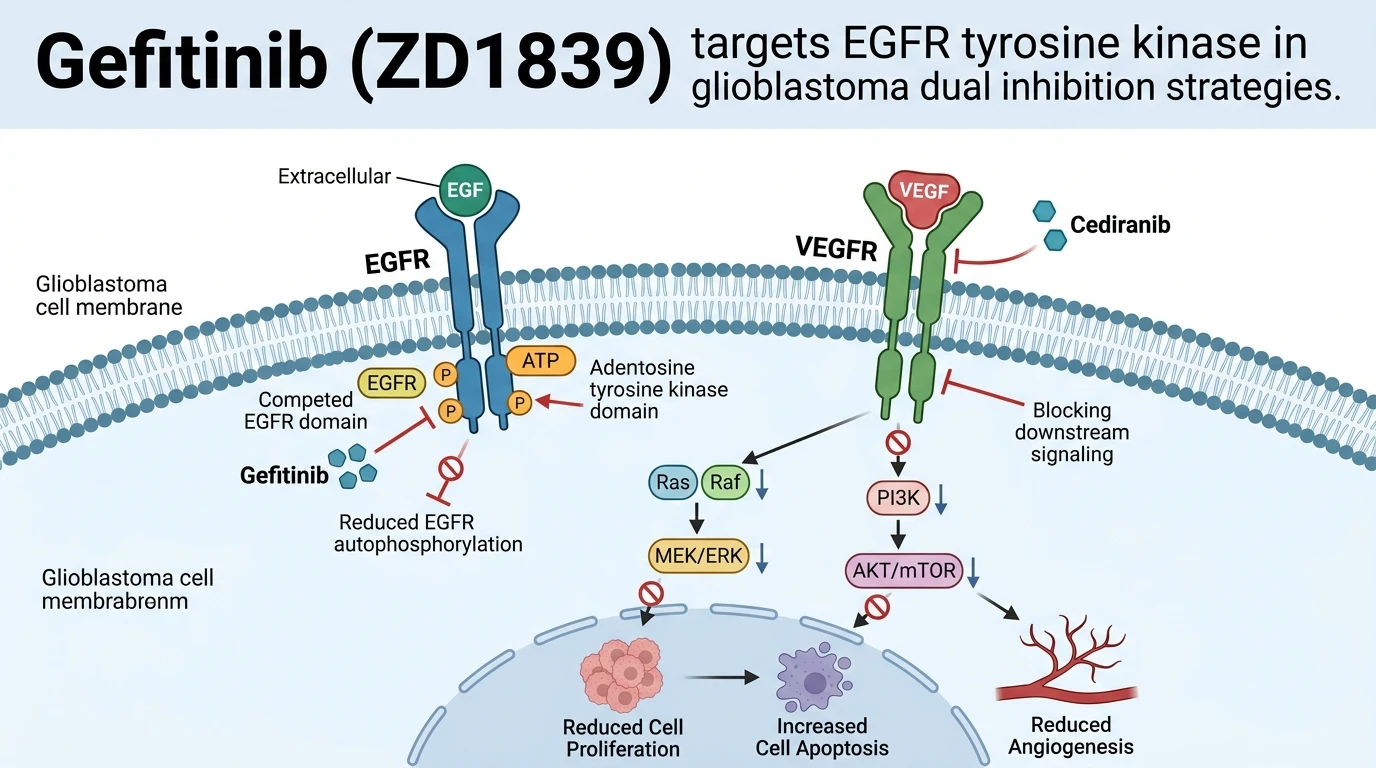
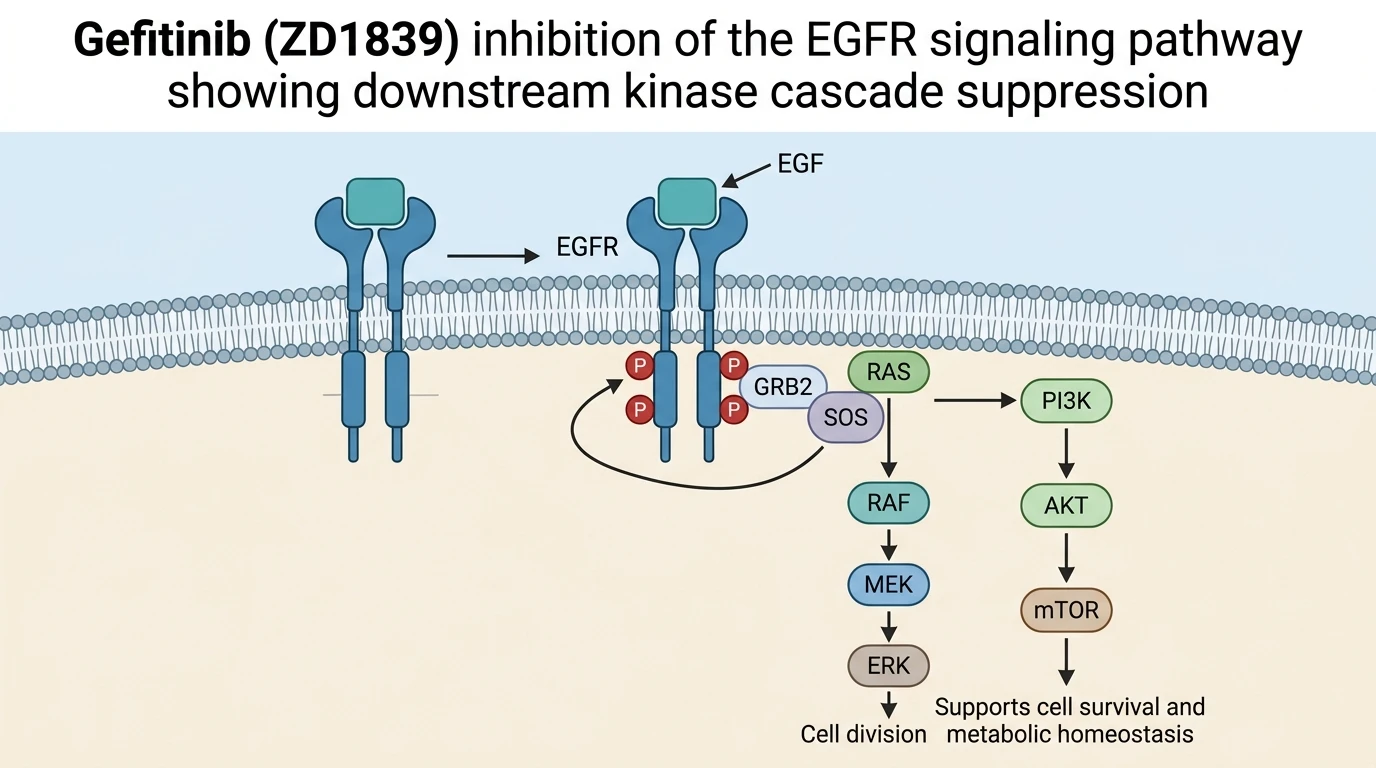
Epidermal Growth Factor Receptor (EGFR) signaling serves as a key driver of oncogenic proliferation, survival, and cell motility across multiple human malignancies. Gefitinib (ZD1839) operates as an orally active, low-molecular-weight aniline-quinazoline derivative designed to selectively target the kinase domain of EGFR. At the molecular level, ZD1839 competes directly with adenosine triphosphate (ATP) for binding within the catalytic pocket of the intracellular tyrosine kinase domain. This reversible binding event prevents magnesium-ATP coordination, halting the phosphotransfer reaction required for receptor autophosphorylation. Consequently, autophosphorylation of carboxyl-terminal tyrosine residues—including Tyr1068 and Tyr1173—is suppressed. Blocking these docking sites prevents recruitment of Src homology 2 (SH2) domain-containing adapter proteins, directly attenuating downstream signaling through the mitogen-activated protein kinase (MAPK/ERK) and phosphatidylinositol 3-kinase (PI3K/AKT) cascades.
In glioblastoma multiforme, EGFR locus amplification, gene rearrangement, and protein overexpression occur in up to 50% of primary tumors. However, monotherapeutic EGFR inhibition routinely fails to produce durable clinical responses in glioblastoma trials. Redundant signaling networks and intense tumor microenvironment crosstalk frequently mediate treatment resistance. High-grade gliomas rely heavily on neoangiogenesis driven by Vascular Endothelial Growth Factor (VEGF) signaling. Compensatory upregulation of VEGFR pathways frequently bypasses single-agent EGFR blockade, maintaining downstream survival signals and endothelial proliferation. Simultaneous inhibition of VEGFR-mediated angiogenesis and EGFR-driven tumor cell survival provides a biological rationale for dual targeted therapy.
To test this dual blockade strategy, a randomized phase II clinical trial was conducted in 38 patients with recurrent glioblastoma. The study evaluated the clinical efficacy and safety of combining cediranib—a potent pan-VEGFR inhibitor—with Gefitinib (ZD1839), comparing this regimen against cediranib monotherapy paired with placebo. The clinical investigation faced significant structural challenges due to the early termination of the broader cediranib development program. This administrative decision led to premature closure of patient accrual. The resulting small sample size reduced statistical power, preventing definitive hypothesis testing. Nonetheless, empirical trends within this randomized cohort provide valuable insights into dual pathway modulation.
Efficacy endpoints demonstrated numerical improvements across primary and secondary outcome measures in the dual inhibition cohort. Median progression-free survival (mPFS) measured 3.6 months in the cediranib plus ZD1839 arm, compared to 2.8 months in the control group receiving cediranib plus placebo. This prolonged progression-free window translated to a hazard ratio (HR) of 0.72. Overall survival metrics exhibited a similar positive shift. Patients receiving combination therapy achieved a median overall survival (mOS) of 7.2 months versus 5.5 months for those in the placebo control arm, yielding a hazard ratio of 0.68. Objective radiographic responses further corroborated these findings. The partial response (PR) rate reached 42% in the combination group compared to 26% in the single-agent cediranib cohort.
Combining targeted agents often elevates the risk of overlapping adverse events, potentially limiting therapeutic index. In this phase II evaluation, the addition of ZD1839 to cediranib produced a toxicity profile that remained manageable under close clinical monitoring. Primary treatment-emergent toxicities included grade 1 to 3 diarrhea, fatigue, hypertension, and acneiform rash, aligning with expected class-specific pharmacological effects. Critical patient-reported outcome measures indicated that overall health-related quality of life was maintained throughout the treatment course. The absence of severe synergistic toxicities confirms that concurrent EGFR and VEGFR inhibition can be tolerated in this patient population.
These clinical observations demonstrate that dual path targeting remains a valid strategy in recurrent glioblastoma. Although sample size limitations necessitate cautious interpretation, the consistent HR reductions across both PFS and OS support the underlying hypothesis. Blocking compensatory VEGFR signaling appears to enhance sensitivity to EGFR TKIs in hypervascular brain tumors. These findings provide empirical backing for future trials exploring optimized multi-target tyrosine kinase inhibitor combinations.
Dual Pathway Inhibition and Clinical Efficacy Evaluation
Copy code to add this image to your page
Gefitinib (ZD1839) acts as an ATP-competitive small-molecule inhibitor targeting the intracellular catalytic tyrosine kinase domain of EGFR. Binding prevents autophosphorylation of key tyrosine residues, thereby blocking downstream signaling cascades including RAS-RAF-MEK-ERK and PI3K-AKT pathways. In glioblastoma paradigms, concurrent inhibition of EGFR and VEGFR pathways disrupts redundant survival pathways, attenuating tumor cell proliferation and vascular proliferation.
Kinase Domain ATP Competition and Phosphorylation Suppression
Target engagement by small-molecule inhibitors depends on binding kinetics within the catalytic pocket. At the intracellular catalytic site of EGFR, ZD1839 occupies the binding pocket and blocks ATP coordination. Downstream phosphorylation events were measured across canonical nodes. Under steady-state binding conditions, receptor autophosphorylation decreases rapidly, impairing adapter protein recruitment. This biochemical blockade prevents activation of downstream signal transducers. The duration of target occupancy directly correlates with sustained suppression of cellular survival pathways.
Efficacy Trends in Recurrent Glioblastoma Patient Cohorts
Clinical efficacy signals were recorded during the phase II evaluation of recurrent glioblastoma. In the clinical setting, combining ZD1839 with cediranib demonstrated numerical superiority over single-agent VEGFR blockade. Median progression-free survival improved from 2.8 months to 3.6 months (HR = 0.72). Median overall survival increased from 5.5 months to 7.2 months (HR = 0.68). Partial response rates were elevated at 42% compared to 26% in the monotherapy arm. Early trial termination reduced absolute statistical power. Nevertheless, these metrics indicate reduced tumor progression under dual pathway blockade.
Safety Metrics and Tolerability under Dual Blockade
Safety parameters were thoroughly documented across the trial arms. Toxicities associated with dual EGFR and VEGFR inhibition remained manageable throughout treatment. Reported adverse effects aligned with expected class reactions, including mild to moderate diarrhea, cutaneous rash, and vascular hypertension. No unexpected cumulative organ toxicities emerged. Patient-reported outcomes confirmed that overall health-related quality of life was preserved during therapy. The observed safety profile supports further investigation of multi-kinase combination regimens.