RU.521 (RU320521) RU.521 inhibitor suppresses cGAS STING driven hepatic inflammation
Copy code to add this image to your page
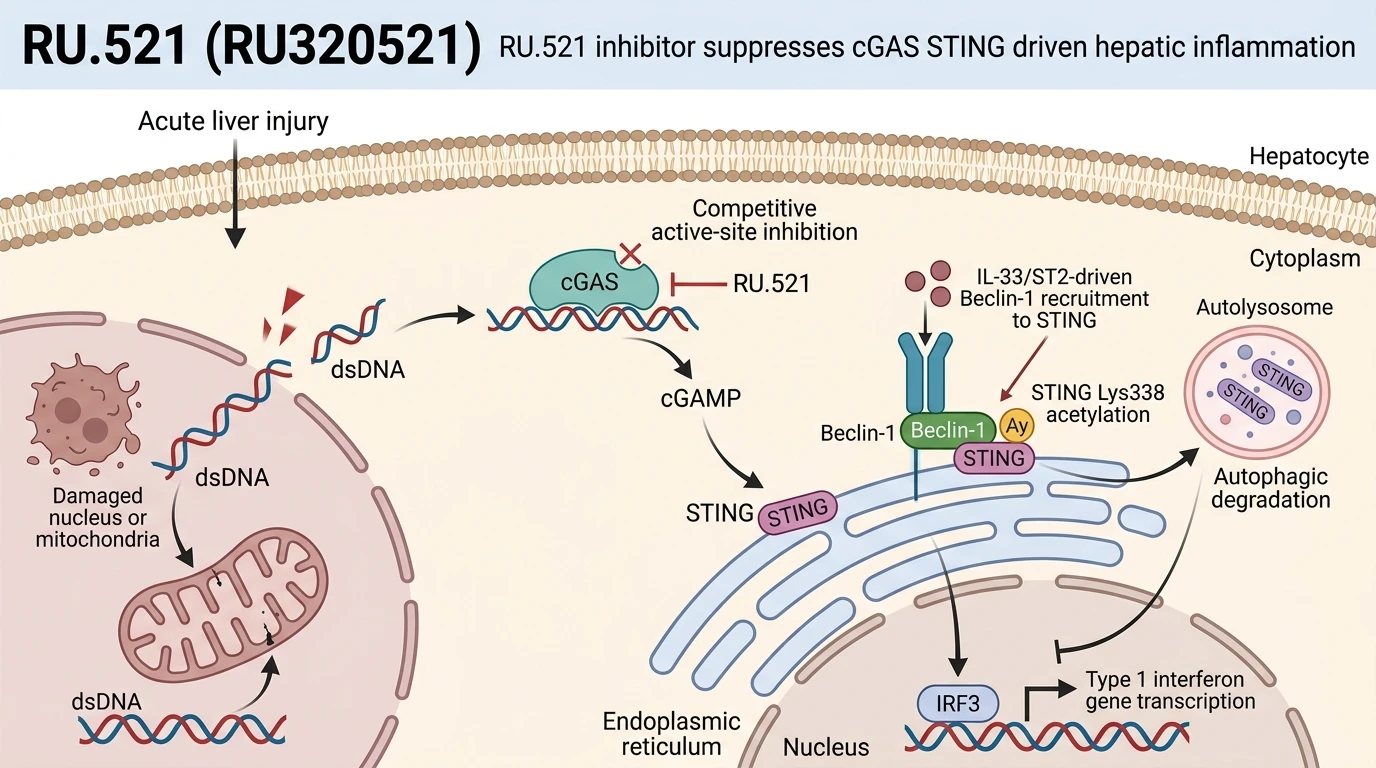
Acetaminophen (APAP) overdose represents a leading etiology of drug-induced liver injury and acute liver failure in clinical toxicology. At elevated doses, toxic accumulation of N-acetyl-p-benzoquinone imine exhausts hepatic glutathione reserves. Subsequent covalent binding to cellular proteins causes acute mitochondrial dysfunction and oxidative stress. Severe hepatocyte necrosis releases abundant nuclear and mitochondrial double-stranded DNA fragments into the extracellular space and intracellular cytosol. Cytosolic DNA accumulation acts as a potent danger signal. The double-stranded DNA sensor human cGAS enzyme recognizes these fragments without sequence specificity.
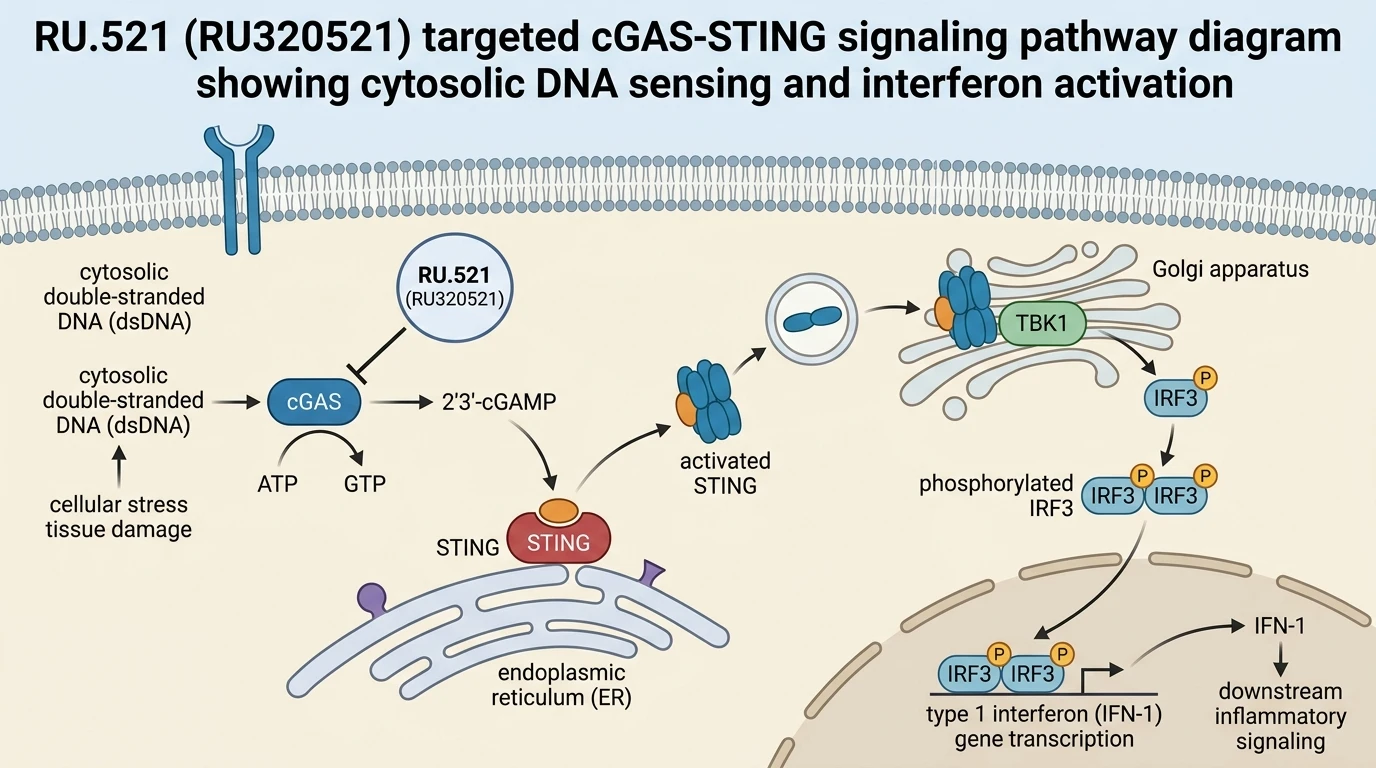
Upon nucleic acid binding, cGAS undergoes conformational switching to form an active dimer. The active site catalyzes the condensation of ATP and GTP into the cyclic dinucleotide 2'3'-cGAMP. This second messenger diffuses locally to engage stimulator of interferon genes (STING) dimers located at the endoplasmic reticulum membrane. Binding of 2'3'-cGAMP induces a 180-degree rotation of the STING ligand-binding domain, closing the dimeric interface. STING then translocates via the endoplasmic reticulum-Golgi intermediate compartment to the Golgi apparatus. During trafficking, STING hires TANK-binding kinase 1 (TBK1). TBK1 trans-phosphorylates STING at Ser366, creating a docking site for interferon regulatory factor 3 (IRF3). TBK1 subsequently phosphorylates IRF3, driving its dimerization and entry into the nucleus. Nuclear IRF3 stimulates the transcription of type 1 interferons (IFN-1) and pro-inflammatory chemokine genes, exacerbating tissue injury.
To interrupt this inflammatory cascade, targeted pharmacological blockade of cGAS catalytic activity is required. The small-molecule compound RU.521 (RU320521) functions as a potent, competitive active-site inhibitor of cGAS. Structural analyses confirm that RU.521 lodges directly within the purine-binding pocket of the enzyme's catalytic domain. By preventing ATP and GTP binding, application of a selective RU.521 inhibitor completely suppresses 2'3'-cGAMP production in DNA-stimulated cells. Consequently, downstream STING translocation, TBK1 recruitment, and IRF3 activation cease.
Endogenous control systems also regulate cGAS-STING signaling during tissue recovery. Interleukin-33 (IL-33), an alarmin cytokine operating through the ST2 receptor, acts as an endogenous negative regulator of STING-mediated inflammation. Following tissue stress, ST2 signaling recruits autophagic machinery to remove active STING complexes. Mechanistically, IL-33 stimulation enhances direct binding between the essential autophagy regulator Beclin-1 and STING. This protein interaction promotes post-translational acetylation of STING at residue Lys338. Lys338 acetylation targets STING for selective autophagic sequestration into double-membrane autophagosomes, followed by lysosomal degradation.
Autophagic clearance of STING halts downstream signal propagation. Dimerization of STING fails; TBK1 docking sites are lost. Phosphorylation of IRF3 stops, leading to decreased nuclear accumulation and diminished IFN-1 gene expression. Co-administration of recombinant IL-33 with the small-molecule RU.521 inhibitor targets this axis through complementary mechanisms. RU.521 blocks cGAS enzymatic generation of 2'3'-cGAMP, while IL-33 accelerates lysosomal degradation of pre-existing STING protein.
In mouse models of APAP-induced liver toxicity, combined therapeutic intervention yields marked hepatoprotective effects. Serum transaminase levels—specifically alanine aminotransferase (ALT) and aspartate aminotransferase (AST)—decline rapidly following dual treatment. Histopathological examination demonstrates preserved parenchymal microarchitecture with reduced centrilobular liver necrosis. Expression of IFN-alpha, IFN-beta, and downstream interferon-stimulated genes drops significantly across hepatic tissue. Overall animal survival improves dramatically post-overdose. These preclinical observations indicate that direct cGAS active-site inhibition, paired with autophagic STING clearance, provides an effective target configuration for limiting drug-induced hepatotoxicity.
Mechanistic Synergy and Therapeutic Efficacy in Liver Injury
Copy code to add this image to your page
Acetaminophen overdose triggers cytosolic DNA accumulation, activating cGAS and STING to induce type 1 interferon transcription and severe liver injury. The cGAS inhibitor RU.521 (RU320521) blocks the catalytic site of cGAS, preventing 2'3'-cGAMP synthesis. Concurrently, IL-33/ST2 signaling promotes Beclin-1 interaction with STING, driving STING Lys338 acetylation and autophagic degradation. Combined treatment with RU.521 and recombinant IL-33 disrupts STING dimerization, prevents IRF3 nuclear entry, decreases interferon gene expression, and attenuates drug-induced hepatotoxicity.
IL-33 ST2 Signaling Drives Autophagic STING Degradation
Excessive release of damage-associated molecular patterns during hepatocyte necrosis engages intracellular nucleic acid sensors. In acetaminophen-exposed liver tissue, released genomic fragments bind cGAS to sustain STING signaling. Endogenous IL-33 signals through the ST2 receptor to restrain this reaction. Experimental data confirm that ST2 activation recruits autophagic machinery to clear STING. Mechanistically, IL-33 enhances physical complex formation between Beclin-1 and STING within microdomains of the endoplasmic reticulum. This interaction induces acetylation at residue Lys338. Acetylated STING enters autophagosomes for rapid degradation. STING protein abundance falls within six hours. Destabilization of STING halts downstream TBK1 recruitment; IRF3 phosphorylation drops sharply. When combined with the catalytic cGAS antagonist RU.521 inhibitor, this autophagic pathway ensures comprehensive silencing of interferon responses.
Dual cGAS STING Inhibition Attenuates Murine Hepatotoxicity
To assess therapeutic efficacy in vivo, mice subjected to lethal APAP overdose received recombinant IL-33 alongside the RU.521 inhibitor. Control mice developed extensive centrilobular necrosis with serum ALT levels exceeding 5,000 U/L. Dual pharmacological administration reduced transaminase activity by over 70%. Histopathological sectioning revealed intact parenchymal architecture and reduced immune cell infiltration. Expression profiling confirmed marked suppression of IFN-alpha and IFN-beta transcripts in tissue homogenates. Survival rates within a 48-hour post-injury window rose from 20% in untreated controls to 85% in the combination cohort. Direct cGAS enzyme blockade paired with autophagic STING degradation effectively limits acute drug-induced liver injury.