Tagtociclib (PF-07104091) Selectively Inhibits CDK2 to Block G1 S Phase Transition
Copy code to add this image to your page
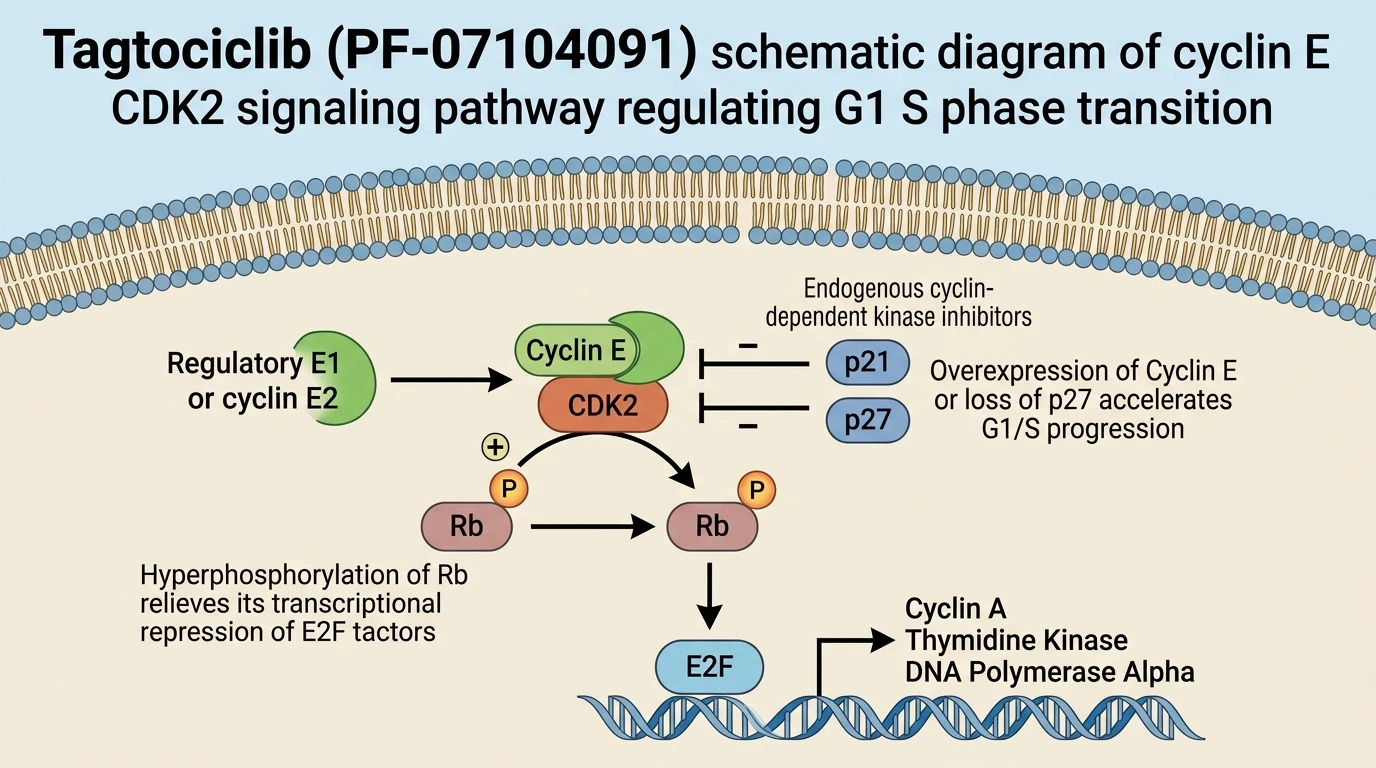
Inhibition of cell cycle progression represents a primary therapeutic modality in hormone receptor-positive, human epidermal growth factor receptor 2-negative (HR+/HER2-) metastatic breast cancer. Cyclin-dependent kinase 4 and 6 (CDK4/6) inhibitors combined with endocrine therapy constitute standard frontline care; however, acquired resistance invariably develops through diverse molecular mechanisms. A prominent driver of resistance involves the bypass of CDK4/6 blockade via cyclin E1 (CCNE1) overexpression and compensatory cyclin-dependent kinase 2 (CDK2) hyperactivation. CDK2 forms active enzymatic complexes with cyclin E or cyclin A, catalyzing the hyperphosphorylation of retinoblastoma protein (Rb) independent of CDK4/6 signaling. This biochemical event unleashes E2F-mediated transcription, compelling cells past the restriction point into S phase.
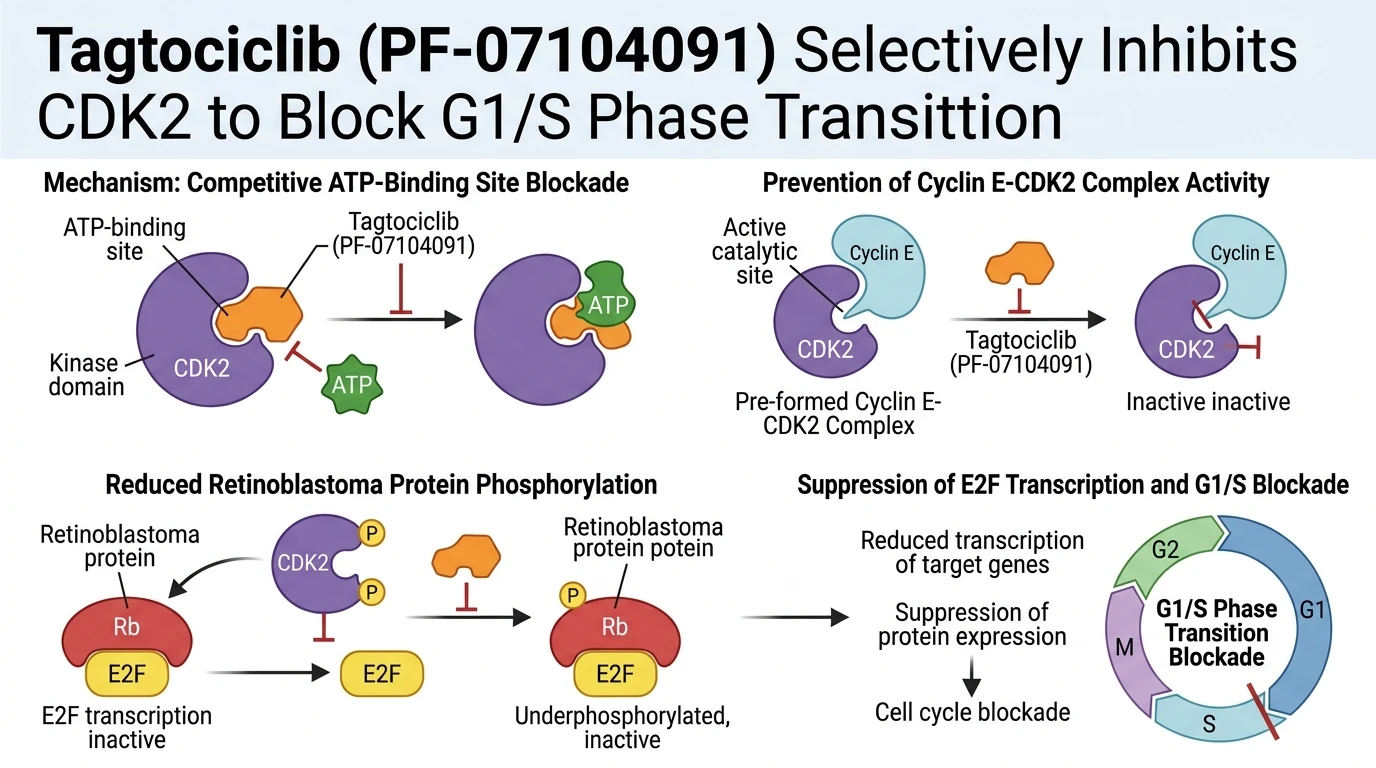
Tagtociclib (PF-07104091) was designed as a potent, orally bioavailable, selective CDK2 inhibitor engineered to intercept this escape pathway. By binding competitively to the ATP-binding pocket of CDK2, the molecule prevents substrate phosphorylation, enforcing a G1/S phase cell cycle arrest in CCNE1-amplified or CDK4/6-inhibitor-resistant tumor models. Early biochemical profiling indicates high selectivity for CDK2 over other cyclin-dependent kinase family members—specifically CDK1, CDK4, and CDK6. This selective profile minimizes toxicities historically associated with pan-CDK suppression, such as profound neutropenia and off-target cytotoxicity.
In early-phase clinical evaluations, Tagtociclib exhibited rapid oral absorption following per os administration on a twice-daily (BID) schedule. The systemic terminal elimination half-life was observed to be approximately 2 to 3 hours across evaluated dose cohorts. Pharmacokinetic analysis demonstrated dose-proportional plasma exposure within the studied therapeutic range. This short half-life supports twice-daily administration to maintain effective target inhibition throughout the inter-dose interval without excessive steady-state tissue accumulation.
Clinical investigations in Phase 1/2a dose-escalation and expansion trials evaluated Tagtociclib as monotherapy in patients with advanced or metastatic solid tumors who progressed on multiple prior lines, heavily enriched for HR+/HER2- breast cancer pretreated with CDK4/6 inhibitors. Pharmacodynamic evaluation confirmed target engagement in patient-derived tissue samples, evidenced by reductions in phosphorylated Rb at serine sites 780 and 807/811 at physiologically achievable drug concentrations. The recommended Phase 2 monotherapy dose was established at 300 mg BID based on safety, tolerability, and pharmacokinetic-pharmacodynamic integration.
The safety spectrum of Tagtociclib reflects typical small-molecule kinase inhibitor dynamics. Common treatment-emergent adverse events reported across clinical trial cohorts included gastrointestinal events—predominantly mild-to-moderate nausea, diarrhea, and vomiting—alongside generalized fatigue and hematologic impacts such as anemia. These adverse effects were predominantly Grade 1 or 2 in severity and proved manageable through standard supportive care interventions or temporary dose holds. Hematologic toxicities, particularly severe neutropenia, occurred at lower rates than observed with frontline CDK4/6 inhibitors.
Efficacy metrics from initial trial cohorts demonstrated encouraging single-agent clinical activity in refractory patient populations. Monotherapy administration of Tagtociclib achieved a disease control rate of 61.5% in patients with metastatic breast cancer, encompassing confirmed partial responses and prolonged stable disease. These clinical observations corroborate pre-clinical hypotheses positioning CDK2 inhibition as a viable therapeutic strategy following CDK4/6 blockade failure. Clinical development has consequently expanded to evaluate combination regimens pairing Tagtociclib with standard endocrine therapies, such as fulvestrant or novel selective estrogen receptor degraders, to establish comprehensive dual-pathway blockade in both early-line and resistant settings.
The mechanistic rationale for targeting CDK2 extends beyond breast cancer into broader oncology indications exhibiting cyclin E genomic aberrations. In preclinical models of uterine serous carcinoma, ovarian high-grade serous carcinoma, and gastric adenocarcinomas, CCNE1 gene amplification correlates with heightened sensitivity to small-molecule CDK2 inhibition. Tagtociclib demonstrates potent antiproliferative effects in these biomarker-selected cell lines, inducing cell cycle arrest and apoptosis. Ongoing translational assays aim to establish whether CCNE1 copy number or cyclin E protein abundance can serve as predictive biomarkers to select patient populations most likely to benefit from Tagtociclib therapy.
Pharmacokinetic Profiling and Anti-Tumor Efficacy Dynamics
Copy code to add this image to your page
Tagtociclib (PF-07104091) is a selective, orally active small-molecule inhibitor of CDK2. By occupying the ATP-binding cleft of CDK2, it prevents formation of functional cyclin E-CDK2 and cyclin A-CDK2 complexes. This inhibition blocks retinoblastoma protein hyperphosphorylation, preventing E2F factor activation and inducing cell cycle arrest at the G1/S phase boundary. Target selectivity minimizes off-target suppression of CDK1 and CDK4/6.
Dose-Proportional Exposure and Rapid Elimination Kinetics
Oral administration of Tagtociclib yields rapid systemic uptake across evaluated dose cohorts. Maximum plasma concentrations occur rapidly post-dosing; the terminal elimination half-life ranges between 2 and 3 hours in humans. This short half-life necessitates a twice-daily dosing schedule to maintain continuous inhibitory threshold coverage. Steady-state plasma exposure scales proportionally across evaluated dose increments up to the recommended Phase 2 dose. Inter-patient pharmacokinetic variability remained moderate throughout trial escalation phases. Pharmacodynamic target engagement closely tracks systemic plasma concentration, verifying continuous CDK2 active-site occupancy at 300 mg BID.
G1 S Transition Blockade in CDK4/6-Resistant Models
Selective inhibition of CDK2 directly suppresses retinoblastoma protein phosphorylation. Downstream E2F transcriptional activity decreased markedly following administration. In patient-derived xenograft models resistant to prior palbociclib exposure, Tagtociclib restored G1/S cell cycle arrest. Cellular proliferation indices dropped precipitously within 48 hours. Clinical evaluation demonstrated a 61.5% disease control rate in refractory metastatic breast cancer, with partial responses enriched in tumors harboring CCNE1 amplification. Gastrointestinal toxicities—predominantly Grade 1 or 2 nausea and diarrhea—represented the primary treatment-emergent adverse events. Severe neutropenia occurred infrequently, confirming the selectivity margin over CDK1 and CDK4/6.