Nedisertib (M3814) blocks DNA-PKcs to enhance CRISPR homology-directed repair efficiency
Copy code to add this image to your page
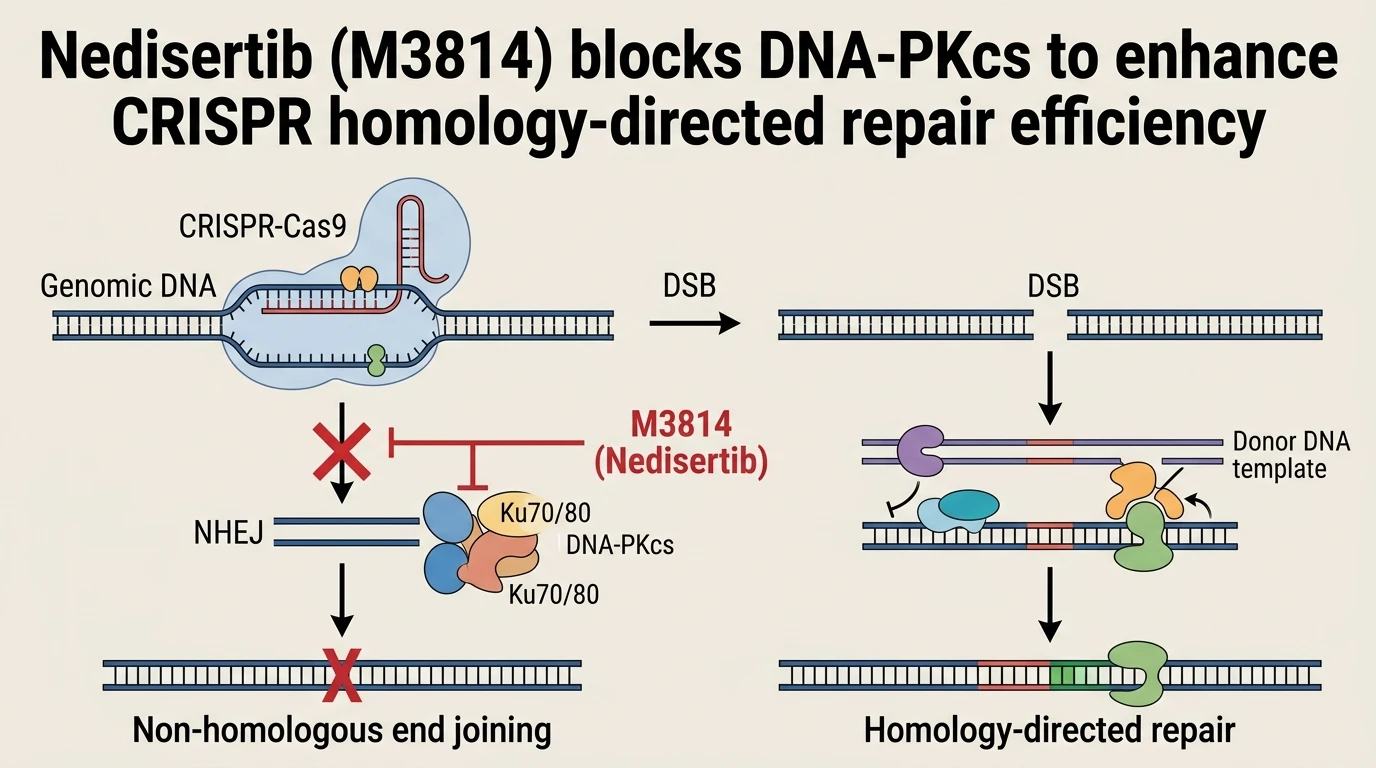
Targeted double-strand break (DSB) induction via CRISPR endonucleases triggers two competing primary DNA repair pathways: non-homologous end joining (NHEJ) and homology-directed repair (HDR). Canonical NHEJ operates rapidly throughout all cell cycle phases, joining broken DNA ends through microhomology recognition without requiring a homologous template. Although efficient, NHEJ is frequently error-prone, introducing insertion or deletion (indel) mutations at the cleavage site. Conversely, HDR utilizes single- or double-stranded donor DNA templates to achieve precise sequence insertion or base correction. HDR activity remains restricted primarily to late S and G2 phases, rendering precise genome editing challenging in many human somatic cell types where NHEJ naturally predominates.
At the central junction of canonical NHEJ initiation resides the DNA-dependent protein kinase catalytic subunit (DNA-PKcs, encoded by PRKDC). Following endonuclease-mediated cleavage, the Ku70/Ku80 heterodimer rapidly associates with exposed DNA termini, recruiting DNA-PKcs to form the functional DNA-PK holoenzyme complex. Phosphorylation cascade events governed by DNA-PKcs promote the assembly of processing factors—including Artemis, XRCC4, XLF, and DNA ligase IV—to complete double-strand ligation. Chemical or genetic attenuation of DNA-PKcs kinase activity disrupts this repair assembly. In the absence of functional DNA-PKcs autophosphorylation, downstream ligation stalls, maintaining open DNA ends and extending the temporal window for high-fidelity HR machinery engagement.
Evaluation of DNA-PKcs kinase dead mutants, such as the K3753R point mutation, demonstrates that catalytic inactivation severely impairs canonical NHEJ without abolishing physical DNA binding by Ku complexes. Replicating this catalytic blockade pharmacologically with the potent small-molecule inhibitor Nedisertib (M3814) provides a tunable mechanism to selectively modulate pathway choice. At nanomolar to low-micromolar concentrations, Nedisertib (M3814) occupies the ATP-binding pocket of DNA-PKcs, completely suppressing autophosphorylation at Ser2056 and Thr2609 target sites. Assays in diverse human cell lines show that transient treatment with this small molecule shifts double-strand break repair dynamics from template-independent end joining toward template-directed repair.
Quantitative analysis of gene-targeting efficiency confirms that transient exposure to Nedisertib (M3814) enhances HDR efficiency up to 81% across multiple locus targets and cell types, including primary human stem cells and transformed epithelial lines. This strategy functions consistently across diverse CRISPR platforms, including Streptococcus pyogenes Cas9 (SpCas9), high-fidelity Cas9 variants, and Cas12a (Cpf1) nucleases. Crucially, because small-molecule suppression of DNA-PKcs is fully reversible upon compound washout, cells recover canonical repair capacity following the editing window. This transient application prevents long-term genomic instability, chromosomal rearrangements, or persistent double-strand break accumulation, enabling precise simultaneous multiplex editing of multiple genetic loci within a single cell population.
Targeted Repair Modulation and Multiplexed Editing Performance
Copy code to add this image to your page
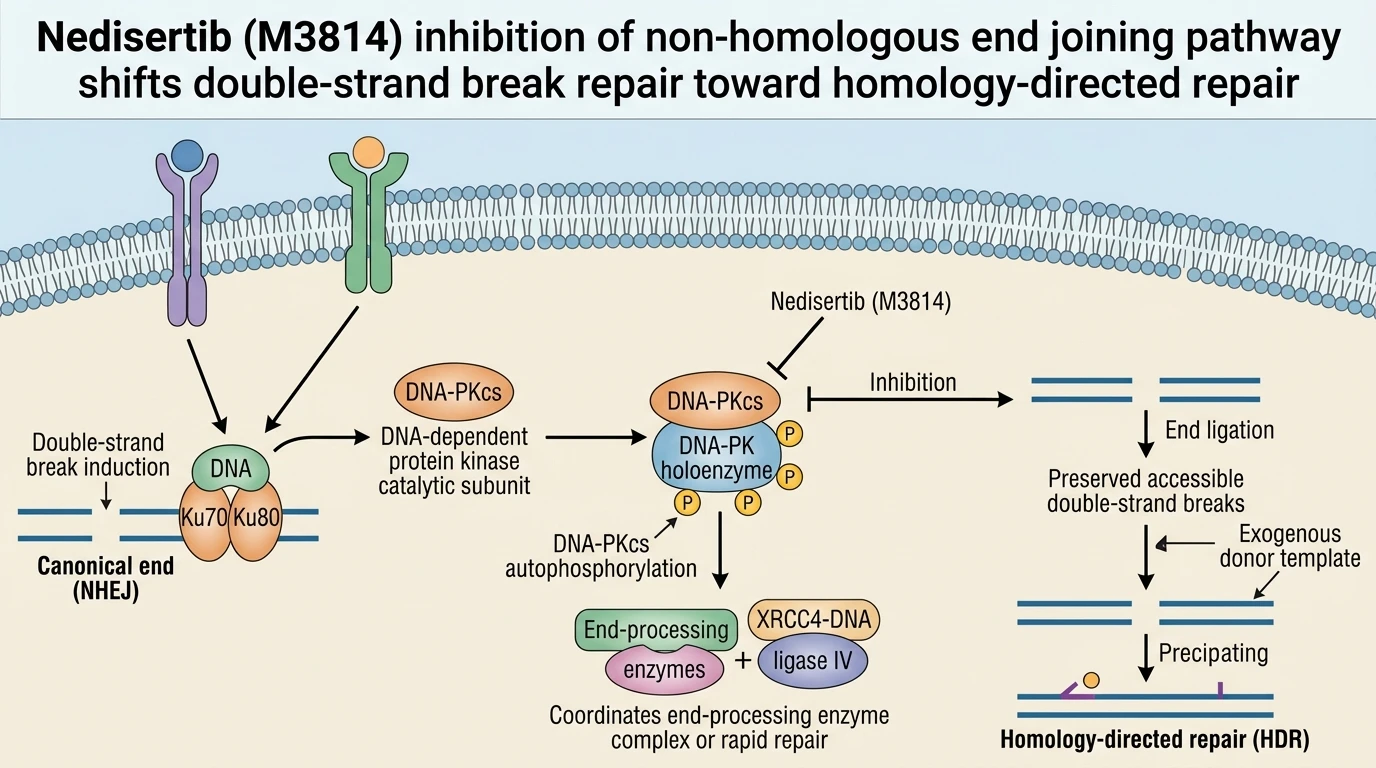
Nedisertib (M3814) is a selective, potent inhibitor of DNA-dependent protein kinase catalytic subunit (DNA-PKcs). By binding the ATP-binding domain of DNA-PKcs, it prevents autophosphorylation and disrupts assembly of the XRCC4-DNA ligase IV complex required for non-homologous end joining (NHEJ). Blocking error-prone NHEJ prolongs the residence time of open double-strand breaks, permitting high-efficiency homology-directed repair (HDR) in the presence of exogenous donor DNA. Transient administration enables efficient, multiplexed precision CRISPR editing without persistent genomic damage.
Transient Kinase Suppression Maximizes Homology-Directed Repair Efficiency
Catalytic inhibition of DNA-PKcs alters the kinetic balance of double-strand break resolution. In cellular assays, treatment with Nedisertib effectively suppressed canonical NHEJ ligation within one hour of administration. Broken DNA termini remained accessible to homology-directed repair machinery. Homology-directed repair frequencies increased systematically up to 81% in treated human cell populations—a marked improvement over vehicle controls. Cellular viability remained intact during short-term compound exposure. DNA double-strand breaks were cleared within 24 hours post-washout; long-term karyotypic stability was maintained.
Multiplexed Editing Preserves Genomic Stability Across Cell Lines
Simultaneous targeting of multiple genomic loci frequently increases the risk of translocations. Co-administration of Nedisertib during multiplexed Cas9 ribonucleoprotein delivery suppressed off-target structural variants in human primary cells. Multi-gene insertion efficiency improved significantly across all tested targets. Translocation frequencies dropped below baseline detection limits. Kinetic modeling revealed that transient DNA-PKcs inhibition delays ligation just long enough for donor template hybridization. Repair fidelity remained high across distinct genomic loci; broad utility was confirmed across diverse mammalian cell lines.