Iberdomide (CC-220) Targeted CRL4-CRBN E3 Ligase Degradation of Ikaros and Aiolos in SLE
Copy code to add this image to your page
Systemic lupus erythematosus (SLE) presents significant therapeutic challenges due to dysregulated humoral immune responses and widespread autoantibody production. Aberrant activation of B cells, pathogenic monocyte signaling, and cytokine imbalances drive tissue injury across multiple organ systems. Transcriptomic profiling reveals that peripheral blood mononuclear cells (PBMCs) from SLE patients exhibit marked overexpression of mRNAs encoding cereblon (CRBN), Ikaros (IKZF1), and Aiolos (IKZF3). These zinc-finger transcription factors control crucial developmental checkpoints in lymphocyte maturation, plasma cell differentiation, and downstream autoimmune signaling cascades. Targeting these intracellular drivers represents an essential strategy for selective autoimmune disease intervention.
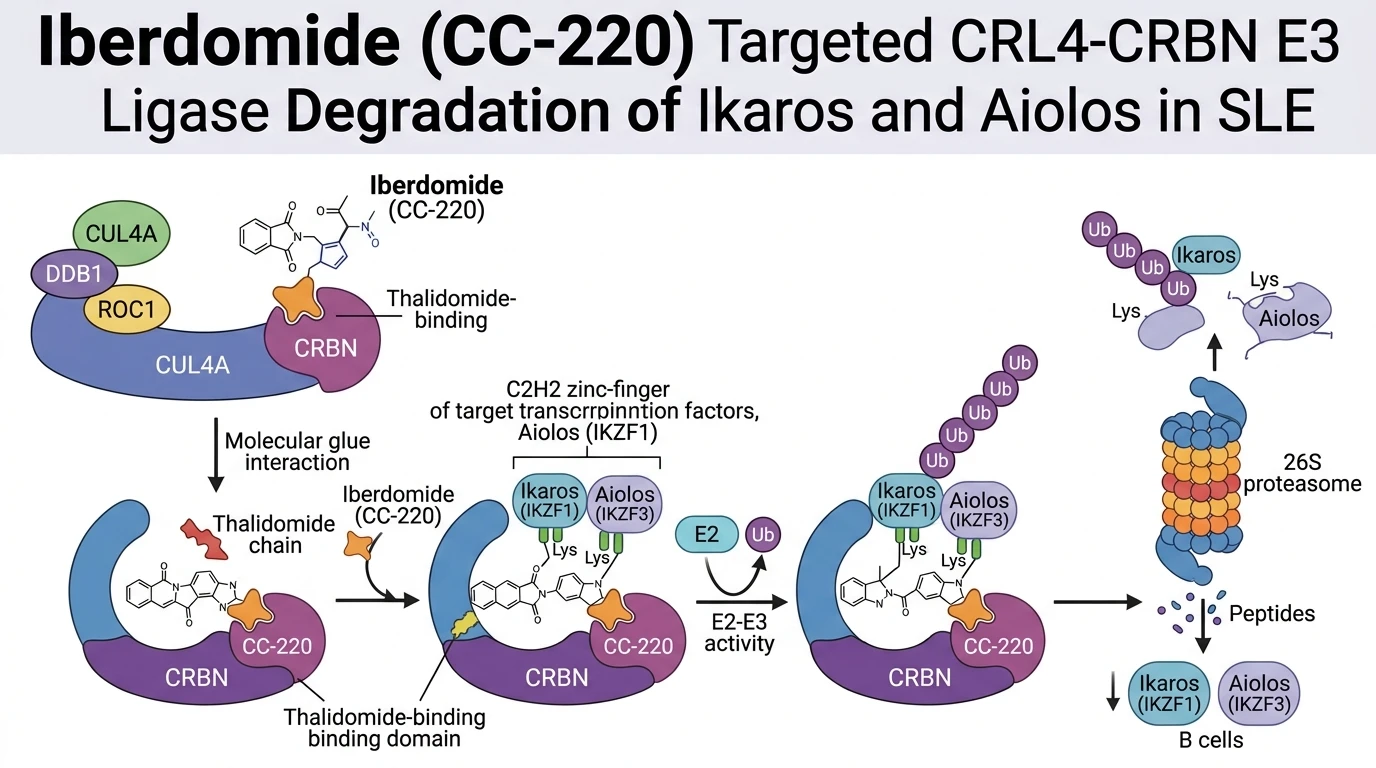
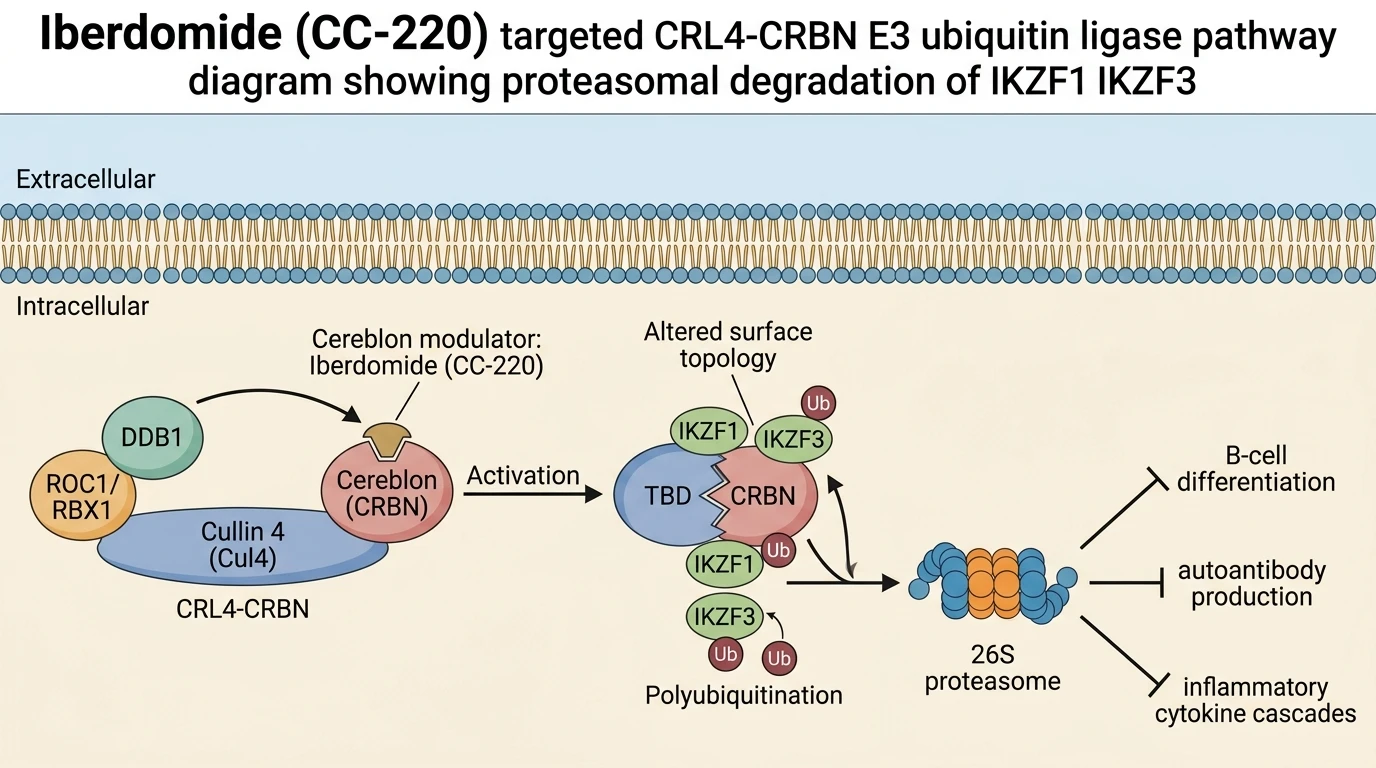
As a structural derivative optimized through cereblon modulator development, Iberdomide (CC-220) functions as a high-affinity ligand for the tri-tryptophan binding pocket of CRBN. The compound does not directly inhibit intrinsic enzymatic activity. Instead, it operates as a molecular glue. Ligand binding induces a localized conformational adjustment on the surface of the substrate receptor within the Cullin-RING E3 ubiquitin ligase complex (CRL4-CRBN). This structural reorientation forms a hydrophobic composite interface. The altered surface binds with high affinity to C2H2 zinc-finger motif 2 (ZF2) present within IKZF1 and IKZF3.
Recruitment to the ligase complex precipitates rapid enzymatic ubiquitin transfer. Polyubiquitinated Ikaros and Aiolos are subsequently recognized and destroyed by the 26S proteasome. In preclinical evaluation, this targeted destruction proceeds with high efficiency across primary human B cells, T cells, and monocytes. Intracellular protein levels decline within hours of treatment. Consequently, key transcriptional networks governing plasma cell survival and immunoglobulin production collapse. Under tested in vitro assay conditions, this depletion markedly suppresses the secretion of both anti-double-stranded DNA (anti-dsDNA) and anti-phospholipid autoantibodies. Pathogenic monocyte-driven inflammatory signaling demonstrates concurrent down-regulation.
Translational validation was achieved in a Phase 1 clinical trial evaluating healthy human subjects. Participants received single oral doses ranging from 0.3 mg to 6 mg. Pharmacodynamic assessments demonstrated dose-dependent reductions in intracellular Aiolos levels across peripheral immune subsets. Circulating CD19+ B-cell counts decreased in parallel with target degradation. Ex vivo functional assays revealed elevated interleukin-2 (IL-2) secretion from stimulated T cells, indicating functional immune recalibration. Additionally, lipopolysaccharide (LPS)-stimulated interleukin-1 beta (IL-1β) release was significantly suppressed. These combined clinical metrics establish robust target engagement and support continued therapeutic development in autoimmune patient cohorts.
Pharmacodynamic Characterization and Target Engagement in SLE Models
Copy code to add this image to your page
Iberdomide (CC-220) binds cereblon within the CRL4-CRBN E3 ubiquitin ligase complex, creating a composite interface that recruits transcription factors Ikaros (IKZF1) and Aiolos (IKZF3). This interaction induces rapid polyubiquitination and 26S proteasomal degradation of both targets. Depletion of Ikaros and Aiolos down-regulates key B-cell transcriptional programs, suppressing CD19+ B-cell survival and blocking autoantibody synthesis. Additionally, treatment modulates monocyte inflammatory signaling, reducing IL-1β production while enhancing T-cell IL-2 expression in SLE models.
Selective Proteasomal Degradation of IKZF1 and IKZF3 in Human Lymphocytes
Targeted protein degradation by CC-220 exhibits notable lineage specificity in human peripheral blood cells. Within B-cell lineages, IKZF1 and IKZF3 sustain terminal differentiation and survival. Treatment with CC-220 accelerates ubiquitin-mediated destruction of these proteins at sub-nanomolar concentrations in vitro. Downstream gene expression altered rapidly. Expression of IRF4 and BLIMP1 dropped markedly within hours of exposure. This transcriptional shutdown inhibits the differentiation of naive B cells into antibody-secreting plasma cells. In patient-derived cell models, baseline levels of pathogenic autoantibodies decreased significantly.
Dose-Dependent Modulation of Cytokine Production and Peripheral B-Cell Dynamics
Phase 1 trial observations confirmed robust target engagement in vivo. Single oral doses of CC-220 induced rapid down-regulation of lymphocyte Aiolos levels within 24 hours. Circulating CD19+ B cells exhibited progressive, dose-dependent reductions across the evaluated dose range. Cellular depletion remained reversible upon compound washout. Monocyte activity was similarly altered, as evidenced by reduced lipopolysaccharide-induced IL-1β release. Concurrently, ex vivo T-cell responsiveness increased, characterized by elevated IL-2 secretion. These integrated pharmacodynamic responses confirm that selective transcription factor destruction translates into measurable immunomodulatory activity.