DT2216 Target Engagement and VHL-Mediated Degradation of BCL-XL in Tumor Models
Copy code to add this image to your page
Dysregulation of intrinsic apoptotic signaling pathways serves as a primary driver of sustained cell survival and therapy resistance in human malignancies. The anti-apoptotic protein BCL-XL, encoded by the BCL2L1 gene, maintains mitochondrial outer membrane integrity by binding and neutralizing pro-apoptotic effectors, specifically BAX and BAK, as well as sensitizing BH3-only proteins such as BIM, BID, and PUMA. In primary human cholangiocarcinoma, BCL-XL is frequently overexpressed, acting as a key molecular determinant of resistance to standard chemotherapy regimens. Historically, pharmacological inhibition of BCL-XL relied on small-molecule BH3 mimetics such as ABT263 (navitoclax). Although ABT263 exhibits high affinity for BCL-XL, its clinical application remains severely restricted by on-target, dose-limiting thrombocytopenia. Because mature, circulating platelets depend almost exclusively on BCL-XL to prevent spontaneous apoptosis, competitive occupancy of BCL-XL by pan-inhibition leads directly to rapid platelet destruction.
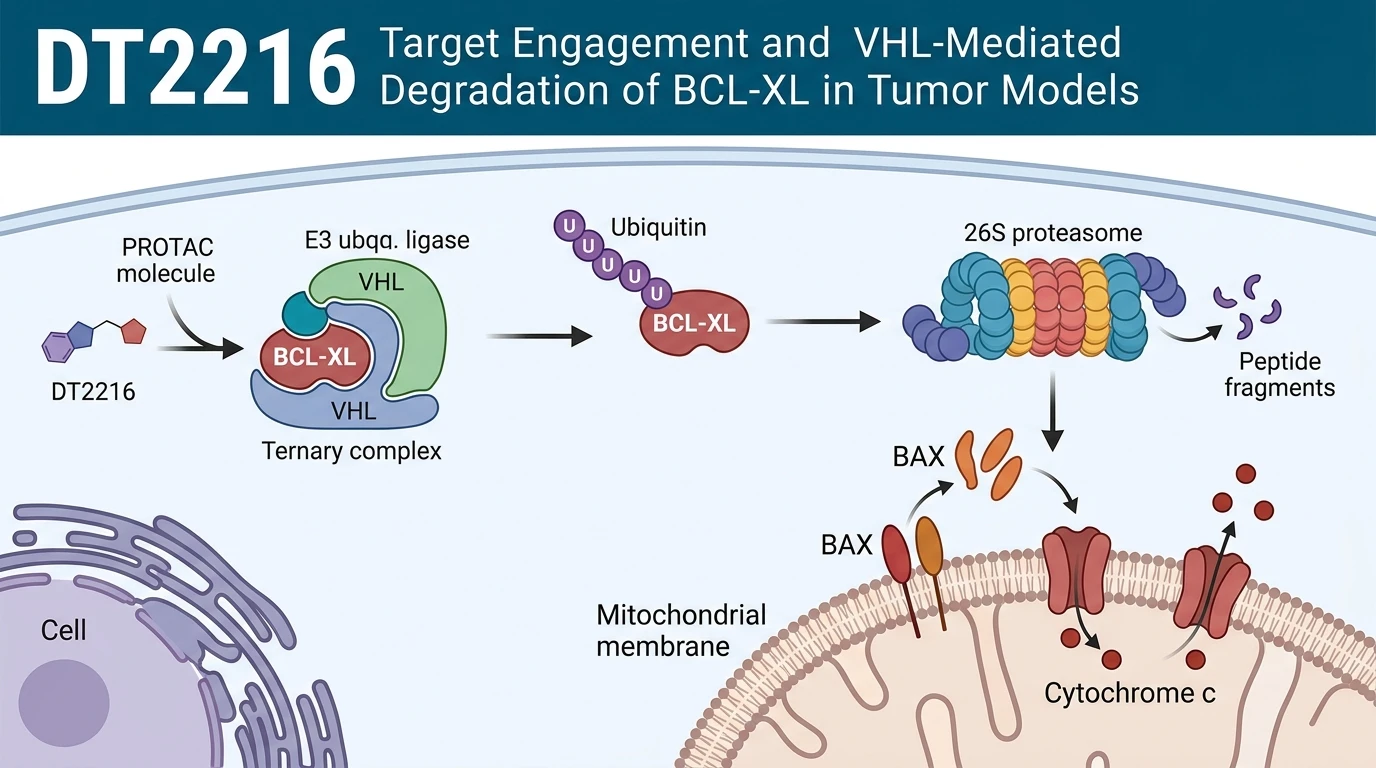
To overcome this clinical bottleneck, targeted protein degradation via proteolysis-targeting chimeras (PROTACs) has emerged as an alternative pharmacological strategy. DT2216 is a heterobifunctional small molecule designed to selectively direct BCL-XL to the ubiquitin-proteasome system. Structurally, DT2216 couples a high-affinity BCL-XL binding element to a chemical ligand that recruits the von Hippel-Lindau (VHL) E3 ubiquitin ligase complex. Engagement of both proteins forms a transient, non-covalent ternary complex consisting of VHL, DT2216, and BCL-XL. Within this ternary architecture, spatial proximity enables the Cullin-RING E3 ligase machinery to facilitate the enzymatic transfer of ubiquitin molecules onto exposed lysine residues on the target protein surface. Once polyubiquitinated with K48-linked ubiquitin chains, BCL-XL is marked for catalytic recognition and breakdown by the 26S proteasome complex.
The rational design of DT2216 exploits differential tissue expression of the VHL protein to establish a wide safety margin against platelet depletion. Human platelets express negligible baseline levels of VHL relative to nucleated somatic tissues and various tumor types. Consequently, DT2216 exhibits minimal degradation activity in circulating thrombocytes, effectively insulating platelets from apoptosis while retaining target degradation capacity in tissue compartments that express sufficient VHL. Under pre-clinical testing, DT2216 demonstrated marked attenuation of platelet toxicity compared to equimolar concentrations of ABT263, representing a key mechanistic advancement in targeting anti-apoptotic BCL-2 family members.
However, target degradation efficiency remains constrained by the strict stoichiometric availability of the recruited E3 ligase inside specific malignant cell populations. In experimental evaluation against human cholangiocarcinoma cell lines, DT2216 exhibited unexpectedly low cytotoxicity, yielding IC50 values greater than 10 µM across multiple assays. Immunoblotting and RNA expression analyses revealed that cholangiocarcinoma models exhibit low baseline expression of VHL relative to other solid cancer phenotypes. Because VHL abundance serves as the rate-limiting node in the formation of active ternary complexes, sub-threshold ligase levels impede polyubiquitination kinetics, rendering BCL-XL levels largely intact.
Conversely, protein expression profiling identified abundant Cereblon (CRBN) E3 ligase expression within the same cholangiocarcinoma panels. Comparative pharmacological studies confirmed that CRBN-recruiting BCL-XL degraders, such as XZ739, achieve potent sub-micromolar cell death and robust target cleavage in these VHL-deficient cells. These observations demonstrate that PROTAC efficacy is inherently conditioned on E3 ligase stoichiometry within the target tumor microenvironment. Selecting an optimal degrader requires mapping target cell ligase profiles to ensure efficient catalytic turnover.
E3 Ligase Profile Dictates Targeted BCL-XL Degradation
Copy code to add this image to your page
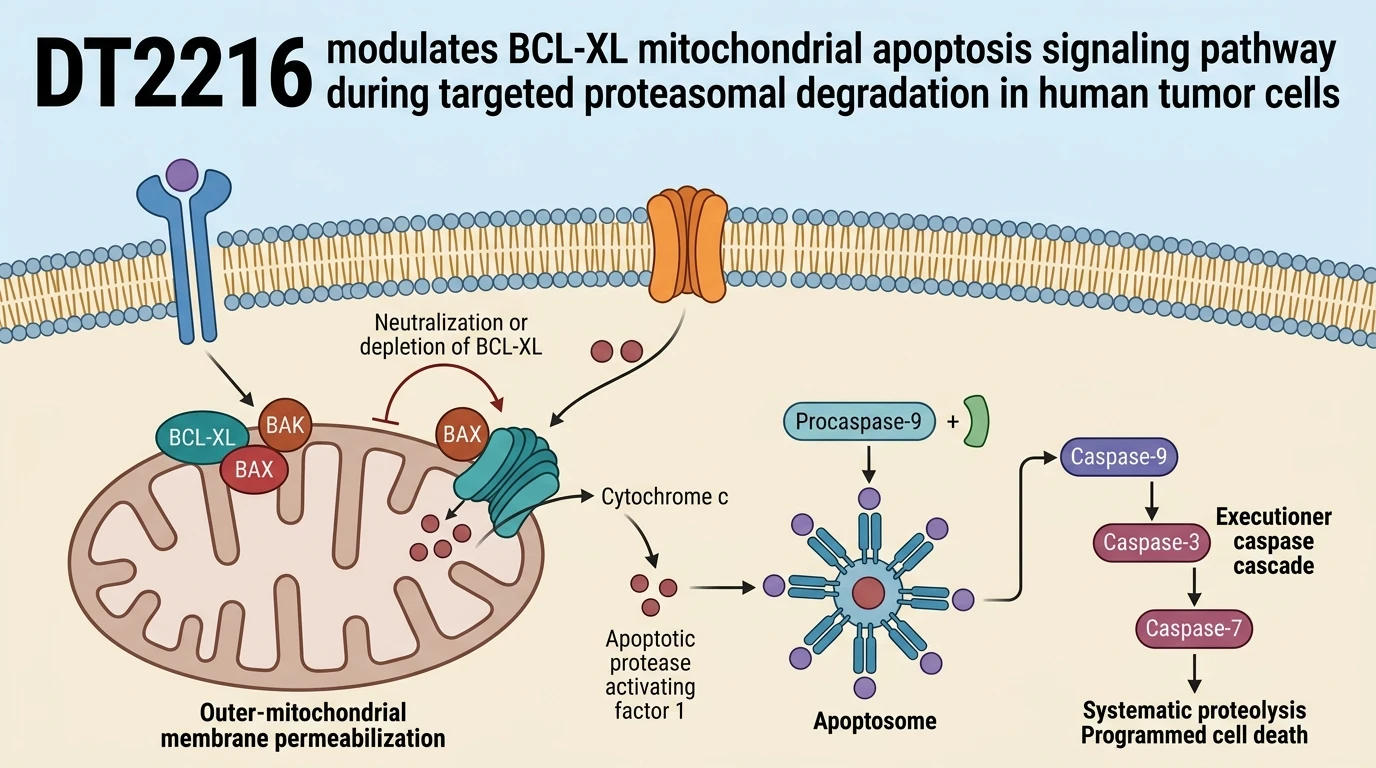
DT2216 functions as a proteolysis-targeting chimera that simultaneously binds BCL-XL and the von Hippel-Lindau (VHL) E3 ubiquitin ligase complex. Induced proximity drives polyubiquitination of lysine residues on BCL-XL, triggering recognition and enzymatic degradation by the 26S proteasome. Target depletion liberates pro-apoptotic effectors BAX and BAK to induce mitochondrial outer membrane permeabilization, cytochrome c efflux, and executioner caspase activation.
VHL Expression Bottlenecks Limit Cytotoxicity in Cholangiocarcinoma Cells
Targeted degradation depends on ternary complex formation. In human cholangiocarcinoma cell lines, DT2216 demonstrated limited cytotoxicity with IC50 values exceeding 10 µM under tested in vitro assay conditions. Baseline VHL expression remained low across analyzed cellular panels. Insufficient ligase abundance impaired target polyubiquitination kinetics. Consequently, BCL-XL levels were not adequately reduced to trigger mitochondrial outer membrane permeabilization. Pro-apoptotic effectors BAX and BAK remained sequestered by intact anti-apoptotic proteins. These findings show that low E3 ligase expression creates a severe bottleneck for VHL-recruiting chimeric degraders.
CRBN-Recruiting Degraders Restore Target Clearance in VHL-Deficient Contexts
Matching degrader chemistry with ligase availability restores efficacy. Cholangiocarcinoma cells exhibit elevated baseline CRBN expression relative to VHL. Utilizing a CRBN-recruiting degrader, such as XZ739, achieved rapid BCL-XL degradation and induced apoptosis at nanomolar concentrations. The contrast between these two degradation strategies illustrates that ligase stoichiometry governs cell-type sensitivity. While DT2216 offers enhanced platelet safety in systemic circulation, its therapeutic activity remains context-dependent. Future degrader selection in biliary tract cancers must account for endogenous E3 ligase profiles to ensure effective target removal.