GS-5734 (Remdesivir) GS-5734 Target RdRp Polymerase Inhibition in Viral Replication
Copy code to add this image to your page
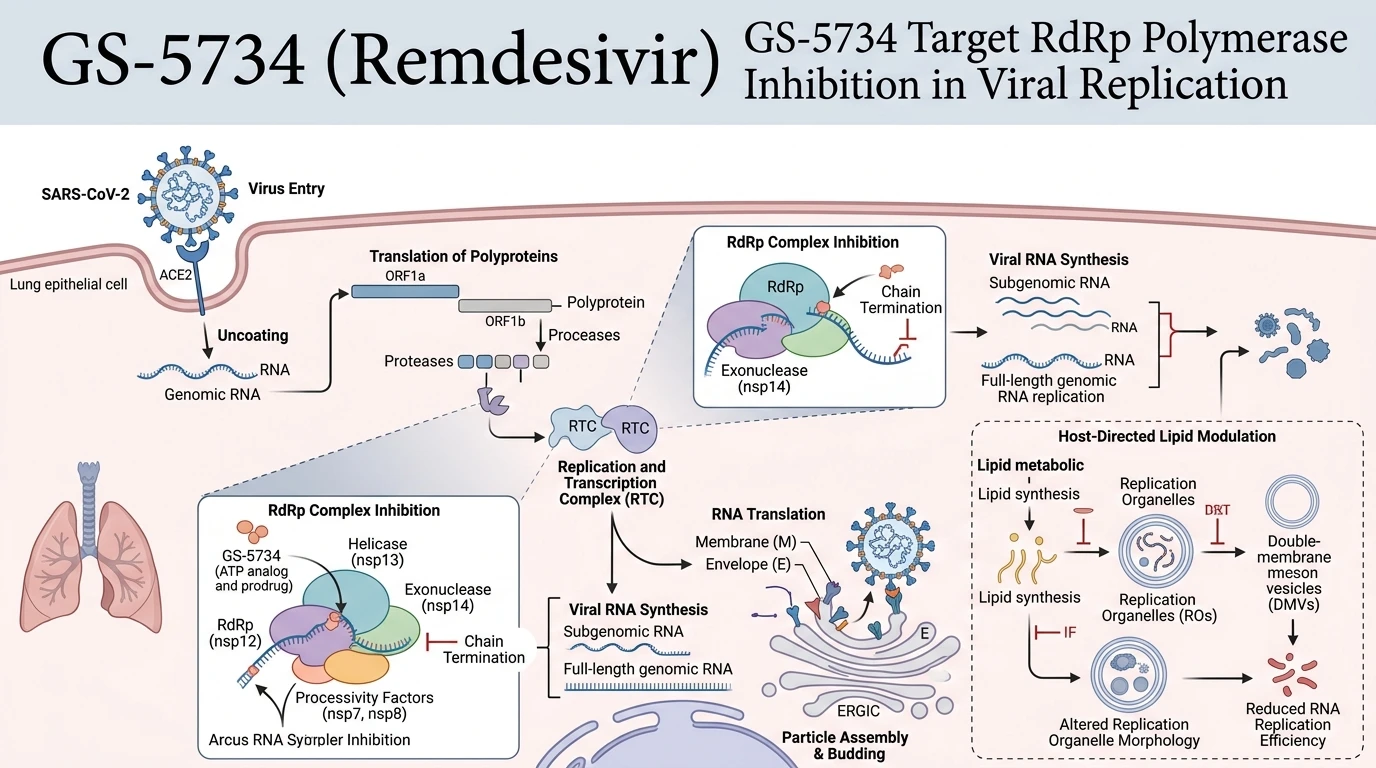
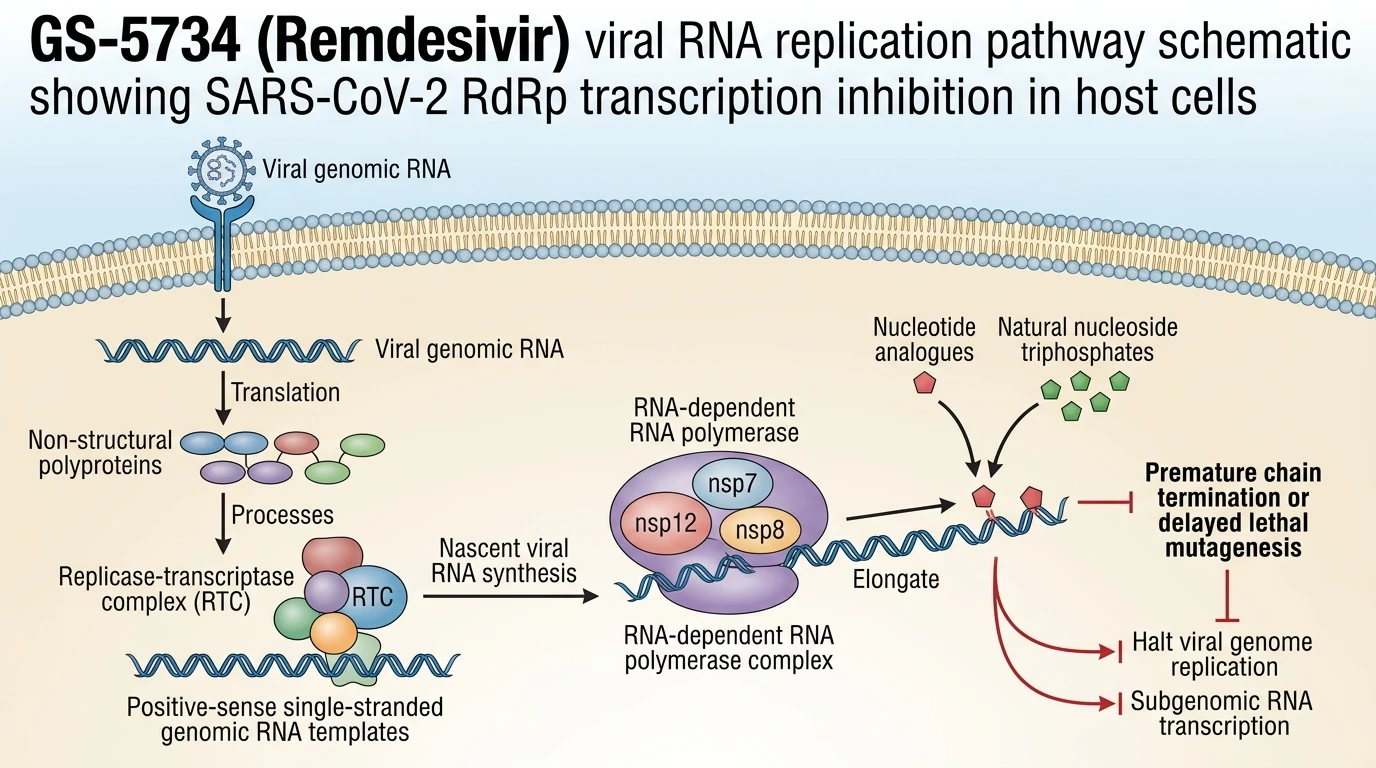
The enzymatic engine driving coronavirus replication resides within non-structural protein 12 (nsp12), the catalytic subunit of the SARS-CoV-2 RNA-dependent RNA polymerase (RdRp). Bound to accessory cofactors nsp7 and nsp8, nsp12 coordinates template-directed RNA synthesis. GS-5734 (Remdesivir) functions as a monophosphoramidate prodrug designed for intracellular conversion into an active nucleoside triphosphate metabolite. Upon cellular internalization, kinase-mediated phosphorylation yields the active 1'-cyano-substituted adenosine nucleotide analogue. The active metabolite competes directly with endogenous adenosine triphosphate for insertion by the viral RdRp complex. Incorporation into the nascent RNA strand does not cause immediate steric hindrance. Instead, polymerase elongation proceeds through three additional nucleotide additions before encountering biochemical arrest. This delayed chain termination mechanism halts further transcription of the viral genome. In addition to premature termination, incorporation events perturb template fidelity. Consequently, total viral subgenomic RNA synthesis drops markedly.
Targeting viral enzymes alone often selects for resistance mutations under high evolutionary pressure. Host-directed antiviral strategy provides an attractive alternative by modulating cell-autonomous factors critical for viral propagation. In this investigation, researchers combined the viral polymerase inhibitor GS-5734 with repurposed host-directed drugs fluoxetine or itraconazole. Experiments utilized Calu-3 cells, a human lung adenocarcinoma line expressing endogenous ACE2 and TMPRSS2. This model closely recapitulates primary human respiratory epithelial infection dynamics. Monotherapy evaluations demonstrated that each compound suppressed viral replication without precipitating cytotoxic burden at therapeutic ranges. Cell viability remained preserved above 85% across working concentrations. However, monotherapy required higher concentration thresholds to achieve complete viral suppression. High drug exposure elevates off-target toxicities in clinical settings. Thus, combination approaches were systematically evaluated to establish potential dose-reduction benefits.
To evaluate drug interaction dynamics, multi-concentration matrix assays were executed in SARS-CoV-2 infected Calu-3 cultures. Combination responses were evaluated against three mathematically distinct synergy models: Zero Interaction Potency (ZIP), Bliss Independence, and Highest Single Agent (HSA). Dual administration of itraconazole with GS-5734 generated strong synergistic inhibition across all three statistical frameworks. Similarly, the fluoxetine-GS-5734 pairing displayed pronounced synergy scores exceeding baseline additivity thresholds. Synergy maps revealed high delta-scores in concentration regimes where individual drug monotherapies achieved only modest inhibition. The consistency across ZIP, Bliss, and HSA models confirms authentic drug-drug synergy rather than artifactual additive dynamics. Importantly, host cell viability remained uncompromised at these synergistic dose combinations.
Beyond reduction of viral RNA copy numbers, the combinations significantly reduced infectious viral titers. Viral plaque formation assays confirmed over 90% inhibition of infectious progeny yield at low micromolar concentrations. Sub-micromolar levels of GS-5734 paired with sub-micromolar itraconazole or fluoxetine achieved complete attenuation of viral cytopathic effect. This exponential drop in infectious particle production highlights the therapeutic gain achieved through dual target inhibition. Disrupting both viral polymerase activity and host lipid traffic pathways presents a dual physical barrier. Host-directed agents like itraconazole disturb cholesterol homeostasis in endosomally derived membranes, impairing viral entry or replication organelle formation. Fluoxetine alters acid sphingomyelinase activity within lysosomal compartments. Co-inhibition of RdRp activity simultaneously degrades transcriptional velocity.
These observations establish a clear pharmacodynamic rationale for combined antiviral interventions in lung epithelial models. Nevertheless, several experimental boundary conditions must be recognized. First, all quantitative interactions were derived from in vitro cell culture models. Cell line assays lack full immunological clearance mechanisms and pulmonary pharmacokinetics present in vivo. Second, host-directed agents undergo complex hepatic metabolism in human hosts. Plasma protein binding and tissue distribution dynamics may shift the effective free drug concentrations required for synergy. Third, timing of intervention relative to viral load peak represents a crucial clinical variable. Validation in animal challenge models and controlled human clinical trials remains necessary before translational implementation.
Pharmacological Synergies and Viral Replication Suppression Dynamics
Copy code to add this image to your page
GS-5734 (Remdesivir) is a nucleotide analogue prodrug converted intracellularly into its active nucleoside triphosphate form. This active metabolite competes with endogenous ATP for incorporation by the SARS-CoV-2 RNA-dependent RNA polymerase (RdRp) complex (nsp12-nsp7-nsp8). Incorporation causes delayed chain termination three nucleotides downstream, halting viral transcript elongation and genomic replication. Combining GS-5734 with host-directed agents itraconazole or fluoxetine synergistically inhibits viral replication in host lung epithelial cells, suppressing infectious virion production by over 90% at reduced monotherapy concentrations.
Potent Synergy Across Multi-Dimensional Mathematical Reference Models
Mathematical synergy modeling distinguishes true biological interaction from simple additivity. In SARS-CoV-2 infected Calu-3 cultures, combinations of GS-5734 with either itraconazole or fluoxetine produced robust synergy metrics across ZIP, Bliss, and HSA models. High delta-scores localized to sub-micromolar concentration windows. Monotherapy required significantly higher dosing to suppress viral transcription. The combination regimen achieved over 90% inhibition of infectious progeny at markedly reduced drug levels. Lowering effective concentrations minimizes potential off-target toxicities. Consequently, dual target engagement broadens the therapeutic window in vitro.
Attenuation of Infectious Viral Progeny Yields in Epithelial Models
Targeting host cell pathways alongside viral RdRp activity restricts viral propagation pathways. Plaque reduction assays demonstrated a sharp decline in infectious viral output following combination treatment. The viral polymerase inhibitor GS-5734 disrupts template strand elongation. Meanwhile, host-directed compounds alter endo-lysosomal lipid trafficking required for replication complex assembly. This dual mechanism prevents the emergence of escape mutants during prolonged passaging. Host cell viability remained intact throughout the dosing matrix. These empirical findings demonstrate potent antiviral suppression without associated cytotoxicity under cellular assay conditions.